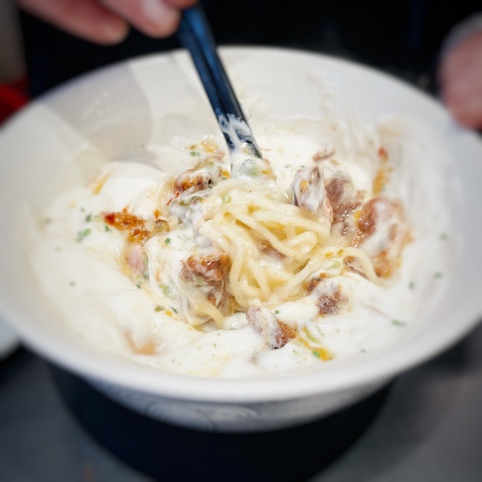
Guitar god Nigel Tufnell once asked “How much more black can it be? … None. None more black”. I’m looking at K’s chilli chicken cappuccino but replacing black with white. It’s like gazing into an open tin of Dulux, albeit slightly frothier. It’s rather mesmerising.
It’s called New-Age “Cappuccino” Chicken Noodles. The cream is really a topping, and underneath is rich chicken broth and, when stirred, fat noodles break the surface along with portions of roasted chicken. The noodles are hand made, silky smooth and have more bounce than Eeyore. It’s not my dish, but I love the flavours so much that I keep dipping in my spoon, much to K’s annoyance. I love the pricks of chili, just enough to fire up the palate not so much as to extinguish all the other lovely flavours, especially the flavour of roast chicken skin.
Located in the very heart of Chinatown and spread over three (possibly even more floors, these Chinatown buildings are bigger than the Tardis inside) San Hao is a new kid on the Gerrard Street block. It may also be the only one that hasn’t got a staff member outside hassling passers by to come in, instead it relies on word of mouth and a man making Baos in the window, to advertise itself.
Billed as San Hao Noodle Atelier, or ‘workshop’, its avowed aim is to do something different with noodles while respecting tradition and leveraging British produce. It’s the first joint project between Daren Liew (Hakkasan, Duddells, Nanyang Blossom) and the people behind the YiQi, The Eight and Dozo.
It’s modern inside, and the staff have headsets, but I got 90s Deja Vu when they told us to go upstairs just as Won Kei always did back in the day.
The range of inventive noodle dishes, wet and dry, is compact but very tempting. When we get upstairs there are a fair few Chinese, or Chinese heritage, people eating which is a good sign and one man appears to be eating a dinosaur bone in broth, but it’s probably Black Garlic Herbal Pork Bone Soup Noodles.
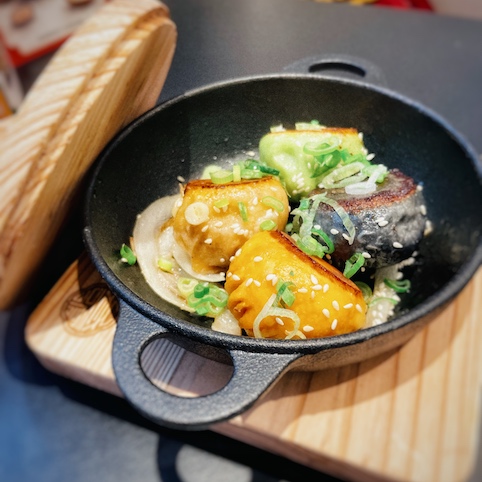
We share the Four Flavor Bao Platter, and there are four of them. This is not usual as Chinese dining rules usually dictate odd numbers only, which makes sharing fairly – fairly difficult.
Not here though. Each was different, so we picked randomly. All delicious and with “nicely browned bottoms”, as they would gleefully say on Great British Bake Off, no doubt courtesy of the cast iron pot they were cooked in. A side dish of chilli oil was useful.
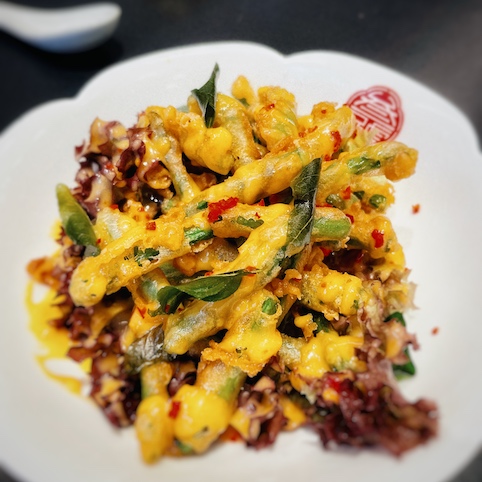
So I told you about the ‘cappucino’, but what else did we have from an extensive menu? Well we share Salted Egg Salad Cream with Fine Bean – translated as ‘crispy green beans tossed in buttery salted egg glaze’. To be honest, this seems to simply be French beans deep fried in a light batter. I believe the salted duck eggs are supposed to add a savouriness but I don’t detect any or much help from the garlic and chilli. A pleasant dish but underwhelming.
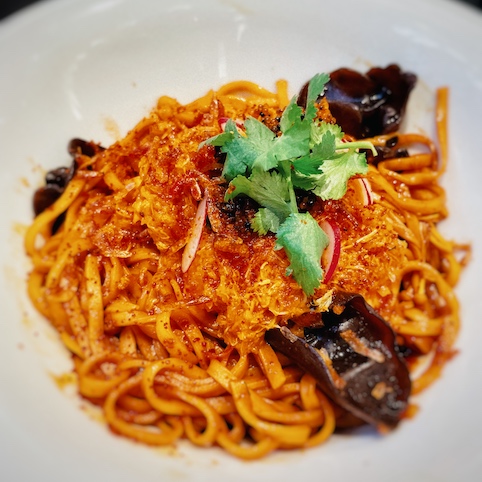
There is a slight lack of heft in my dry noodle dish, Golden Roe Chilli Crab and Salted Prawn as well. Lovely pieces of crab and prawn in a sauce that is tasty but overly sweet for my liking. I expected more saltiness from the roe and the prawn, and the obvious pieces of chili are surprisingly muted, considering the dish’s name.
For a Chinatown place, San Hao seems a bit Western timid in its spicing. Great noodles, just the right bite and the sauce sticks to them lovingly, so perhaps though I should have had Hot ‘n’ Spicy Roasted Yellow Chilli Grouper Noodles?
We don’t have desserts. I rarely do in Chinese (or Indian) places, but the two on offer sound quite interesting.
I like the concept of San Hao, a Chinatown restaurant that’s not offputting to Westerners. It’s clean and crisp looking, and there are plenty of unusual dishes that are clearly explained on the menu. Just as well, as I think we’ve all at some time ordered something from a Chinatown menu that made us feel a bit shocked, if not ready to scream, when it arrived.
Hotel restaurants, when not stand alone specials, can get a bad rep. The challenge is to provide food for everyone of any race, creed or colour. And, of course, their kids. Sycamore has got it right.
Sycamore, is an Italian restaurant at the five-star Middle Eight hotel, Covent Garden. It’s not quite in Covent Garden to be fair, it’s east of the architecturally gruesome Masonic Temple, but it’s only a few minutes walk away and not much further to Theatreland.
It’s a super modern hotel, all glass fronted and with sliding doors that cleverly open just before you crash into them. The bar is very large, an island surrounded by seating, with a ceiling that’s all ducting camouflaged by thousands of gilded sycamore leaves.
It’s a good space, warm and welcoming despite its size. We ate here, as the restaurant proper is at the back and a little less welcoming. Everyone eating was in the bar area and there were a lot of people for a Wednesday. Many were guests, I assume, but all the same it was a good sign.
Real napkins. I know that seems a small thing, but it’s a good sign in my book. They’ve gone for the extra expense of laundry to make the dining a bit classier.
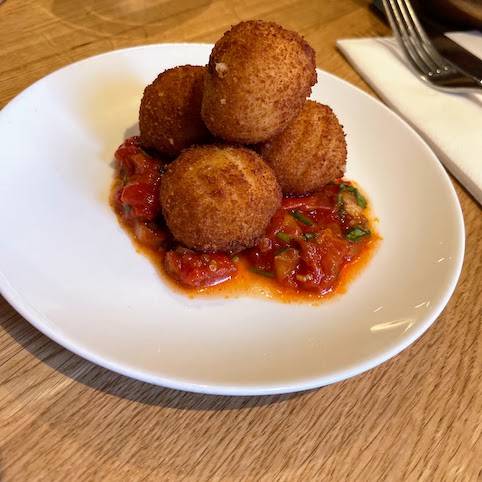
The menu is, obviously, Italian. There’s plenty of choice for starters that range across mushroom arancini with basil aioli; mac and cheese croquettes with marinara sauce;, garlic king prawns with chilli and fresh herbs and more. Small plates, so you could easily make a meal out of these alone. There are pizzas too, of course, but personally I don’t trust restaurant pizzas, I only eat pizzas in pizzerias.
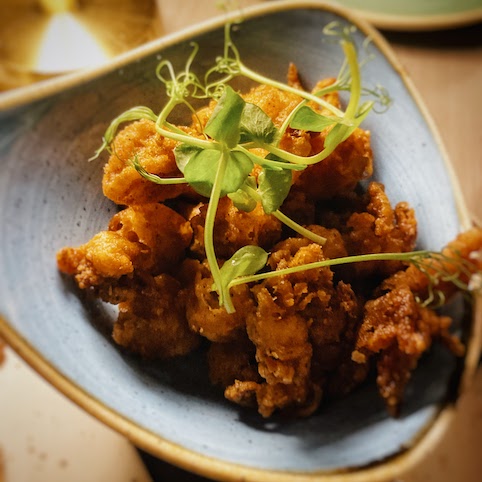
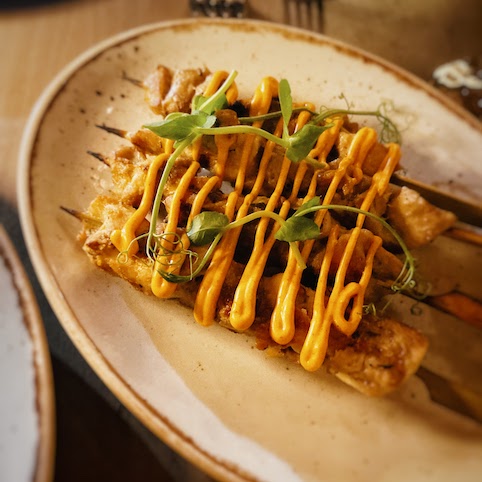
We share chargrilled chicken skewers with lemon, thyme, smoked paprika, and golden calamari with lemon aioli. I always tell myself I won’t order calamari yet again, and yet againI always do. I have some kind of addiction to these things.
These are good, if a little overbattered which makes them quite filling, and a bit more lemon in the mayo wouldn’t have gone amiss.
The chicken skewers are moist, not always the case with grilled chicken, and the paprika spiced mayo swirls are helpful. I do like the pea shoots, still a trendy garnish, the crispy stems a good contrast. As you can see from the photos though, pea shoots got rather a lot of airplay across the meal. I began to wonder if I’d get some on my dessert as well.
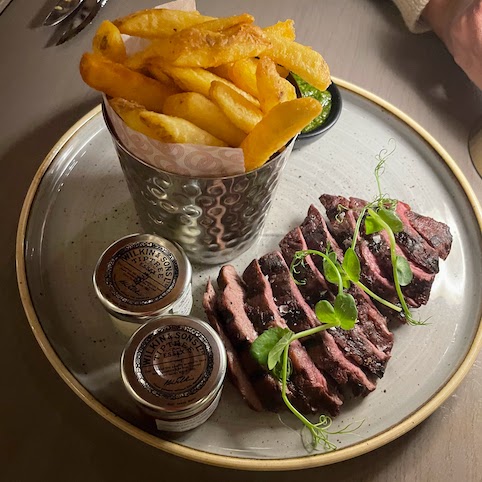
I press S not to have steak, not on a review, anyone can cook a steak, but he really insists. Rather an expensive Flat Iron steak, but it’s a good one. Medium rare and well rested so that the pink is smoothed out, and it’s pre sliced against the grain too, which I think makes it always look a bit more interesting as well as easier to eat. Flat Iron is probably the next most tender cut of beef after fillet, with the all important marbling that means flavour.
The smoked salt fries that I repeatedly steal are delicious, and the chimichurri sauce is well made so he doesn’t need to open the little pots of tomato sauce and mayo provided, presumably intended for less sophisticated diners to ruin their chips with.
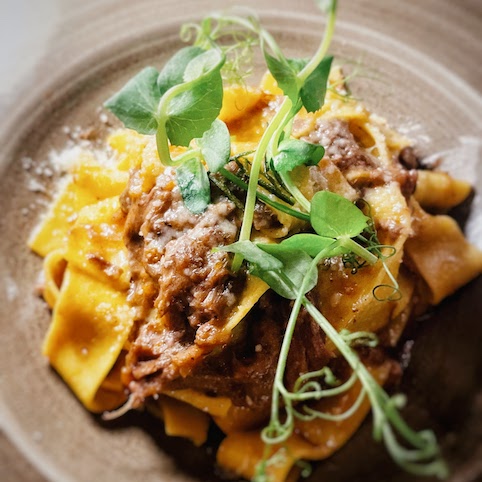
For me it has to be pasta, and while truffle carbonara tagliatelle with pancetta, cream, and pecorino would have been glamorous, and king prawn linguine, with garlic, chilli, parsley very fancy, I wanted ragu, slow cooked beef ragu with pappardelle.
This is just how it should be, the beef ragged and scrappy from its long cooking and the sauce rich with the smooth wide pasta having absorbed some of it. No parmesan at table, but enough already added and yes, more pea shoots. They must have bought a job lot of them.
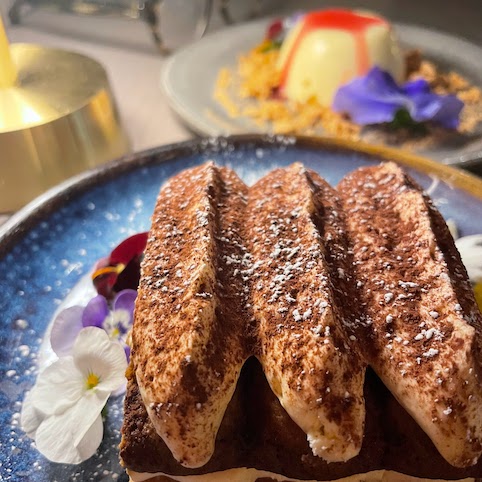
Tiramisu to end. Very nicely done, kind of deconstructed and modern, plenty of chocolate, plenty of mascarpone but B all Marsala as far as I can tell. I imagine alcohol is not included because of children, there should be two versions – one for the little darlings and one for grown ups.
Panacotta is wonderfully wobbly and unctuous, we love the vanilla in it and the strawberry sauce and crumbled shortbread are good dance partners. Pea shoots have been replaced by edible flowers and look very pretty.
Conclusion? Hotel guests unwilling or wary of eating out in the wilds of Covent Garden won’t be disappointed, especially if they have kids in tow. A nice classy place with prices within reach especially if you look for daily deals.
It’s also ideal for theatre goers who want to eat something first without being ripped off and still be within easy reach of the show. No need to go full on, three small plates or bites and a glass of wine is £25 which seems very reasonable.
Sunday Roast in the country. You can’t beat it, especially when it’s in a restaurant that knows how to cook beyond the beef. Nick laps it all up
One of the great reasons to live in South London, aside from it not being North London of course, is how easily you can reach the real countryside of Kent. And then carry on to the coast, if you want. Or indeed France.
Fancying a Sunday Roast that wasn’t in a pub overwhelmed by uncontrolled toddlers, while their parents hid behind copies of The Observer, we fired up the planet destroying ICE car and pointed the SatNav to Sevenoaks.
Within a short while of leaving vibrant Brixton, we were barreling down cheerful A roads winding between fields, the car astonished at for once actually making it all the way to fourth gear.
It took just over an hour to reach Sevenoaks, it is only 21 miles from Charing Cross after all, it would have been quicker, but for some Sunday road closures. It’s a pretty little town that has suffered a bit from the plate glass window rash that spread throughout the UK. As someone once said, what’s so exciting about the inside of a Building Society that you want to display it to the street?
Parking is quite easy, if restricted to a few hours, but we managed to get close to Number 8, a 16th century building next to one of the classic old Lloyds Banks and set back from the road to allow al fresco dining in the summer.
Number 8 is run by chef/restaurateur Stuart Gillies with his wife Cecilia, and Stuart is a well-seasoned pro, having run the Gordon Ramsay group globally as MD and then CEO, so you know this is going to be proper and professional. People like to have a pop at Ramsay, but I’ve never had a bad meal at any of his spots.
Inside it is very pleasant, warm and very full, the locals obviously know a good thing and these look like prosperous people used to high quality. I wore my quilted gilet to fit in and it was a good choice. I am not the only one sporting farmer-core fashion today.
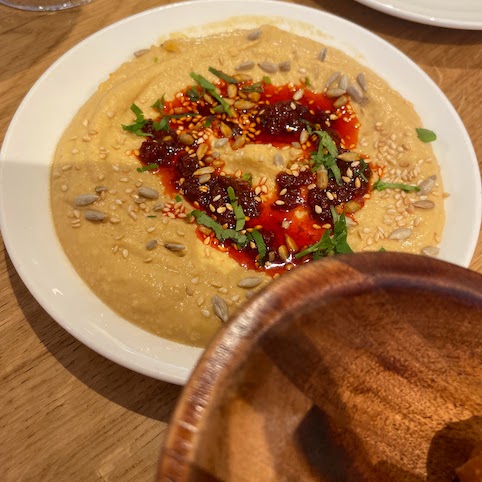
Not being a pub, No 8 can offer more interesting starters than your local boozer and we share a gorgeous whipped hummus topped with sesame seeds and chives, scooped up with (slightly oily) toasted focaccia, along with deliciously creamy Iberico ham croquettas on a lively smoked chili salsa.
So the roast, obviously there is beef, aged Chart farm beef to be precise, chicken, mushroom tortellini for the vegetarians, and fish for those not fancying a pure roast.
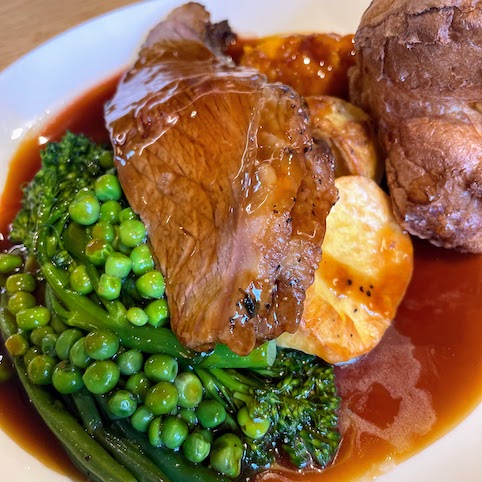
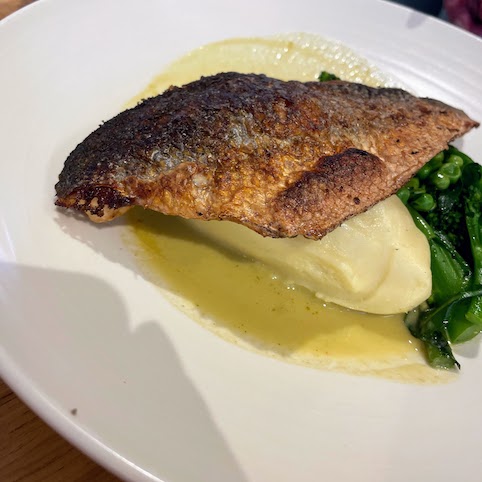
Which happens to be my wife today, so she goes for seabass, mashed potato, lemon grass coconut sauce and buttered greens, while I go classic on the beef with green veg, roast potatoes, and Yorkshire pudding. And gravy, definitely.
Both are winners, the beef the best I’ve had for a very long time. Thickly cut, which is a good sign as pubs are inclined to slice the beef thin as they know it’s going to be chewy. This is anything but, very soft and packed with flavour. Generous amount of it too.
The spuds are also good, they are not faked by being deep fried, which always annoys me, but properly roasted. This means they aren’t as crisp as they might be, but they’re really nice inside. Soft and mashable into the gravy, as well as the unadvertised but very welcome sweet potato puree. Broccoli is bright green and al dente, while the beans are a trifle squeaky but better than being overdone. Very good
The gravy is my one criticism, there’s nothing at all wrong with it but I prefer it to come jugged on the side and not floating my dinner. It’s messy, as my shirt now testifies. I prefer to make my own gravy decisions. Lovely Yorkshire Pud, not a monster but crispy and fluffy.
P’s decision to go for the fish bears out. She says it’s great, the mash creamy, the fish skin crispy and the sauce delicious. Once again, this is a benefit of eating Sunday lunch in a restaurant and not a pub, you get proper cheffing.
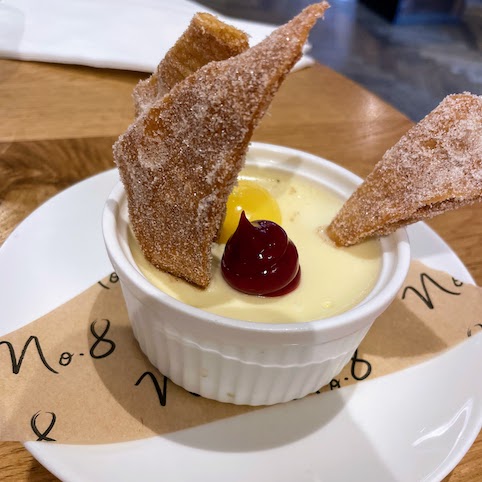
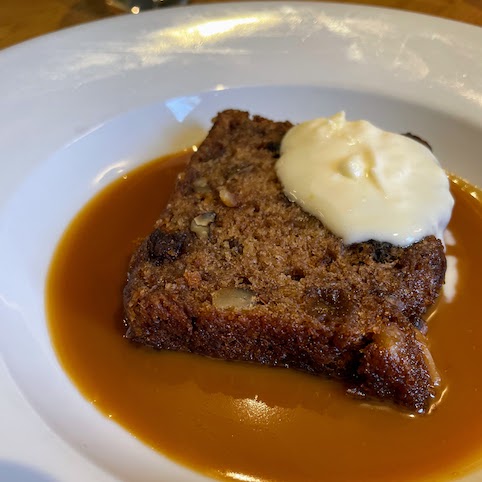
And good desserts, too. Lemon Posset with a cinnamon and sugar tortilla is very unctuous, and Glazed Banana and Walnut bread with a toffee sauce and creme fraiche, is just what Sunday ordered. We’re happily stuffed and leave just in time before our parking runs out.
Did I mention the price? A very reasonable two courses for just £29.95, and 3 courses £34.95 Or just have roast chicken or beef for £24.*
Anyone who fancies a nice trip to the country for a decent Sunday roast dinner should consider Number 8 as a Number 1 option.
Hankki means ‘one meal’ in Korean, but when Nick and K went in they ate enough for an army.
Just on the fringes of Chinatown, a few doors down from my once beloved Wong Kei ( it eventually got too self-aware and ironic), Hankki is the kind of place Instagrammers love. It’s not completely traditional Korean, the full on cooking can be a bit challenging for some, and it has made sure it’s brightly lit with a very youthful vibe out front. The staff took one look at K and me and directed us out to the back, we were far too old and vibe killing.
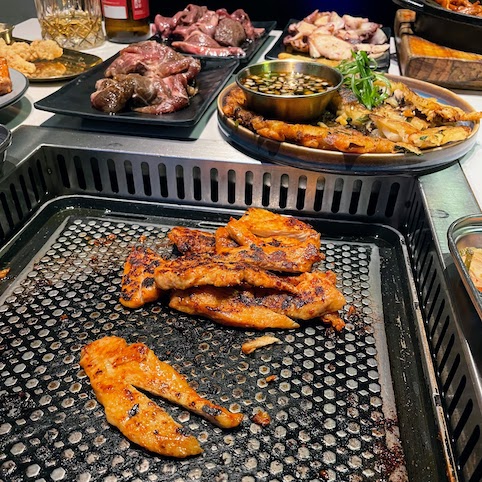
Actually though this was a good thing as we got to sit at a nice large table, and we were going to need all that space as the dishes soon started piling up to satisfy our venerable greed. The centre of the table had a BBQ skillet which our waiter, sensing our intentions, fired up straightaway to get good and hot.
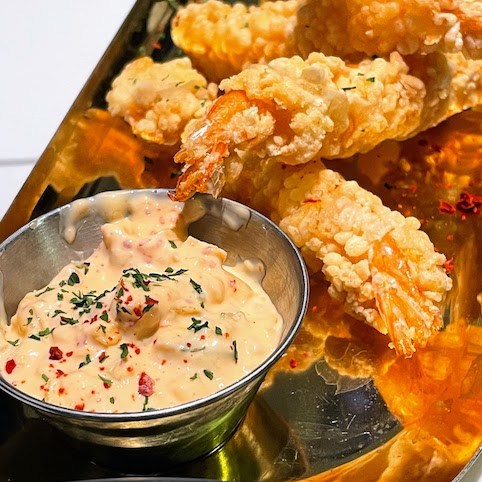
There are various set menus available, from £31 to £46 per person and they’re all generous in choice and taste, but we dive straight in to a la carte with some prawns in batter which are properly crispy but not overly exciting, whereas the fried squid is lively with, I assume, gochujang, Korea’s marvellous fermented chili paste.
This is perfect for knocking back in quantity with cold beer, so that’s what we do. I really like the fact it is all in odd size pieces, the tiniest and best bits being almost all batter, just like it used to be in UK fish and chip shops.
Talking of batter, the seafood pancakes (Haemul Jeon) feature a lot of batter around a good selection of seafood and the all important spring onions, nice and crispy on the outside, a little bit oily inside, but very delicious. We then have to drop our follow-up slices to deal with Kimchi Tofu soup.
It’s more kimchi than soup and that’s fine by us as we both love kimchi and its full on funk. This hot and sour soup is often made with pork, but this is cubes of tofu along with garlic, ginger, spring onion and daikon. Spooned onto rice it’s frighteningly addictive and we shovel it down like it was going to run away.
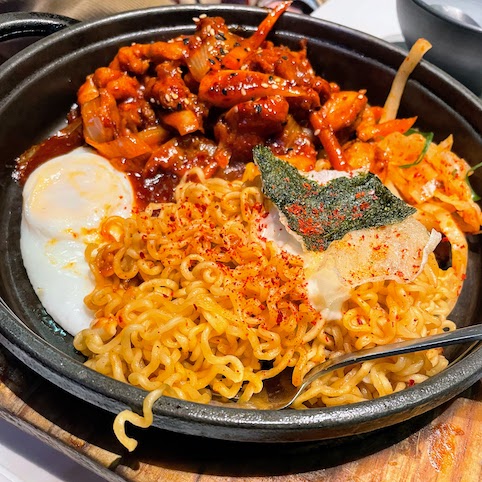
But hold on, there is now Chicken Noodle Cheese. A tangle of bouncy noodles with lots of chicken thigh and topped with cheese. Plenty of Gochugaru and Gochujang are pumping out heat with a hint of sweetness to balance it. The cheese topping binds it and there is a fried egg included, although it’s hard and I think it should be soft so it can be broken and stirred in. Absolutely delicious.
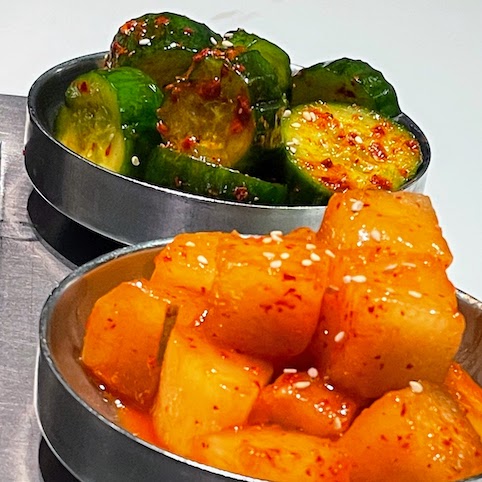
We really could call it a day and roll out happy, but there is the BBQ to be dealt with. Plates of raw Hankki beef, Bulgogi Wagyu Sirloin, spicy chicken and sweet soy octopus to griddle and eat along with more kimchi, cucumber, daikon and other assorted pickled vegetables and sauces.
We do our best. The Wagyu is of course divine, the basic beef great, the chicken tender and soon charred, and the octopus, depending on how long we leave it on the grill, nice and tender or overdone.
And we’re done, lolling back in our seats and groaning slightly with no room for the IG special, Yuzu cheesecake in the shape of a miniature dog. We see it being served as we leave soon after and it is so realistic it’s a bit unnerving.
We absolutely loved our Hankki feast and with so much on the menu it’s a place to go back to again and again. Bold flavours, plenty on the plate and a great atmosphere. ‘One meal’ indeed, but what a meal.
Opulent and impressive, with a side order of slightly camp, this restaurant celebrates the past and feels guaranteed to have a glorious future
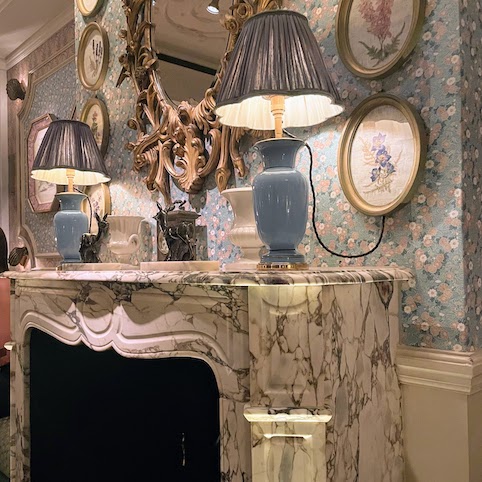
An IKEA TV campaign, not so long ago, urged everyone to ‘chuck out their chintz’. It seems that much of it ended up in Lilibet’s. I’ve not seen so much of the stuff since my maiden aunt died at 97, the same day as Elizabeth II, and her house hadn’t changed since the 1940s.
This new restaurant is on the site of the building where Elizabeth (Lillibet) II began her life, although the actual house was demolished years ago.
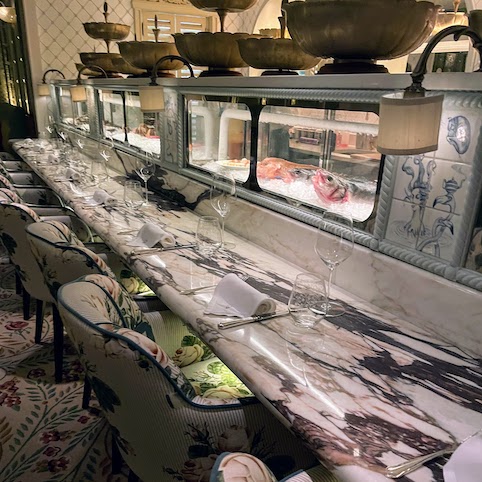
Internally Russell Sage Studios have created what can be either called a loving homage of interior design trends back then, or an affectionate parody of the same. There are handwoven Gainsborough silks on the walls, and even the sort of fake fireplace once found in stately council homes. Usually accompanied by a car up on bricks outside.
I like it, everything about the place has a wry smile on its face and it’s extremely welcoming, comfortable and, yes, it is actually elegant. There’s nothing else like it in an area that has become very blingy, majorly catering to Russian and Middle Eastern tastes.
It’s not perhaps what you’d expect from Ross Shonhan, once Executive chef at Zuma London, and who created the iconic Bone Daddies ramen bars that for years were the talk of blogland, with people scrambling to get as much oily broth inside themselves as possible..
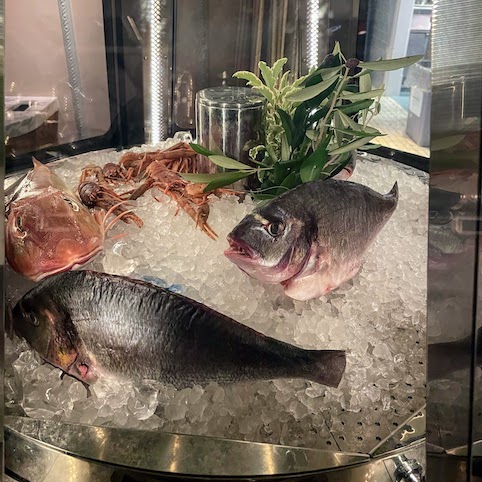
Here it’s fish, fish and more fish across a very large space divided into zones. A bar, a marble topped seafood bar, (oysters and caviar feature, of course) a fish grill, and traditional seating to eat whatever you want. These seats are extra plush, and whilst the tables have no tablecloths, they are dark wood and so still feel upper class.
It’s a menu that could have you indecisively flicking back and forth for a month, but we know what we want.
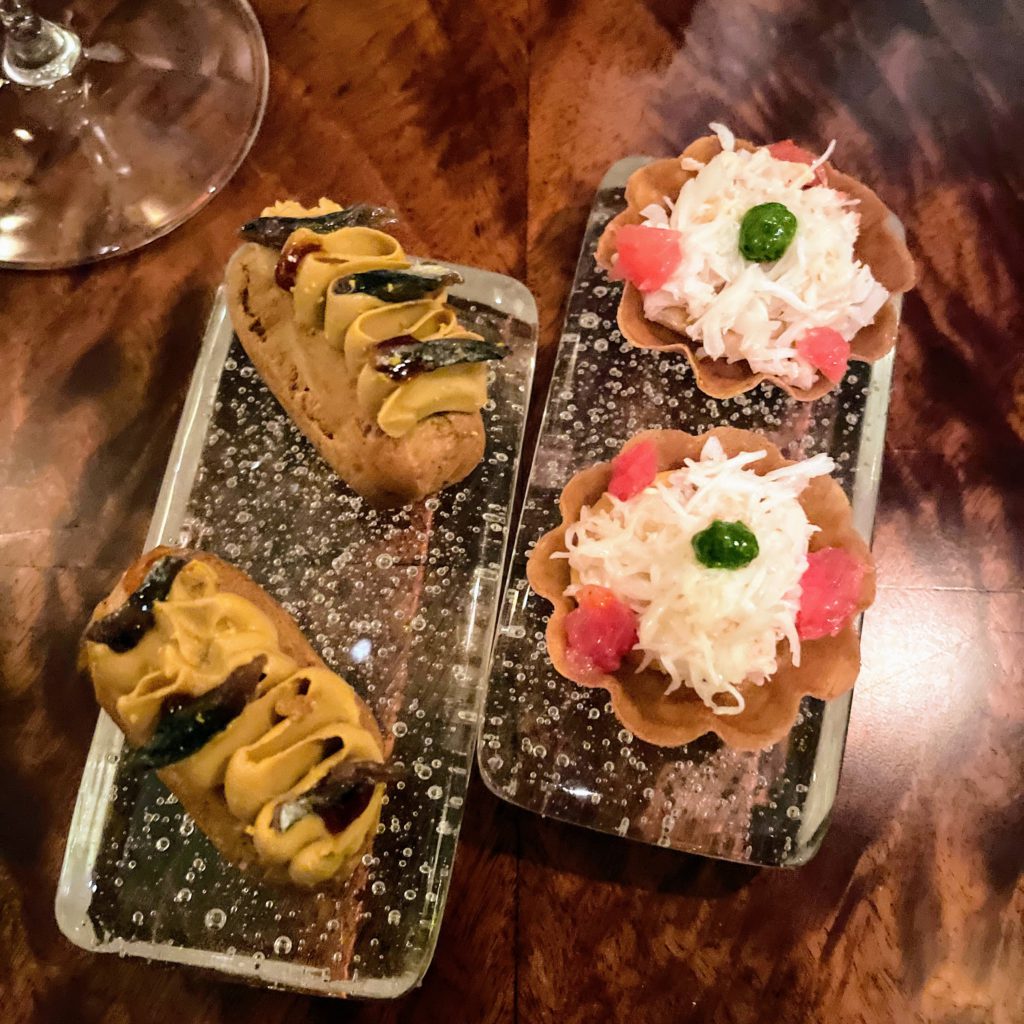
Anchovy éclairs and crab tarts are more nibbles than full on starters, but they are both rather wonderful. I love anchovies, particularly the tinned brown fillets, but they do repel some people. The important thing is to get the best you can find – cheap anchovies don’t have the rich texture and deep umami that’s so present here.
I saw a recipe for these in the The Official Downton Abbey Christmas Cookbook (don’t judge me). So as a savoury they have been around a long time in posh circles. They’re usually made with puff pastry, here though it’s proper choux with the hollow space inside piped with anchovy parfait and on top sharp/sweet sauce. Gone all too quickly, but the memory lingers.
The crab tarts are equally impressive, small works of culinary art, super-fresh sweet crab enlivened by citrus and cosseted in pastry shells that are as delicate as the porcelain Liz 2 probably had her afternoon tea served in.
Did I mention it’s a big menu? Well we dither over the Ricotta agnolotti, lobster spaghetti, whole turbot pil pil as choices, but the “fish triptych,” fish served in three different ways – a crudo, a grilled main and a soup – sounds too unique not to try.
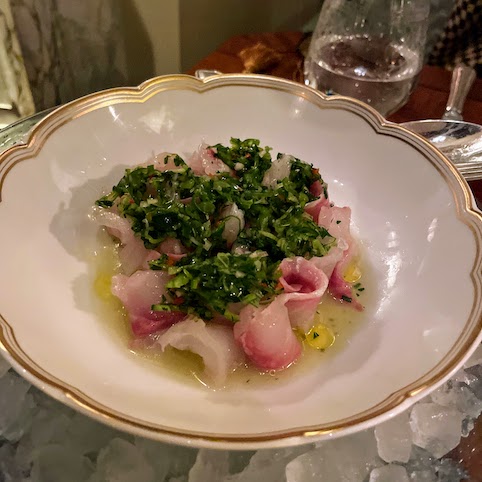
From the fish of the day we have the Sea Bream. This arrives first as crudo – raw – dressed with olive oil, salt, lemon and perhaps vinegar, and liberally scattered with herbs. This really showcases the fish which is firmly ‘cooked’ by the acids to a divine buttery texture. My only caveat being that the fresh chili was rather too fierce at times.
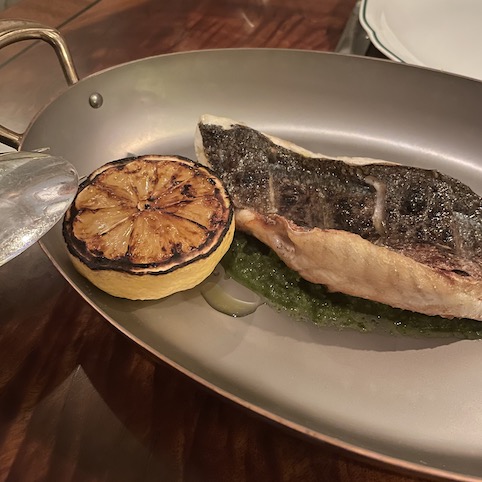
Next from the same fish comes its fillets, cooked in the searing heat of the bespoke wood oven. A perfect piece of fish, the skin crispy and golden, the flesh gorgeously creamy. It is so naturally excellent that the mojo verde sauce is in some ways not needed, but in other ways I need lots more. And a spoon, too. I could also do with some chips, but then I am common.
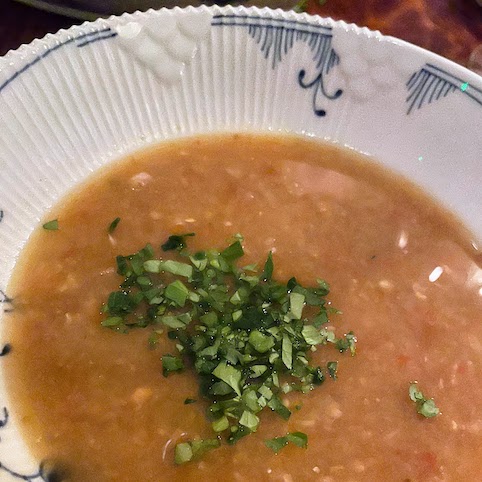
Lastly, the remains of the fish are cooked fast in a pressure cooker to create one of the best fish soups either of us have ever tasted, and yes we have been to the South of France.
It’s ladled out tableside, which is posh, and we boat it back with little oohs and aahs. There is some left in the tureen, so rather than summon a footman I top up our bowls myself. Sometimes one simply cannot wait to be served.
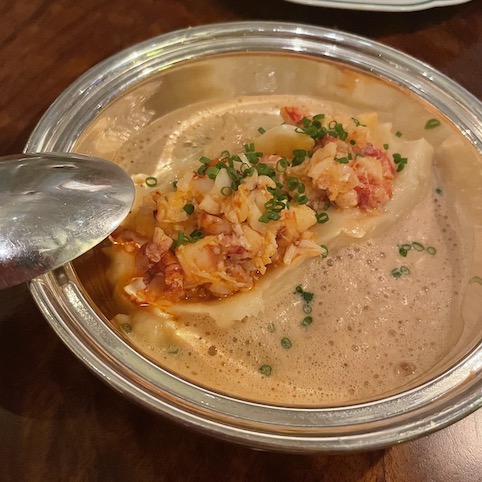
I now have to mention the Lobster Mash, after all everybody else has. Firstly it gave me an annoying earworm; I can’t stop hearing ‘Monster Mash’ in my head, and secondly it really is very good. Buttery, creamy, mash anointed with a lobster bisque? How can it fail?
It’s served after the soup, I’d have liked it served with the #2 fish, although that may not have been the best way to showcase either dish. Anyway, it is decadent, depraved and delicious. It’s a must have, a right royal treat.
They do a rather odd dessert here, a Prego sandwich. It’s a garlic steak sandwich, the word ‘prego’ in Portuguese means ‘nail,’ perhaps the nail in your coffin? It is actually a well-loved Portuguese snack that is often eaten after a seafood meal. I don’t really fancy it, but a twist on crepes suzette does sound good.
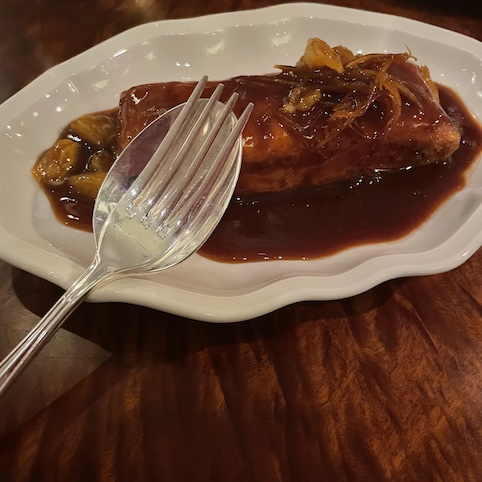
It arrives rolled up, topped with a sauce of caramelised sugar, orange juice and butter, plus thin candied orange peels, and yes, it is torched (or flambeed as they say in more refined circles) at the table. It’s a blast from the past and a very welcome one.
Lillibet’s really is something special in London; its interiors, its staff, its food all remind me of why I go out to eat in the first place, not to greedily catch a trend but to relax and enjoy time with friends and family in a place that believes in the basics.
Lillibet’s I am sure will become as much a part of London’s history as Liz 2 was, and hopefully live just as long.
Sicily DOC wines are exciting, fresh and a world waiting to be explored. I visit the island to discover a new age of quality that’s all in the family.
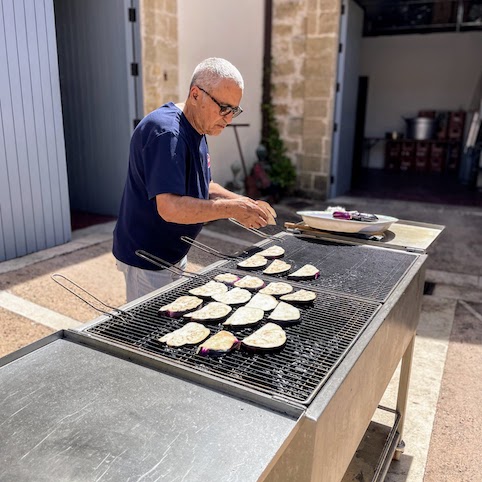
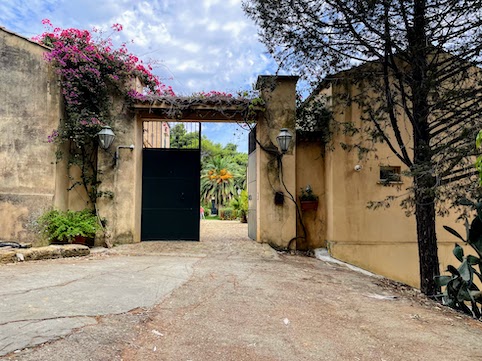
In the “baglio” or traditional central courtyard of Tonnio Baglio Ceuso, the father of the winery is frying aubergine slices and fennel sausages over glowing charcoal. The aroma is fantastic but, not speaking any Italian I can only give him a thumbs up and get one back with an accompanying grin.
Now semi-retired, he enjoys watching his descendants do most of the wine work while he offers sage advice that I’m sure is warmly welcomed, although perhaps not always, but hey, that’s families the world over.
I’m discovering a new generation of Sicilian wine makers, the sons, daughters and even great grandchildren, of the originals, who are now front and centre in Sicily, and that’s a good thing for Sicilian wine. The island’s wine scene is no longer dominated by the production of cheap, generic, wines, as it has been for so long.
The big name red grapes such as Nero d’Avolo, Nerello Mascalese and Frappato ‘fruity’ are still king of course. Whilst for whites, Cataratto (now named Lucido, because apparently we non-Italians can’t pronounce Cataratto) can still be found across the island, and crisp, savoury Grillo (used to make Masala) is now a fine white wine all on its own. Winemakers are using these grapes to make exciting new style wines, as well as growing ‘international’ grapes such as Syrah, Merlot and Chardonnay for blending and single grape production
There is power in a union
Around 450 forward thinking Sicilian wine makers came together in 2011 to promote tradition, innovation, and quality over quantity in Sicilian wine, as well as to support each other in what can be challenging times, by creating Consorzio di Tutela Vini Sicilia DOC which now numbers 7,000 winemakers and more than 530 bottlers.
One problem they all face is climate change. A young winemaker showed me a photo taken last year of the lake that has always irrigated his vines, ‘this year,’ he said drawing with his finger, ‘this….’. He indicated an area of water so reduced it was hard to believe it was the same lake. The patches of blackened undergrowth I saw all over the island also witness the lack of rain this year and the outbreaks of devastating fires.
Positivity is the main vibe from all the winemakers I met though, even when grumbling slightly about how big UK importers are still adamant they only want cheap plonk. They are reluctant to buy the more expensive quality wines these winemakers have dedicated themselves to, but that’s changing as UK wine lovers wake up to the new Sicilian scene and its amazing options.
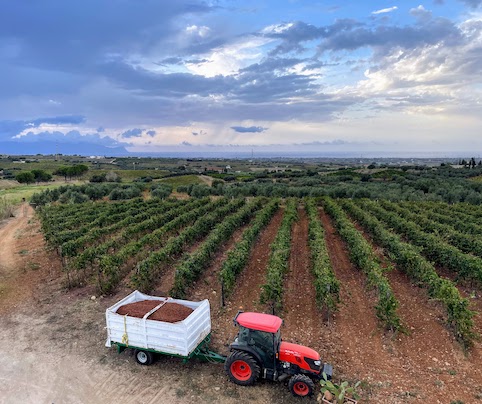
The island can have four different climates over a vineyard surface that’s three times that of New Zealand’s, which allows for a lot of wine variety, but all over the DOC portfolio, quality and organic farming is key.
Sicily is now the top producer of organic grapevines in Italy. By leveraging the natural climatic conditions of the island, fewer treatments are needed. One winemaker told me how he is trialling a natural insecticide derived from local cacti as a cheap and effective crop protection solution.
Don’t walk away René
At Fuedo Diso, a fifth generation winery, the Di Lorenzo family were the first registered company to produce Chardonnay in Sicily. They’ve owned the winery, whose Baglio dates back to to the 17th Century, since around 1867, and whilst the buildings are gorgeously ancient, the equipment they use is state of the art.
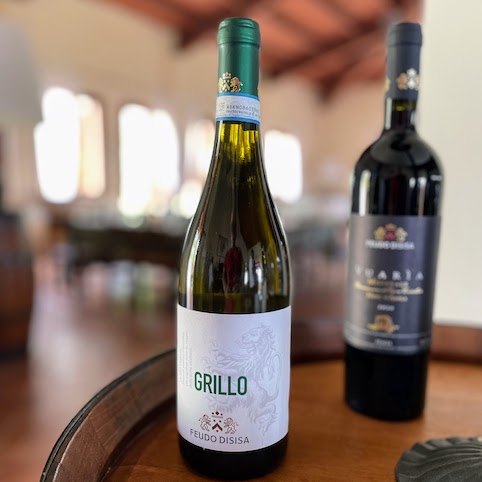
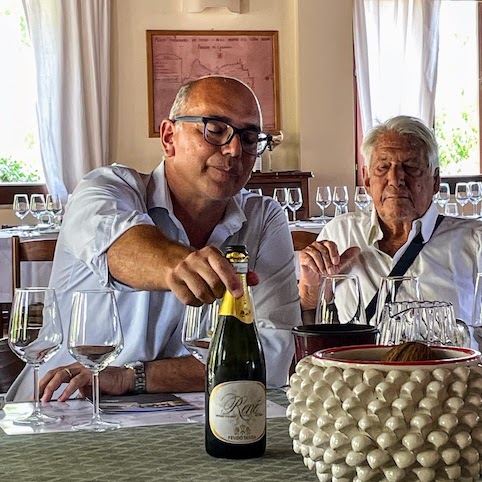
Their Grillo, Chara, Nero d’Avola and Adhara wines are fresh and revitalising. Their particularly deliciously crisp Grillo is a star wine, while their sparkling wine René, named after the patriarch, comes from the oldest Chardonnay vineyard in the Feudo. As we taste through their range of wines, René is front and centre with his glass, and he’s not spitting any out. Mind you, neither am I.
Vinifying up a storm
The fresh energy at the Tola winery is also palpable. As I tasted the wines in their ultra modern building south east of Palermo, the skies darkened and the giant windows framed dramatic lightning storms over the gulf of Castellamare to the north.
The winery crackles with life – all white surfaces and sharp angles it’s run by Francesco Tola almost 400m above sea level. This makes the temperature moderate – it can actually be very cold at night – with sea breezes bringing salinity to his classic Sicilian grapes of Nero d’Avola, Syrah, Grillo, Catarratto, Insolia and Zibibbo, as well his international vines of Chardonnay, Sauvignon Blanc and Pinot Noir.
He uses steel tanks a lot, to keep the freshness of the grapes alive to produce light, zesty Nero d’Avola and, as a very modern winemaker, he is happy to use the latest machinery for efficiency, while keeping his CO2 emissions low.
Out back a machine is processing just picked grapes, blowing streams of stems into a pile to be composted. I can’t help but notice the workers here are all wearing Kippahs. ‘ Ah yes,’ says Mimmo, ‘this batch is for kosher wine and so can be only touched by Sabbath-observant Jews from the harvest to the bottling’. An interesting example of finding markets for his second division grapes.
His flagship red wine Black Label – Nero d’Avola Doc Sicilia – though is traditionally made from the best hand harvested grapes and is an intensely fruity example, while his sparkling wine, made from Catarratto and Grillo grapes, gets its fizz from the Charmat Method, where the second fermentation that gives the lovely bubbles is created by using large pressurised tanks, and not bottle ‘dosage’, as used for Champagne. This makes for wonderfully bright bright fruit flavours
Concrete Proof of change
Concrete often gets a bad rep. In the old Soviet Union it was used for shoddy buildings that fell down a lot, usually due to the ‘concrete’ being made of flour, water and potato peelings.
However for a long time proper concrete was the storage vessel of choice for winemakers – cheap, easy to clean, stable and hardwearing, it’s also slightly porous and its thickness makes the wine inside less susceptible to temperature changes or ‘shock’.
Stainless steel seduced many winemakers in the 1980s and lots of old concrete tanks were literally smashed up. Back at Tonnino Baglio Ceuso, with the aubergines eaten, I went with the chef’s daughter, Francesca, to see the usual steel vats, but also their row of concrete tanks that were still in place when they took over in 2023.
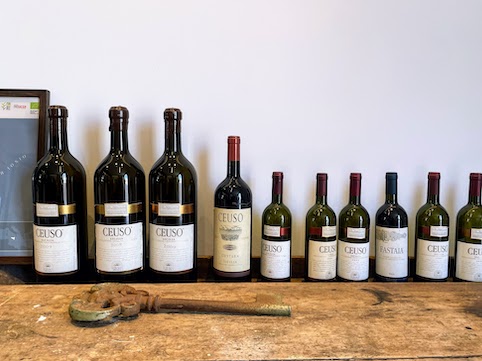
Their flagship wine Ceuso, created by enologist Giacomo Tachis in the 90s, is a modern blend of Nero d’Avola, Cabernet Sauvignon and Merlot. After fermentation, the wine is sent to mature in these old cement tanks before moving on to Seguin Moreau barrels. The result is an exceptional wine with velvet tannins and which can be aged for years in your own ‘cellar’.
They also produce a delicious dessert wine, ZIBÒ Made from their best Zibibbo grapes, it’s a reimagined Sicilian classic being fresh and balanced and not as cloying as older styles.
The variety of wines at each winery was remarkable. Innovation was everywhere and this was confirmed at a final tasting in town with twenty six producers and their wines present. It was head-spinning and not just because of the wine being drunk.
Twenty six passionate (yes, for once that word is appropriate) winemakers is a big crowd and whilst I tried to sample every wine, it was impossible. So many superb wines in one place was a remarkable one off event, and all the winemakers were lively and refreshingly young and keen. I naively asked some of them if they had ever wanted a different job from the family business and not one said ‘yes’ and no wonder.
The work is undoubtedly hard; it can be heart-breaking when a year fails to meet expectations, or an experiment with planting fails, but the joy of creating something superb cannot be beaten. Sicilia DOC wines are moving forward at pace, the bad old days are over, and their wines should be on everyone’s oenological shopping list
There’s dog on the menu and a lot more besides at this cool wine bar slash restaurant beside the canal in Coal Drops Yards.
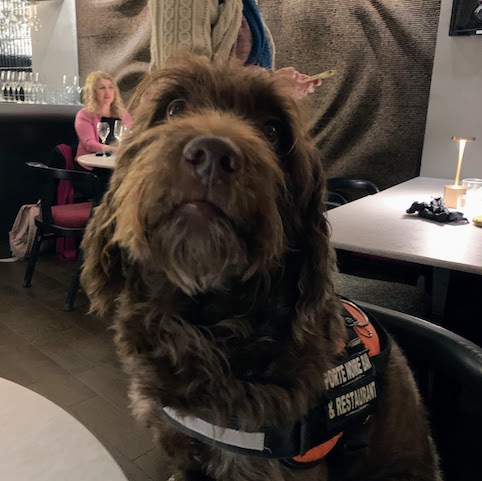
Okay I admit the dog bit is pure click bait. There is indeed a dog at Porte Noire but he’s very much alive and wagging. After a fraught, irritating, windswept search for the restaurant located in the base of one of the old gasometers, now fancy apartments, his happy face behind the glass doors waiting to welcome us cheered us up no end.
His name is Cooper and he belongs to the co owner David Faber, the founder of Connaught Wine Cellars and his presence rather sums up the wine bar’s character – warm, welcoming and cheerful. The other co-owner is Idris Elba, by the way, also a bit shaggy and loveable and curator of his very own champagne brand, Porte Noire, after he and David visited the Sanger Viticultural School in Champagne in 2018. His Porte Noire champagne and cognac are on the drinks menu, of course.
David has taken his own vast wine knowledge and placed it in a restaurant setting and the result is a place that is a wine lover’s ideal spot, but the food makes it not just a banlieue for the bibulous.
The curve of the old gasometer makes the room pleasingly unusual, while the metal of its construction blocks out mobile signals. This was not deliberate, but it does have the effect of making people put away their phones and concentrate on wine, food and friends. Given the amount of tech types in the area this may be the only oasis they have away from their screens. I don’t think there is any guest wi-fi available, at least none showed up on my ‘phone.
Outside is seated and canal facing and I can well imagine how nice it must be come the summer. Incidentally if you follow Google Maps from Kings Cross you will arrive from this direction and you won’t get as lost, as we did. Once at the door you pass by an impressive wine wall at the entrance, where you can also catch a glimpse of cabinets of cured meats
The menu is short, compared to the wine list, which is long. I believe there are over 800 wines in the cellars. I do like wine, but I make no pretense of knowing a lot so we gaze at the wine list rather blankly, while eating from an excellent charcuterie board. There are cornichons, I do love the crisp vinegary tang of cornichons, but I would have also liked some sliced baguette and a big cold lump of butter as well.
Wine help is at hand from the sommelier, who doesn’t make us feel ignorant, but is friendly and keen to find us wines we’ll enjoy. Prices are reasonable I suppose for London, but one can still wince a bit at £12.50 for a small glass. Still you can pay close to that for rubbish wine in many places, and these wines are very good, Plus what does a pint of cooking lager in a London pub cost these days? Almost £7.00.
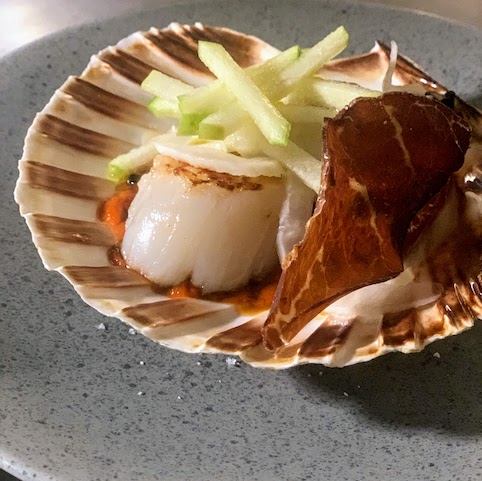
With the charcuterie devoured we turned our attention to Truffle and mushroom arancini n and truffle mayo, and Devonshire hand dived scallops , Bresaola crisps which we drink with Chateau Paillas, Cahors. This pairs well with both the shellfish and the arancini. The scallops are butter soft and creamy, with a gently spicy sauce buoying them up, the bresaola a salty texture contrast.
Arancini are crispy fresh and the bosky flavour of the mushrooms is set off by the rich truffle in an unctuous mayo. When no one is looking I use my finger to scoop up the last of it.
We move to a glass each of Lyseras Blanc 2023, a soft yet zesty white which is parfait with my stuffed squid. Not the most elegant of dishes, it looks like a Zeppelin has landed on my plate, it’s a powerfully flavoured dish thanks to a rich stuffing of chorizo and a bed of sun-dried tomato tahini.
The squid is a little bit tough, nothing to worry about, but it could have been softer. It’s a good bistro-style dish overall and I like the crispy cavolo nero on top. Cavolo nero is a type of kale and baking the oiled leaves makes it very palatable. Boiled or steamed, it usually comes out as more of a penance than a pleasure.
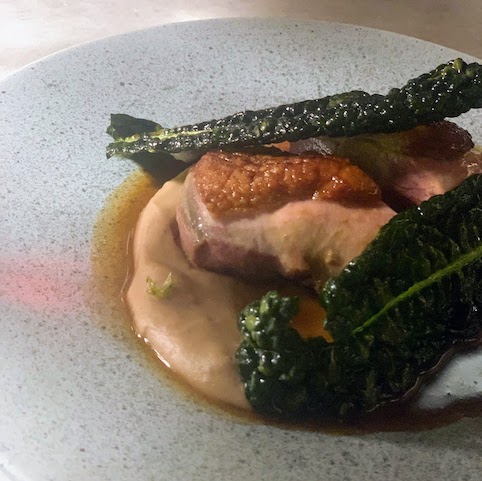
M is on, Shropshire duck breast, chestnut puree and a pinot noir jus. He really loves that puree, mentioning how nice it is several times. The jus is jus(t) great too, he reckons and the duck is perfectly cooked, a hint of pink and no more. He also gets those cavolo crisps and likes them as much as I do.
Unsure what to have on the side, we order the ‘famous’ chickpea chips to share. Like panisses, the south of France street snack, these are based around Gram (chickpea) flour. A thick batter that once set is deep-fried. Delicious and addictive, especially when we dob them into the thick luscious mayo served generously with them.
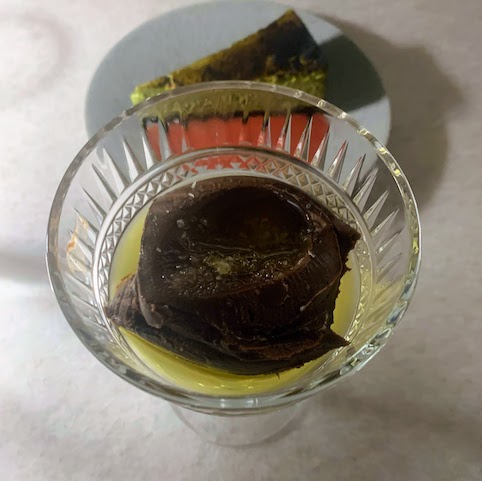
We end with Burnt Matcha Cheesecake on a raspberry puree, and a chocolate cremeux with Calabrian olive oil and Maldon sea salt. The latter was a bit too heavy for me, although chocolate fanatics would love it. The olive oil worked surprisingly well, but personally I would hold back a bit on the salt. The cheese cake was gone in seconds, so that was clearly well liked.
Cooper came round on his patrol, seeking more head rubs and praise, which we were more than happy to give him. Praise to David and Idris as well, they’ve created a lovely little place at Porte Noire that has a lot of taste and a lot of style.
A bit hard to find (again, use Google Maps and not Apple), it’s hard to beat for a relaxed glass or two and some highly competent food.
Valentines’ Day sees a candlelight dinner at Porte Noire with live music
Wine is available to buy both in the ‘shop’ and online and there is a set lunch every weekday.
Not sure what gifts to get friends and relations that live nowhere near you? A great British Hamper can send your best wishes as far away as Australia.
‘That’s called ‘sizzle’, a friendly packer tells me as I handle one of the elements that go into packing a British Hamper Company hamper for postage.
I feel like Gregg Wallace, but while he always feigns amazement, ‘Gor! Vat’s incwedible!’, I am genuinely intrigued..
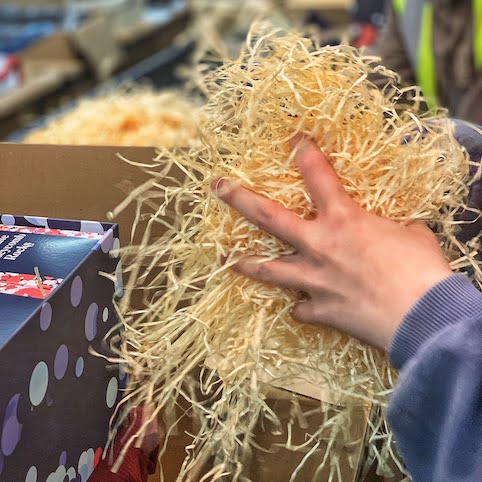
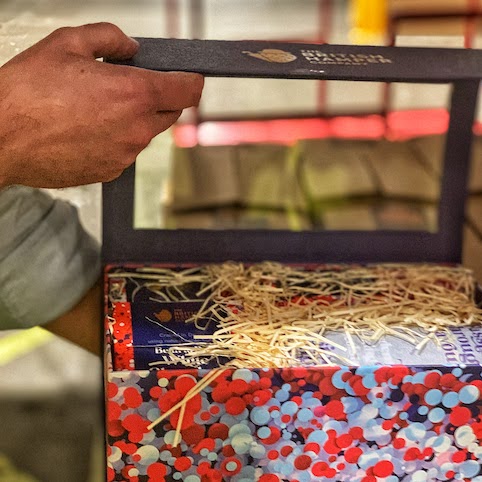
Sizzle is the trade word for the shredded paper ‘straw’ that is used in vast quantities not just to protect all the items in transit, but to add to the visual appeal and the excitement when the lucky recipient delves into their hamper.
‘We do it in layers, as well as around the items, that way the surprises keep coming. It’s all part of the fun’.
It’s a happy place, The British Hamper Company. The regular staff of around eighteen are right now supplemented with another thirty to handle the demands of Christmas. There is no automation, no humming soulless machines, each packer finds all the items required for the hamper that’s been chosen online and adds them to the hamper by hand.
There’s an art to the packing and each item has its own rules to make sure it presents at its best. Even the ribbons are tied in a standardised way. ‘I love working here.’ one young seasonal worker tells me (and no, she was not in earshot of management) ‘best place I have ever worked. It’s good to know what you’re packing will be a lovely gift for someone and doing it well is satisfying’.
It’s a family business, James Tod is the co-founder and MD, his dad Mike is the other founder and Chairman, and his sister Alice is Sales Director. In 2014 they decided to get into e-commerce and from experience in his world travels, James felt there was demand from expats for much loved British food, as well as British gifting.
A website was set up and the best British artisan producers found. At first, working out of a gazebo office and a barn, sales were slow, around sixty hampers a month. Then came the first Xmas period and sales hit a thousand a month. Now sales are around 30 thousand a year, and they have a proper warehouse facility just outside of historic Lincoln.
‘Thirty five percent of our hampers go overseas’ explains James as we eat a ‘picnic lunch’ using a variety of delicious goods from the warehouse, ‘although’ he says, gesturing at the table, ‘of course those going out of the UK can’t contain perishable produce like this smoked salmon’. It’s very good smoked salmon, and I help myself to some more luscious slices. I also eat more than I should of the All Butter Cheddar Biscuits, which are absolutely delicious and fiendishly addictive.
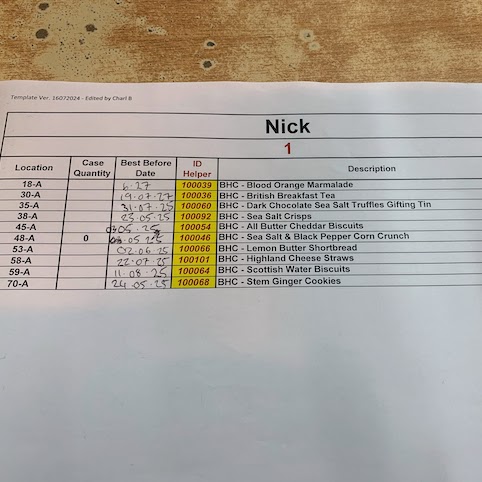
‘We begin planning for Christmas in March,’ James explains,’then start test-tasting new products and ordering the stock in May. Finally in September we begin to pack 500 – 600 hampers a day with the dry goods. These can be stored ready and then just before dispatch in go any perishables such as cheese and salmon, as well as any personal message. Delivery is guaranteed within a few days in the UK, often the next day.’
Each year artisan producers all over the UK approach the company hoping to be selected, a tasting task that the family relish. Whilst everything in the hampers carries only TBH branding, the volume they can sell makes it well worth it for the producers because that income supports their businesses in a reliable way. ‘They can focus on creating great products and we do all the rest,’ says James.
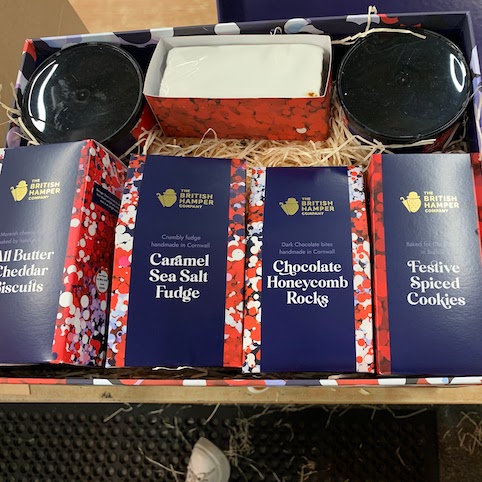
So what might lucky recipients find in their hampers, which come in all sizes from bijou to whopping? Well a £55 Xmas hamper has Sweet & Salty Popcorn, Caramel Sea Salt Fudge Gifting Tin, Bean to Bar Milk Chocolate, Jalapeno & Lime Mixed Nuts, Festive Spiced Cookies, Sea Salt & Black Pepper Corn Crunch, All Butter Cheddar Biscuits and Bean to Bar White Chocolate. The options are almost infinite and all very tasty.
At the very top end there is the £1000 Grand Extravagance Hamper with whiskies, cheeses, and superb English sparkling wines, amongst a plethora of other treats, all in of course an eco-friendly traditional wicker basket. Hampers also come in cool cardboard boxes, too.
In between there is a massive choice to suit all tastes, including vegan, gluten-free, halal and other specialty options. About thirty five categories in all, which makes picking the perfect hamper very easy.
Prices include packaging and carriage to your chosen destination. And with a hub in the Netherlands, hampers and gourmet produce can be shipped across Europe with fast and reliable delivery and no additional customs fees.
‘We also do a good trade year round in providing corporate gifts.’ adds James, ’many big companies like to fly the flag with their customers and a luxury hamper of British goods is a great way to do it. We can personalise their hampers, too.’
Down in the warehouse, I have a go at packing. It is actually quite good fun, although my attempt would not pass the quality control. My sizzle action is praised though ‘Nice and tight’.
Maybe I can come back next year.
You’ve still got time to order a gift hamper for someone special for Xmas, although the last dates for abroad are fast approaching.
In the heart of Kangaroo Valley, this small but perfectly formed Vietnamese restaurant is properly delicious
It’s not really fair to call Earls Court ‘Roo valley anymore, but back in the 60s just about every young Australian lived there. Today its grand old houses are more likely to be hotels than bedsits, but the area still has a certain rundown aura.
Down under one of the big houses, in what would once have been the servant’s domain, there is still a kitchen at 32-36 except now instead of boiling cabbages it’s grilling delicious fish and meats and simmering some wonderful Phos.
Med Sallah is the new restaurant from Med Pang and Koi Lee, the people behind critically acclaimed Malaysian favourite Med Salleh Kopitiam.
Once down the steep little steps you enter a compact place warmly painted and with a market scene across one wall. The chairs look like they’ve been rescued from a 1920’s British open topped car, they’re very covetable and also very comfortable.
Koi’s Vietnamese wife Syphong Lam is in the kitchen and out front is a welcoming and friendly team. Most of the customers also appear to be Vietnamese, which is usually a very good sign.
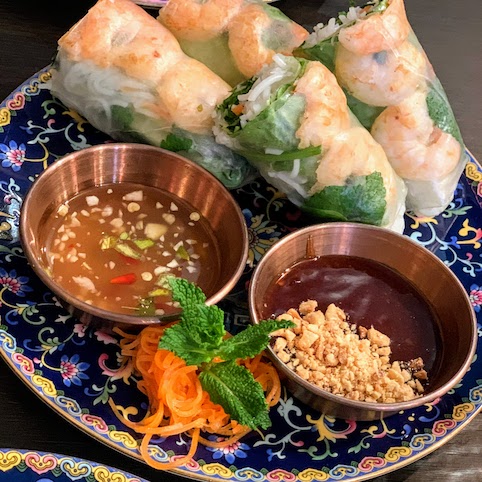
We sat back and let the team choose for us, after wimpishly specifying ‘no offal’ and we certainly got the works. Translucent prawn summer rolls with dipping sauce were packed with crispness and great clumps of fresh herbs, the prawns eerily visible through the wrapper skin as if hiding behind a shower curtain.
Rather cleverly the prawns are divided in half lengthways so they appear large but are in fact light and delicate. Veggies can have the version with mushrooms.
Moving on, a mango and prawn salad has the classic Vietnamese interplay of sharp, sour, sweet and hot. Tomatoes, grated carrot and lettuce all up the freshness. Personally I would have upped the fish sauce quotient too, as well as the lime, but I have no doubt this is done correctly for Vietnamese tastes. It was delicious all the same.
Med Sallah focuses on street food and in Vietnam that means things cooked over the simplest grills, literally on the street.
We have three superb lamb chops, crusted in spices, grilled and perfectly pink-ish. Lemongrass and chilli seem solidly represented and they are very gnawable right down to the bone where the best flavour always is.
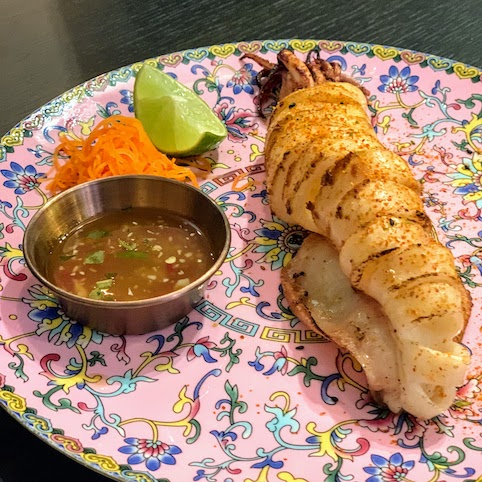
Also grilled is a squid, the whole tube and at sea-monster size too. It’s not easy to cook squid well, it either needs to be cooked very fast and very hot, or slowly braised. In between it’s rubbery. Here it was spot on, and again generously but not overpoweringly spiced. The waitress cuts it into rings with large scissors, a very useful aid to eating. We have a little tussle over the tentacles, for me the best bit.
Bun Cha is cold vermicelli rice noodles with meat marinated in lots of lemongrass, garlic and fish sauce and soy sauce. You can have it here with grilled chicken, beef, prawn or mushroom. We have excellent beef and chicken, the cold noodles are a bit odd at first but we come to love them. I imagine they are wonderfully refreshing in a hot climate.
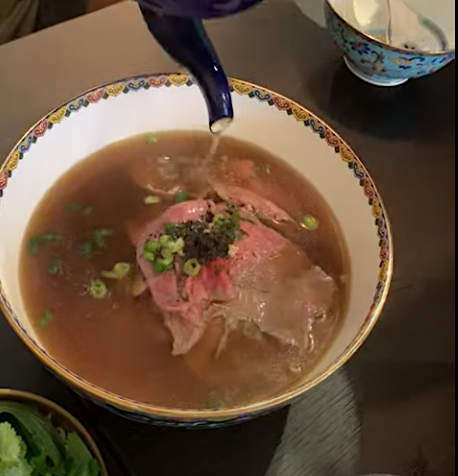
And Pho. Created in Nam Định, Pho Phở is of course broth, rice noodles, herbs, and meat. The meat cooks in the hot broth when mixed at the table. Here we had a version almost certainly not eaten on the average street, unless perhaps it’s Bond Street, which was their Classic Signature Truffle Wagyu Pho.
Well it was superb, the dense flavours of the stock pricked by the truffle and the beef was remarkable. Soft, melting and all too soon gone, but drinking the stock kept the flavours going.
And to end something from the mists of time, a deep fried banana with ice cream. This made me very nostalgic as I burned my tongue just as I used to do all those years ago. Mind you,this was fresh crisp batter, and back in the day that was unheard of.
You have to like Med Sallah, its cafe style relaxed atmosphere, the great food and the lovely people. Take a first date there and impress them with your knowledge of places not on the radar.
Seafood of the finest kind is served at this ancient Irish pub, but horned hats are optional
Looking over my shoulder I can see my fellow viking crew members pulling hard at their oars. Turning to the right I can see the shoreline and our settlement. A quiet voice in my head is telling me the history of the place.
Ten minutes later and I’m back in the pub, readjusting to the world as it is now.
The Glyde Inn, Annagassan County Louth has stood for centuries on the site of what was once a major viking settlement. It was ‘National Irish Pub of the Year’ in 2018 and from the front it seems no more than a small pub in a terraced row of houses, but pass through the cosy 1770s interior and head out back and you come across breathtaking views of both the enormous Dundalk bay and the Mountains of Mourne.
The enterprising owners Paul and Ann O’Neill have built up the business since 1976 and recently created an engrossing VR headset experience to illustrate the village’s viking settlement history, a time when it was Linn Duachaill, a Viking Longphort. It really is the last thing you’d expect to find in an Irish pub once the evening haunt of C.S Lewis, author of the Narnia tales.
Viking tales aside, I’m here for the beer and the Viking Seafood Feast. These waters produce superb seafood and have done so since the Viking times, one of the reasons they chose to settle here about an hour’s drive from what is now Dublin. After a surely very difficult and perilous journey around Scotland, to find this earthly paradise must have been a relief.
I’m relieved to find it too. While the weather outside is unusually fine for October, a cosy pub is always a pleasure to dive into.
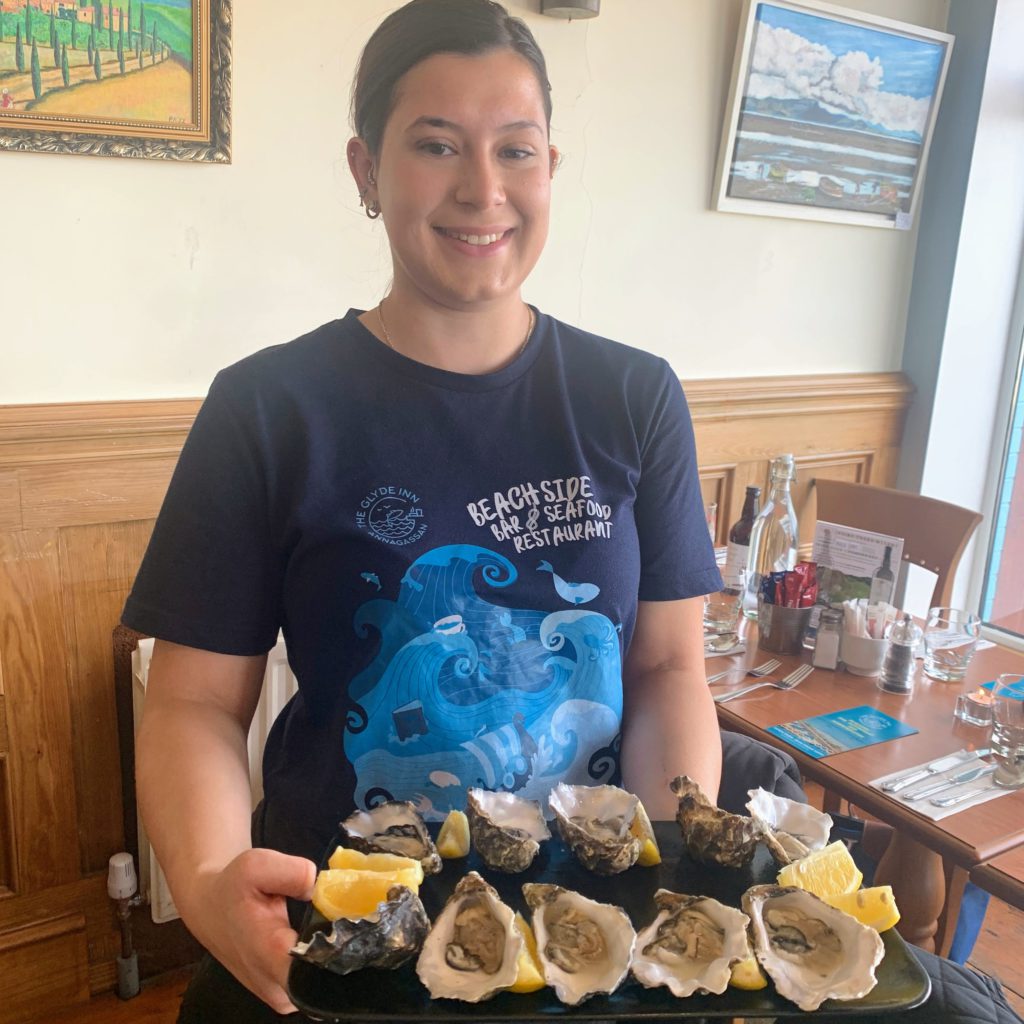
With the VR goggles off it’s time to don beer goggles for a bottle of Linn Duachaill Irish Pale Ale, the house beer of The Glyde Inn and made in small batches for them by the Brehon Brewhouse. Nicely hopped, not like the London hipster pale ales that taste of urinal cakes, it’s a good palate teaser for the first dish- Carlingford oysters from nearby Carlingford.
Superb oysters, screamingly fresh, plump and briny, you’ll be hard pushed to find better. The beer is a perfect pairing.
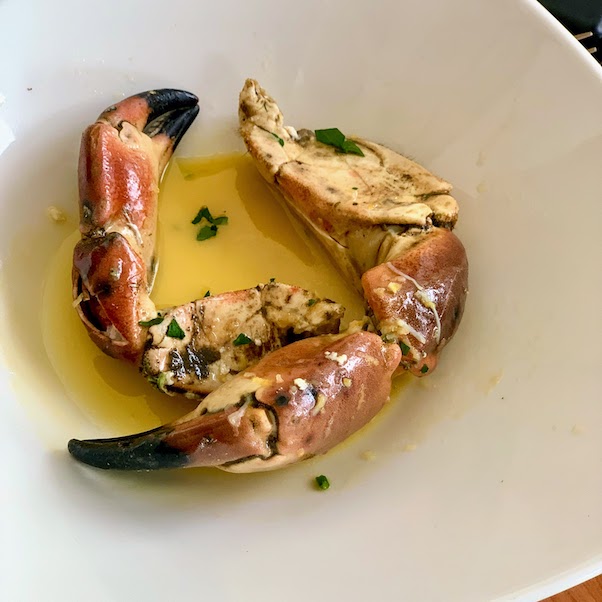
Next crab legs, again pulled out of the nearby waters. Massive things simply dressed with Irish butter aromatised with lemon. I wield my ‘crackers’ with what I assume is skill, but manage to explode a leg so that butter, and fragments of crab, go everywhere, some of it on other diners. This being Ireland it’s taken in good spirit.
I spend a happy ten minutes teasing every last piece of the deliciously sweet white meat out of the shells. So simple, so delicious. I drink a glass of Fairy Trees Chardonnay aged in Irish Whiskey Barrels for 3 months with it. The grapes are grown not far away on the banks of the River Dee. Who knew wine was made in Ireland? Not me. The creamy texture and hints of whiskey work well with the crab.
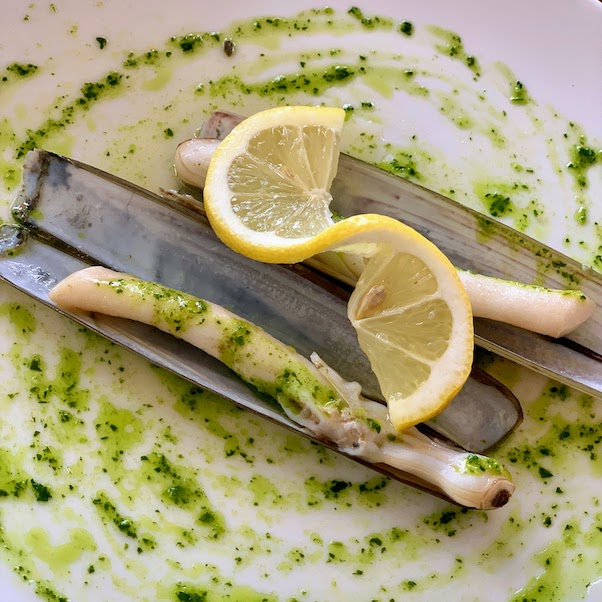
Like a true Viking I plough on. Next up are razor clams, one of the most delicious seafoods there is. Again fished straight from Dundalk bay, cooked they’re served in a garlic, white wine reduction. For anyone that’s not had razor clams, the texture is soft but firm rather like a cooked king prawn. The tip is usually more tender than the base, which is a bit more chewy. Lovely.
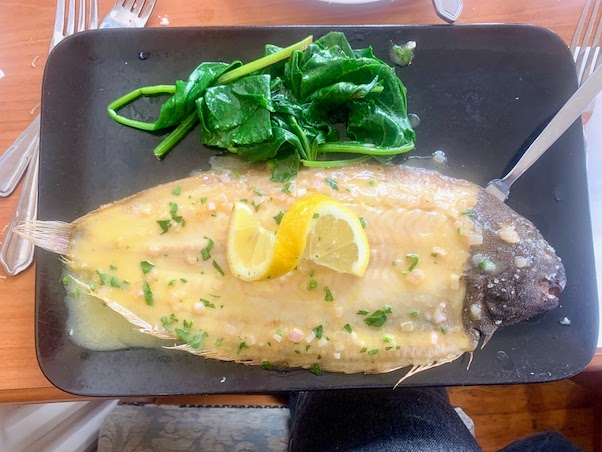
And then something new to me, Cloggerhead Black Sole served on the bone. What a fish, the flesh lifts away perfectly, while dripping butter, and soon only a Tom & Jerry skeleton is left. What a London restaurant might charge for such superb fish I can only guess at and it’s academic anyway, it would never taste as good if it had to travel hundreds of miles rather than hundreds of yards.
It comes with Colcannon mash that’s made gloriously green with sea radish that I saw chef foraging earlier from the shoreline. And with that I breathe a deep sigh of happiness and down a Bailey’s before heading off back to modern times.
This really is the kind of seafood meal that would be all over the Sunday magazines if it were in Spain, and yet this kind of excellence is available just next door to Britain.
It’s another excuse to travel to County Louth for a short break of a foodie kind. Skol!
Aer Lingus fly to Dublin with 9 daily flights between London Heathrow and Dublin, Ireland. One-way fares start from £59.99 each way including taxes and charges. For more information visit www.aerlingus.com”
 The Culinary Traveller