Jamie Oliver Catherine Street Review

Jamie is all over the place, but his restaurants no longer are. I try a recent new one in the company of some actors

To be honest, I am not actually at the same table as the actors, but next door is a Very Well Known TV Actress and an equally Very Well Known TV Chef, plus some other people I vaguely recognise.

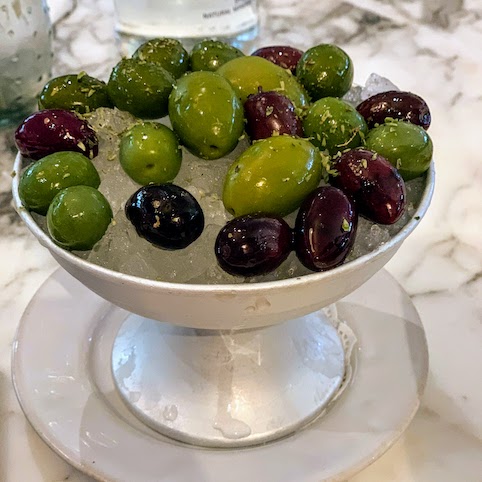
As I wait for my wingperson to turn up, while grazing a mix of olives dusted in oregano and  served, rather unusually, on ice, I also try to keep my own cool. Nonetheless when I momentarily glance over She looks up at the same time and our eyes meet. ‘ Big fan’, my eyes say, ‘Oh God, a stalker!’ say hers.

You’d expect to find actors in here for lunch though  as it adjoins the back of the Theatre Royal. A space between the buildings is now roofed over to create a spacious and airy mini dining atrium, so thesps only have to walk a few yards for a meal.

We are eating inside today though, in what was once the ground floor of an office block, not that you’d ever know it after a splendid refurb. The place has a Grand Cafe kind of buzz to it; classy without being snobby.

There are trendy artworks on the wall, classic old photos, unusual lighting, comfy banquettes plus Sade on the sound system. Apart from the latter it could almost be a Jeremy King joint, another restaurateur who has had his ups and downs.

It’s family friendly;  there are kids here and a kids’ menu. The seasonally changing menu itself is a one sided affair, colourful but disposable, it tells diners this is easy-eating. A two- or three-course set menu is available Monday–Saturday from 12–6pm, Sundays offer roasts with all the trimmings. 

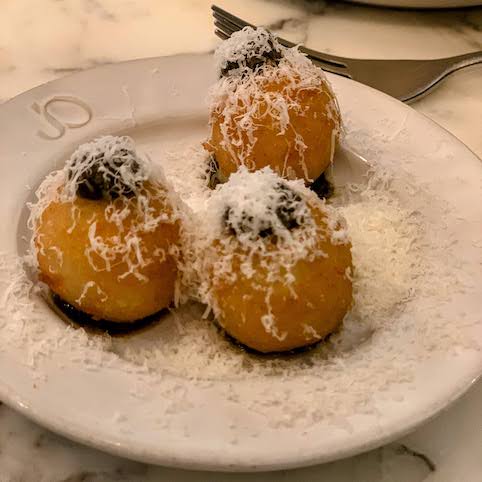
Apart from the icy olives there are other nibbles on offer.  Now that S has finally arrived  we try croquettes made with pureed Mrs Kirkham’s Lancashire cheese with leeks, and dobbed on top with pickled walnuts and they are one-bite tasty, the cheese gooey and sharp. Shame they are served in threes though and not twos or fours.

Jamie has said the food’s inspired by what he grew up eating at his parents’ pub, which explains the prawn cocktail on the menu, although it’s a bit more than that – it’s a seafood cocktail with British crab, brown shrimp, prawns, yuzu cucumber, Marie Rose sauce (natch) and focaccia crisps
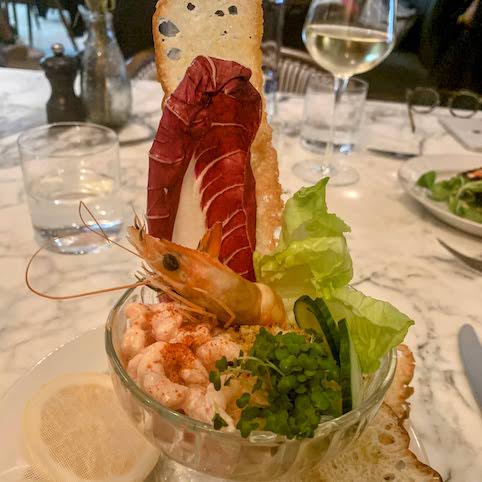
It’s an impressive dish, the focaccia crisps are large sails powering the dish towards me. The prawns are a bit watery, the rest is good, especially the crab. I’d have liked some more Marie Rose sauce, my mother used to always sink our family Prawn Cocktails in the stuff and I used to also surreptitiously eat it out of the jar.

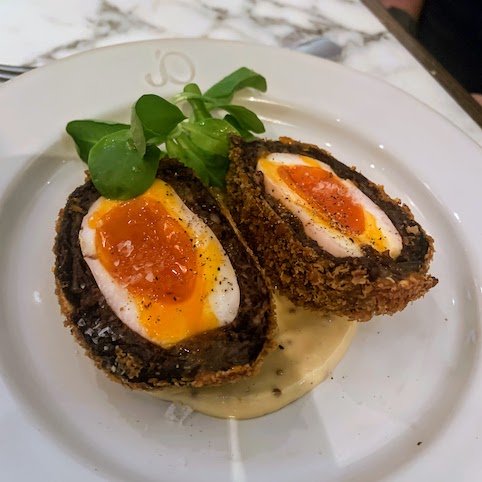
Mr Forty Minutes Late For Lunch has a Scotch Egg made with Stornoway Black Pudding, a Cacklebean egg and mustard mayo. It’s the sort of thing we ate a lot of in the late 80s and 90s, a Gastropub thing, and he reports it’s fine but not overly exciting. It’s a well-golden egg though and it is cooked perfectly.

The menu is full of Jamie’s other culinary memories and I recognise a few pasta dishes from the old BBC Executive Canteen, better known as the River Café, and some from legendary Fifteen as well. I go for the Dayboat Fish though, which today is Stone Bass, (or ‘Wreckfish’ or ‘Meagre’ ). A fish normally farmed and not caught, it comes swimming in a lake of “Champagne Cream Sauce, Dulse, Royal Kombu, Green Peppercorns, Herb Oil”. 

It’s a chunky fish, not quite as good as Sea Bass but firm and white and generously sized. The sauce is excellent, but it needs a spoon (or even a straw) to eat it. I instead use my ‘Koffman’s fries’ to blot it up. Good fries, but they needed more salt IMHO
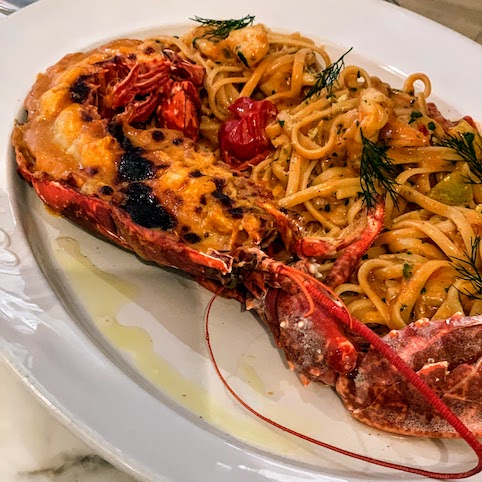
Also a day special is a whole split lobster with linguine and tomatoes. A big plateful, it rather intimidates S who finally has to admit defeat trying to eat it all. The pasta has absorbed lots of good juices from the tomato and shellfish, but it also makes it rather heavy going. He doesn’t regret trying though, it was a good lobster.

We’re drinking Pale Ale made by one of Jamie’s ‘mates’ in Walthamstow. Unlike most hipster ales it hasn’t gone overboard with the hops, so it doesn’t taste like drain cleaner. I like it so much I have two.

S is still suffering from lobster overload, so I have dessert alone, a rather nostalgic Jelly & Ice Cream, although this is very grown up jelly. Made with Provence Rosé, it wobbles like Keir Starmer being asked what a woman is, and raspberry and vanilla ice cream and summer berries finish it off. Really enjoyable.

This new Jamie puts bad memories of his Italians to bed, although there is a sense that the kitchen is being run by people doing a professional job and not a passionate one. With a menu that is obliged to cover all bases, from pasta to burgers, seafood to grills, that is perhaps not surprising though.

It’s certainly an excellent space and the food is highly competent, although the prices are somewhat higher than you might expect. The staff are charming, all commiserating with me as I waited and waited and waited for my guest to finally turn up.

And you may even get the chance to freak out a famous actress. What’s not to like?

6 Catherine St Covent Garden London WC2B 5JY
www.jamieolivercatherinest.com

Opening Times: Sunday to Wednesday: 12:00 – 10:30PM Thursday to Saturday: 12:00 – 11:00PM

Telephone: +44 (0) 20 3084 7565

Reservations: reservations@jamieolivercatherinest.com
Proper Parmesan Takes Its Time

If your cheap parmesan tastes terrible it’s because it’s not the real thing. I went to Parma to see how genuine, PDO protected, proper Parmigiano Reggiano is made and why it has a premium price tag.

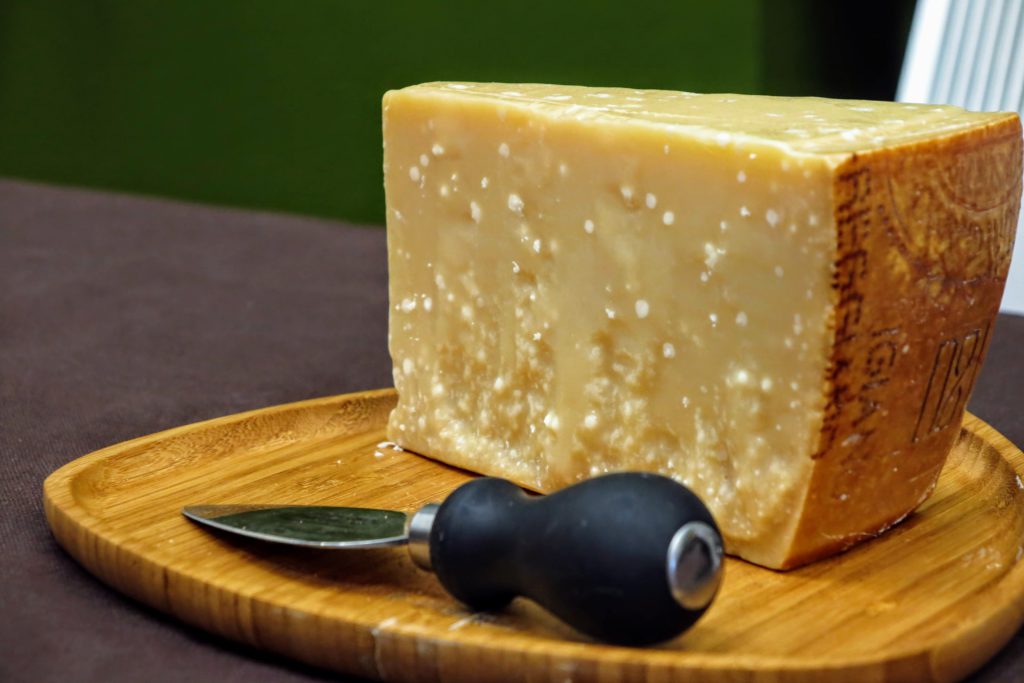
‘So this cheese is twelve years old,’ says Simone Ficarelli, the international marketing officer of Parmigiano Reggiano, expertly wielding the short, stubby, knife that’s the traditional tool used to break off chunks from the giant wedges.

There are white lumps in it, a distinct mark of a mature cheese. These are calcium lactate crystals, and are perfectly safe to eat. In fact the crystals in Parmigiano Reggiano cheese are a sign that the cheese has been properly aged. When you eat the cheese the crystals spark out a nutty flavour that complements the saltiness.

DOP Parmigiano Reggiano has been made for over 900 years and is only produced in the provinces of Parma, Reggio Emilia, Modena, Bologna to the left of the Reno river, and Mantua to the right of the Po river. This is the area of the farms where the cattle for the milk are fed on locally grown forage. It can only be made with this skimmed cow’s milk, salt, and rennet for curdling.

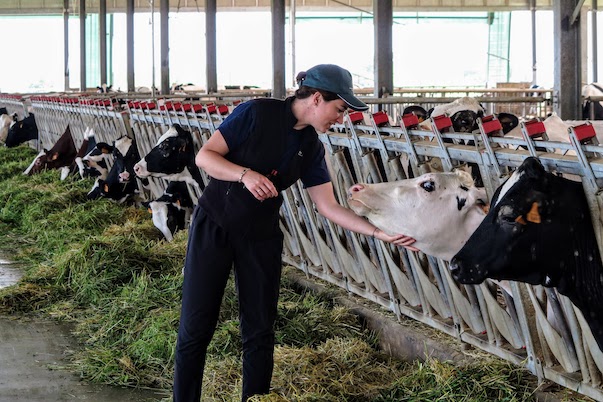
The cows live in airy open-sided barns, with extra fan cooling in summer, and they eat bundles of the lush grass that surrounds them. Strict rules ban the use of silage, fermented feeds and animal flour. They seem very happy, with plenty of room to move, and their waste is regularly pushed out and used for the farmlands. Water is carefully rationed for cleaning, no more than is necessary. This is an eco conscious process with rainwater collected from the giant roofs

Making milk into magic

TIn the dairy later, suitably attired in hair net and white coat, I learn more. Their milk then travels just a hundred metres to the next door dairy where, after being left long enough for the cream to rise and be skimmed off, it’s poured into traditional copper vats to be heated. It takes about 550 litres of milk to produce one wheel of Parmigiano Reggiano.

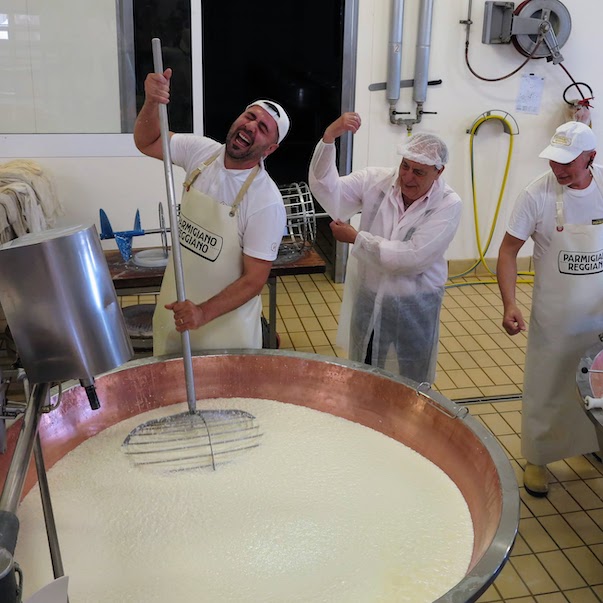
Rennet is added to curdle the milk and I watch the expert cheese makers sift the milk through their fingers to check the process. It’s a skill that a machine cannot emulate, only experience can work the magic.

When the expert decides the time is right, a large ‘whisk’, a  traditional tool called a “spino”, is used to break up the curd into smaller pieces. It’s hard work but the men cheerfully put their backs into it. This isn’t just a job, this is a labour of love.

The cauldron is heated to 55 centigrade, and the granules slowly sink to the bottom forming a single mass. After about fifty minutes the large lump that’s formed is divided into two with a  large wooden paddle and these are lifted out in muslin bags. The remaining liquid, the aromatic whey, will be sent off to feed local pigs and give us delicious Parma ham.

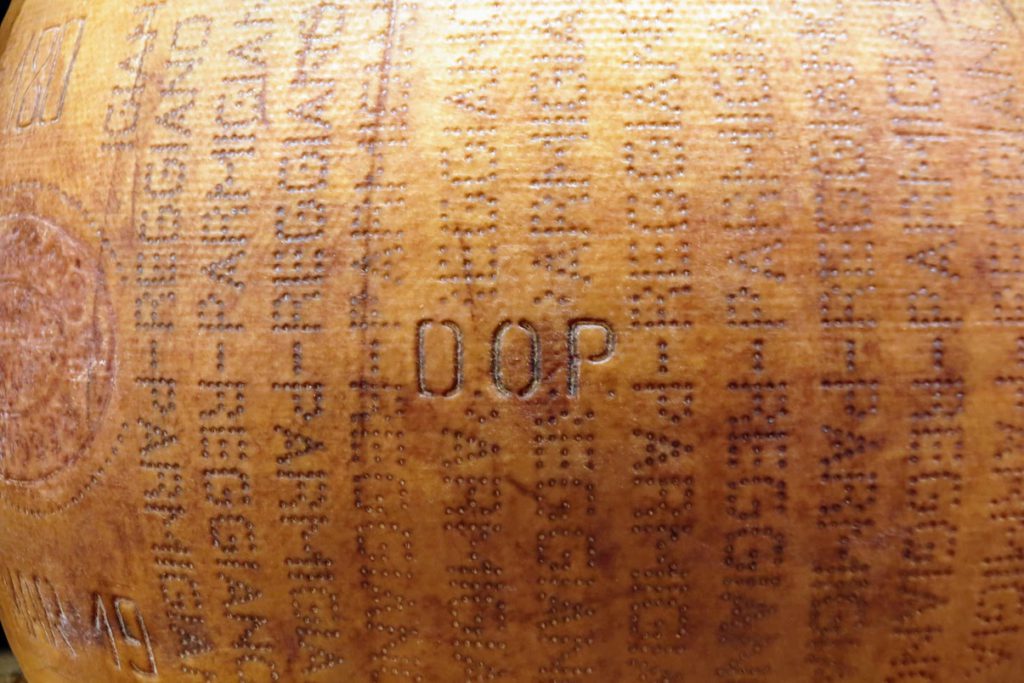
The next stage is to put each lump into the cheese moulds. These have a plastic lining embossed with all kinds of details of date, time and place, as well as a number that tells if the cheese was made in Reggio Emilia, Parma, Modena or Mantua 

This information embeds itself permanently into the rind as it forms, meaning the cheese has a ‘signature’ that’s impossible to fake or remove. Apparently though they are also experimenting with putting a microchip in the cheese to make it even easier to check provenance. As I say, there is big money in forgery and this product is so fine that the consumer has to be protected. 


The cheeses then head off for a relaxing salt bath for about three weeks. Here modern machinery is used to do the regular lifting and turning. These cheeses are very heavy at this point, being still full of moisture. In the old days it must have been very tough work.

Age is key

The cheeses once out of their briny bath are never aged for less than 12 months. At this stage the aroma is of fresh fruit, grass and flowers and the cheese is almost sliceable. After 24 months the crumbliness develops, while at 36 months spicier notes arrive. 36 months is usually the cut off point for general consumption, but some cheeses are pushed on to 48 which is a bit of a connoisseur’s cheese.

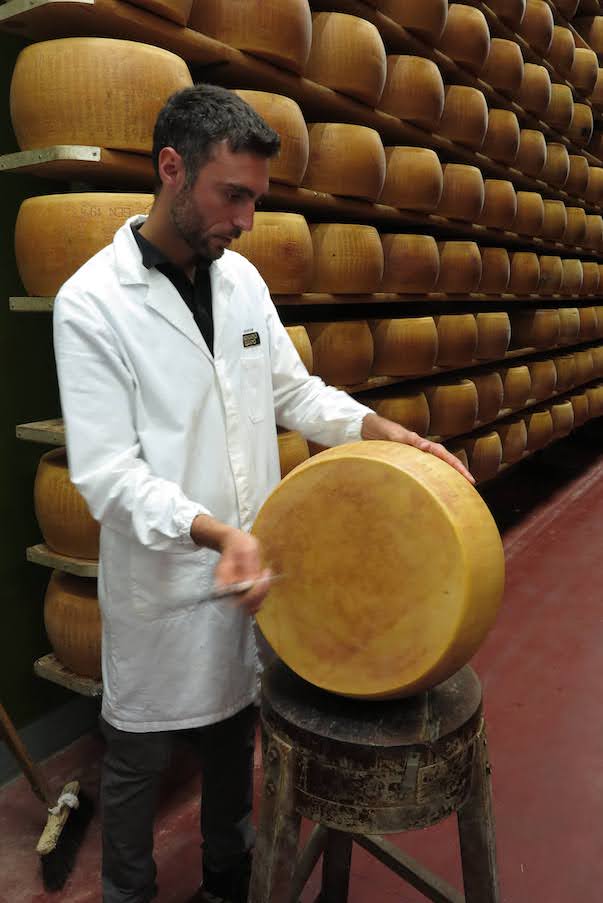
The cheeses are stored for all this time in vertiginous racks in massive temperature controlled rooms, and regularly tested by tapping them with a special hammer, as has been done down the ages.

The sound it makes is just a dull thud to my ears, but it tells the experts how well  the cheeses are maturing and any subtle tone variation will also reveal any fissures hidden inside the cheese. A fissure means the cheese, while perfectly good in every other way, must be rejected for sale as a whole cheese, the identifying rind will be removed and it will be broken up and used to make high quality ground Parmigiano Reggiano instead.

Cheese to please

The different ages result in cheeses for all occasions. The more mature being ideal for eating on their own as an aperitif, the irregular lumps really spreading the flavours onto the palate. Try some with a dab of honey and perhaps some walnuts.

Of course they are all delicious grated or shaved fresh onto salad or over pasta, but never please over seafood. Pasta with lots of butter, black pepper and grated Parmigiano Reggiano is a simple and delicious dish when made with such a quality ingredient.

It is of course delicious in a risotto, that final addition lifting all the flavours up

To keep a large block, which is a great investment, ideally wrap it in greaseproof paper, vac pack it, and put it in the fridge (never the freezer). It should be brought out to room temperature at least an hour before eating so the aromas and flavours reawaken.

If you have a large pestle and mortar then grate  Parmigiano Reggiano in, then add the best basil you can find, pine nuts, garlic and olive oil to make the very besto pesto.

So don’t just use Parmiggiano Reggiano for your spag bog! This versatile cheese has taken a long time to get to your kitchen, so take the time to make the very best of it.

#tasteofeurope #enjoyitsfromeurope #parmigianoreggiano #parmesan #euquality @parmigianoreggianouk