Sicily DOC wines are exciting, fresh and a world waiting to be explored. I visit the island to discover a new age of quality that’s all in the family.
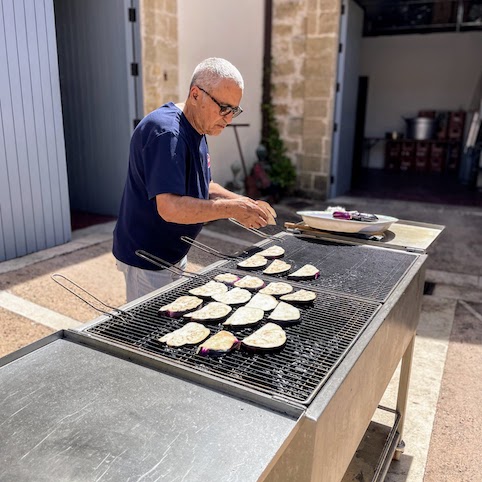
In the “baglio” or traditional central courtyard of Tonnio Baglio Ceuso, the father of the winery is frying aubergine slices and fennel sausages over glowing charcoal. The aroma is fantastic but, not speaking any Italian I can only give him a thumbs up and get one back with an accompanying grin.
Now semi-retired, he enjoys watching his descendants do most of the wine work while he offers sage advice that I’m sure is warmly welcomed, although perhaps not always, but hey, that’s families the world over.
I’m discovering a new generation of Sicilian wine makers, the sons, daughters and even great grandchildren, of the originals, who are now front and centre in Sicily, and that’s a good thing for Sicilian wine. The island’s wine scene is no longer dominated by the production of cheap, generic, wines, as it has been for so long.
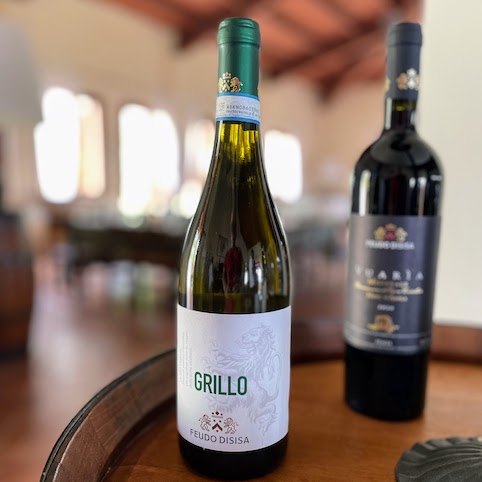
The big name red grapes such as Nero d’Avolo, Nerello Mascalese and Frappato ‘fruity’ are still king of course. Whilst for whites, Cataratto (now named Lucido, because apparently we non-Italians can’t pronounce Cataratto) can still be found across the island, and crisp, savoury Grillo (used to make Masala) is now a fine white wine all on its own. Winemakers are using these grapes to make exciting new style wines, as well as growing ‘international’ grapes such as Syrah, Merlot and Chardonnay for blending and single grape production
There is power in a union
Around 450 forward thinking Sicilian wine makers came together in 2011 to promote tradition, innovation, and quality over quantity in Sicilian wine, as well as to support each other in what can be challenging times, by creating Consorzio di Tutela Vini Sicilia DOC which now numbers 7,000 winemakers and more than 530 bottlers.
One problem they all face is climate change. A young winemaker showed me a photo taken last year of the lake that has always irrigated his vines, ‘this year,’ he said drawing with his finger, ‘this….’. He indicated an area of water so reduced it was hard to believe it was the same lake. The patches of blackened undergrowth I saw all over the island also witness the lack of rain this year and the outbreaks of devastating fires.
Positivity is the main vibe from all the winemakers I met though, even when grumbling slightly about how big UK importers are still adamant they only want cheap plonk. They are reluctant to buy the more expensive quality wines these winemakers have dedicated themselves to, but that’s changing as UK wine lovers wake up to the new Sicilian scene and its amazing options.
The island can have four different climates over a vineyard surface that’s three times that of New Zealand’s, which allows for a lot of wine variety, but all over the DOC portfolio, quality and organic farming is key.
Sicily is now the top producer of organic grapevines in Italy. By leveraging the natural climatic conditions of the island, fewer treatments are needed. One winemaker told me how he is trialling a natural insecticide derived from local cacti as a cheap and effective crop protection solution.
Don’t walk away René
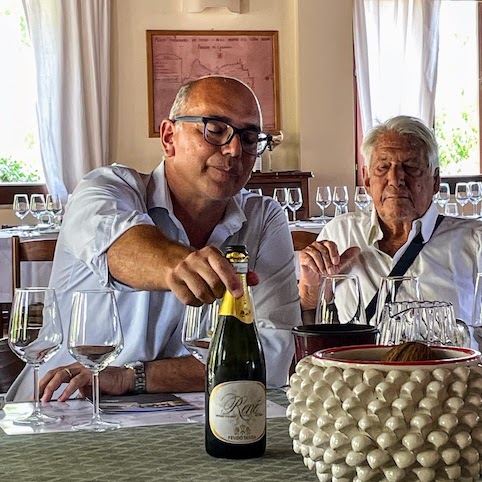
At Fuedo Diso, a fifth generation winery, the Di Lorenzo family were the first registered company to produce Chardonnay in Sicily. They’ve owned the winery, whose Baglio dates back to to the 17th Century, since around 1867, and whilst the buildings are gorgeously ancient, the equipment they use is state of the art.
Their Grillo, Chara, Nero d’Avola and Adhara wines are fresh and revitalising. Their particularly deliciously crisp Grillo is a star wine, while their sparkling wine René, named after the patriarch, comes from the oldest Chardonnay vineyard in the Feudo. As we taste through their range of wines, René is front and centre with his glass, and he’s not spitting any out. Mind you, neither am I.
Vinifying up a storm
The fresh energy at the Tola winery is also palpable. As I tasted the wines in their ultra modern building south east of Palermo, the skies darkened and the giant windows framed dramatic lightning storms over the gulf of Castellamare to the north.
The winery crackles with life – all white surfaces and sharp angles it’s run by Francesco Tola almost 400m above sea level. This makes the temperature moderate – it can actually be very cold at night – with sea breezes bringing salinity to his classic Sicilian grapes of Nero d’Avola, Syrah, Grillo, Catarratto, Insolia and Zibibbo, as well his international vines of Chardonnay, Sauvignon Blanc and Pinot Noir.
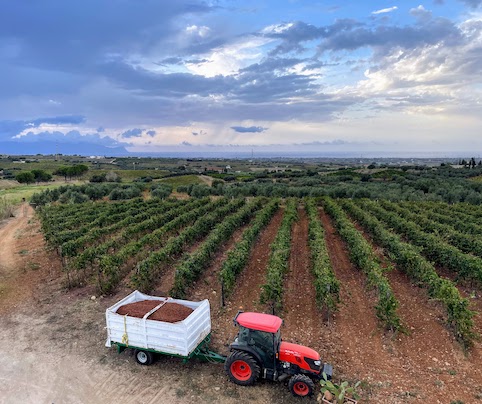
He uses steel tanks a lot, to keep the freshness of the grapes alive to produce light, zesty Nero d’Avola and, as a very modern winemaker, he is happy to use the latest machinery for efficiency, while keeping his CO2 emissions low.
Out back a machine is processing just picked grapes, blowing streams of stems into a pile to be composted. I can’t help but notice the workers here are all wearing Kippahs. ‘ Ah yes,’ says Mimmo, ‘this batch is for kosher wine and so can be only touched by Sabbath-observant Jews from the harvest to the bottling’. An interesting example of finding markets for his second division grapes.
His flagship red wine Black Label – Nero d’Avola Doc Sicilia – though is traditionally made from the best hand harvested grapes and is an intensely fruity example, while his sparkling wine, made from Catarratto and Grillo grapes, gets its fizz from the Charmat Method, where the second fermentation that gives the lovely bubbles is created by using large pressurised tanks, and not bottle ‘dosage’, as used for Champagne. This makes for wonderfully bright bright fruit flavours
Concrete Proof of change
Concrete often gets a bad rep. In the old Soviet Union it was used for shoddy buildings that fell down a lot, usually due to the ‘concrete’ being made of flour, water and potato peelings.
However for a long time proper concrete was the storage vessel of choice for winemakers – cheap, easy to clean, stable and hardwearing, it’s also slightly porous and its thickness makes the wine inside less susceptible to temperature changes or ‘shock’.
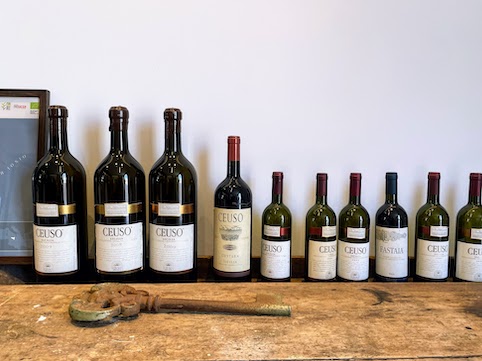
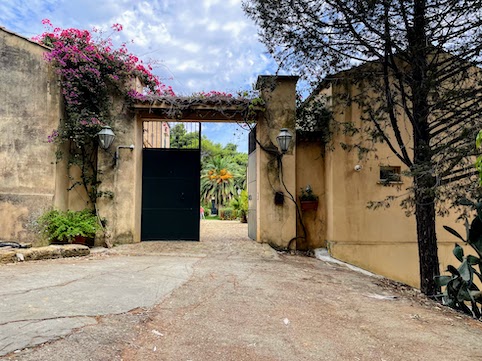
Stainless steel seduced many winemakers in the 1980s and lots of old concrete tanks were literally smashed up. Back at Tonnino Baglio Ceuso, with the aubergines eaten, I went with the chef’s daughter, Francesca, to see the usual steel vats, but also their row of concrete tanks that were still in place when they took over in 2023.
Their flagship wine Ceuso, created by enologist Giacomo Tachis in the 90s, is a modern blend of Nero d’Avola, Cabernet Sauvignon and Merlot. After fermentation, the wine is sent to mature in these old cement tanks before moving on to Seguin Moreau barrels. The result is an exceptional wine with velvet tannins and which can be aged for years in your own ‘cellar’.
They also produce a delicious dessert wine, ZIBÒ Made from their best Zibibbo grapes, it’s a reimagined Sicilian classic being fresh and balanced and not as cloying as older styles.
The variety of wines at each winery was remarkable. Innovation was everywhere and this was confirmed at a final tasting in town with twenty six producers and their wines present. It was head-spinning and not just because of the wine being drunk.
Twenty six passionate (yes, for once that word is appropriate) winemakers is a big crowd and whilst I tried to sample every wine, it was impossible. So many superb wines in one place was a remarkable one off event, and all the winemakers were lively and refreshingly young and keen. I naively asked some of them if they had ever wanted a different job from the family business and not one said ‘yes’ and no wonder.
The work is undoubtedly hard; it can be heart-breaking when a year fails to meet expectations, or an experiment with planting fails, but the joy of creating something superb cannot be beaten. Sicilia DOC wines are moving forward at pace, the bad old days are over, and their wines should be on everyone’s oenological shopping list
The sausages, by the way, were delicious!

 The Culinary Traveller