Thornbury Castle Restaurant Review

You may not eat in the same room that Henry VIII did, but you will have a royal good time

There’s a bit of a cliche around the royal meals of Olde Englande. Kings chucking well-chewed chicken legs over their shoulder, at least twenty meats on the table and the fish could include ​​conger eel and even porpoise.

These days castle meals are finer dining and the restaurant at Thornbury Castle is a restrained and elegant affair with Executive Head Chef, David Williams who recently retained the hotel’s 3 AA Rosettes with his tasting as well as his a la carte and set menus, serving up a three course menu of three dish choices for each course at £75 per person.

The setting could not be more fabulous, the beautiful castle was once the property of Edward Stafford, who built it in the 1500s but who lost it to a jealous Henry VIII. The King then stayed there on occasions with Ann Boleyn who got the chop, and not the lamb and mint sauce kind, months after her last visit.

Courtyards, stone stairs, gorgeous lounges and grand bedrooms abound in the hotel and the dining room is a cosy circular ground floor room with a massive fireplace. A place for a posh meal and suitably decked out with the sort of heavy white linen now sadly absent from many high end restaurants, presumably because of the cost of cleaning.


After drinks in the pretty Privy Garden, we found our way to the dining room and had no problems choosing from the compact set menu.

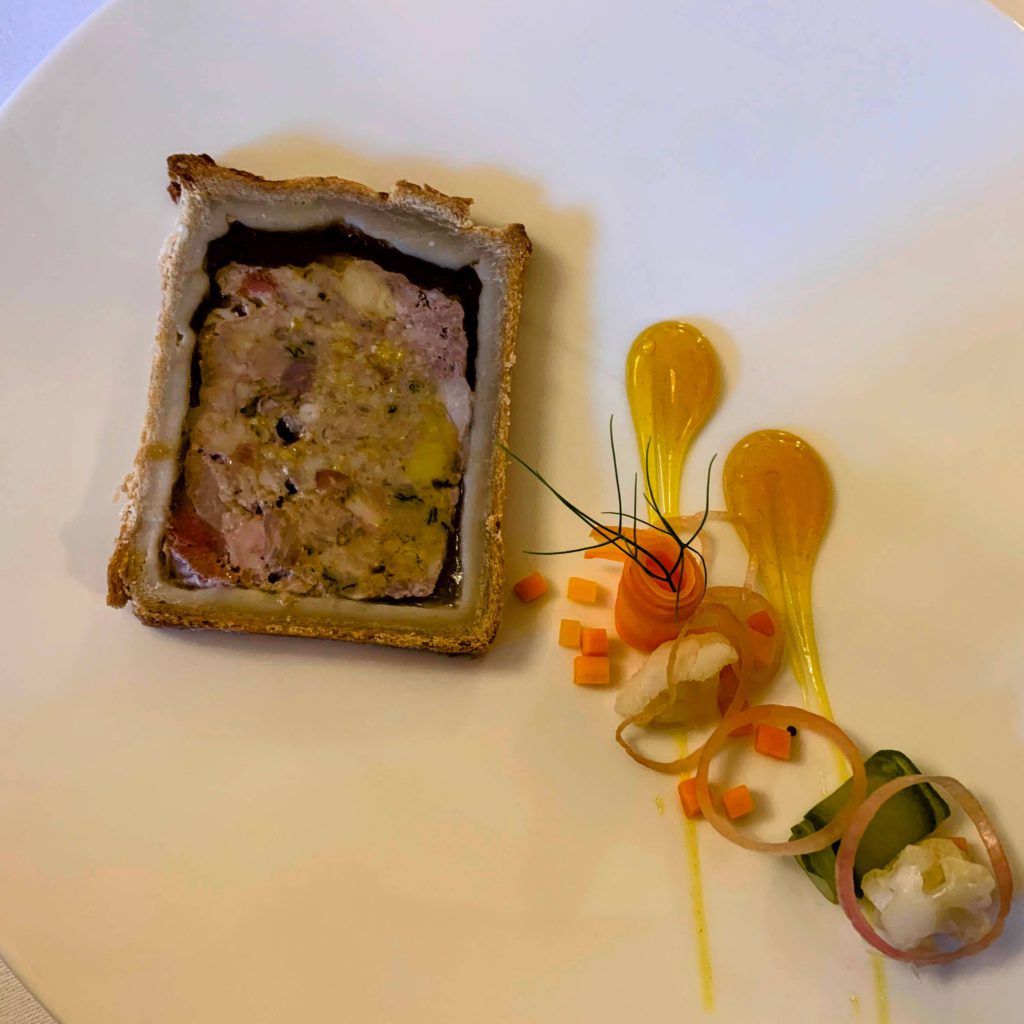
We rather like our amuse of frothy avocado and then soon settle down to some Pate En Croute with Rare Bread (sic) Pork and the hotel’s  own Piccalilli. A large walled vegetable garden in the grounds provides much of the fresh produce required by the kitchen with preserves keeping things going into the winter months.

Pate en croute is French for Game Pie (not really as there’s no hard boiled egg, but there is a family resemblance) and this has lovely pastry, very much a leading component, along with a thin layer of jelly and well-seasoned pork interior. The crisp pickle is a good foil to the meat and jelly, while the minimalism on the plate is attractive, although the lack of bulk would have had Henry VIII calling for the chef’s immediate execution. Today it’s a perfect portion.

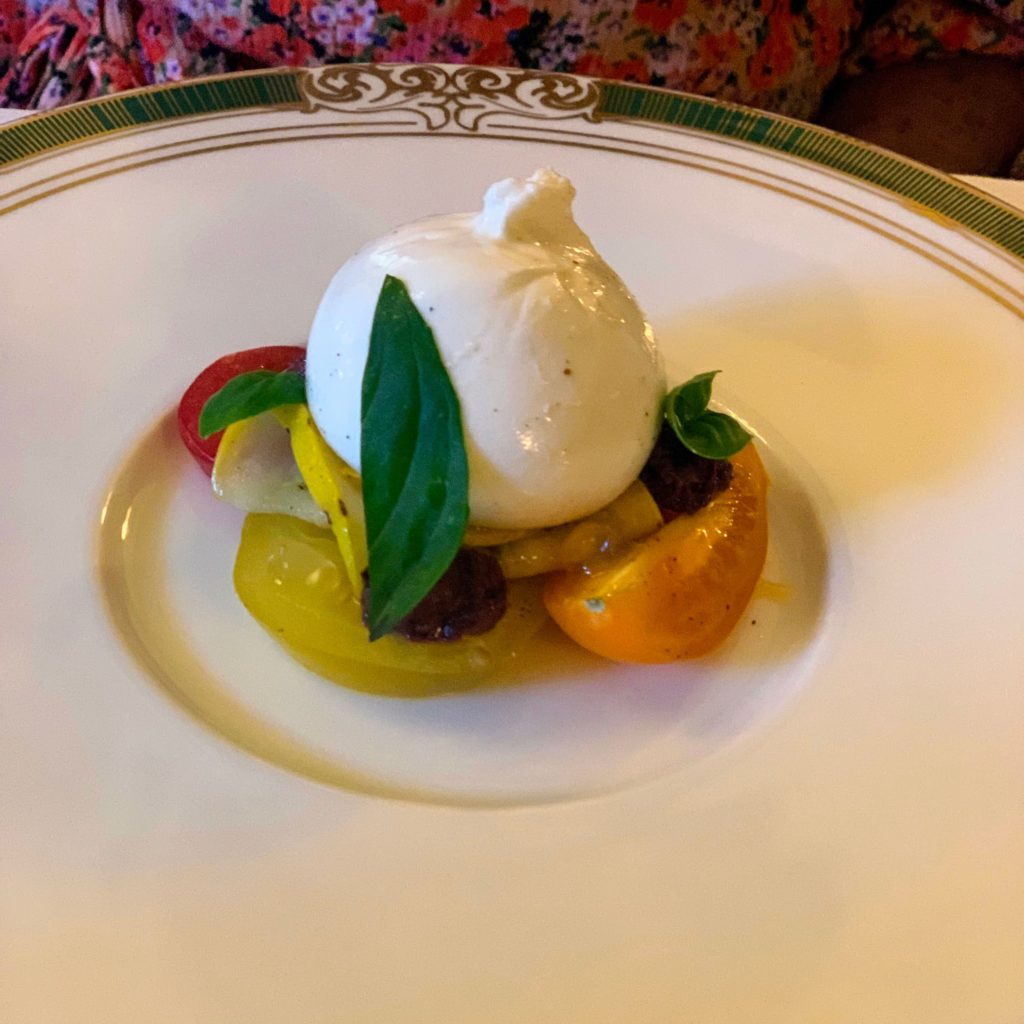
Burrata with heritage tomatoes, with balsamic vinegar and olives, always relies on excellent burrata and tomatoes with flavour and this dish scores highly. The pouch of cheese cuts open to let the creamy interior flood out and mingle with the sweetly sharp vinegar. The tomatoes are well ripened, slightly acidic as they should be and very colourful too.

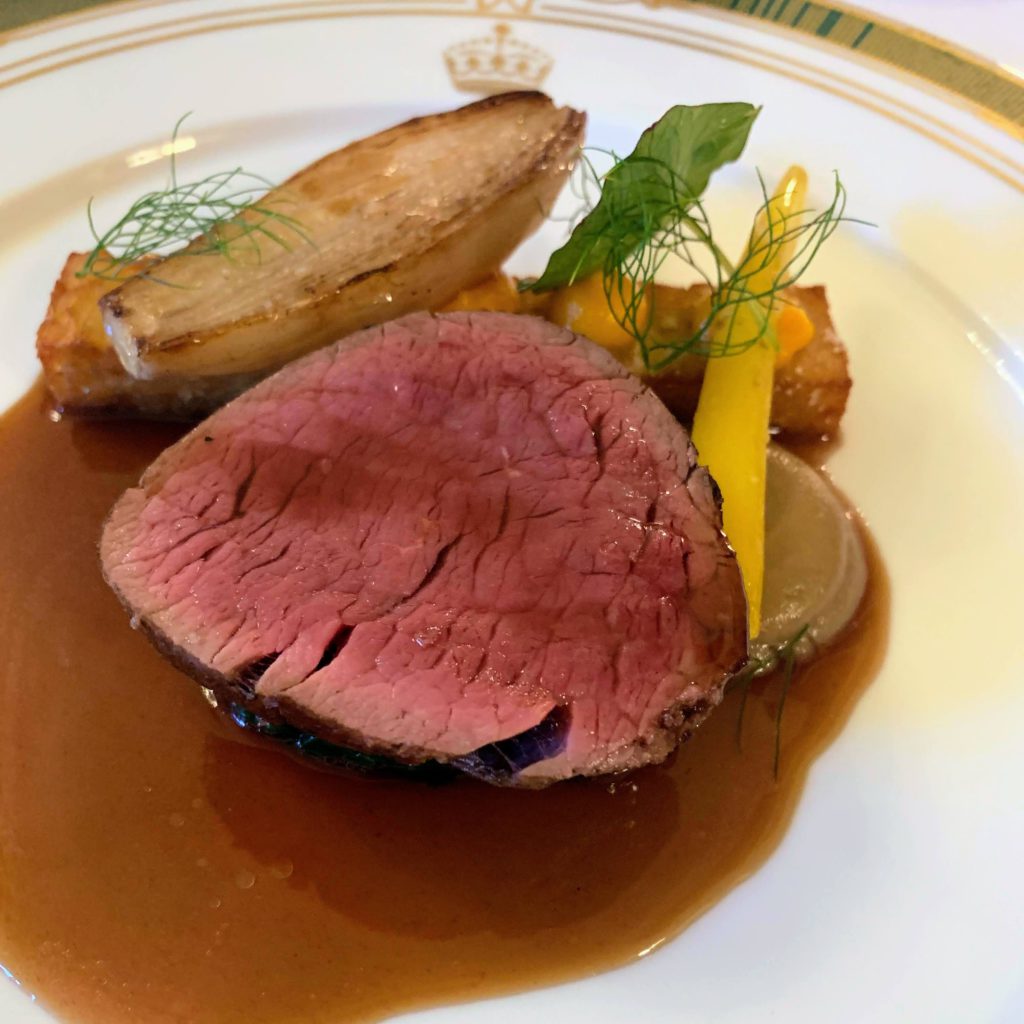
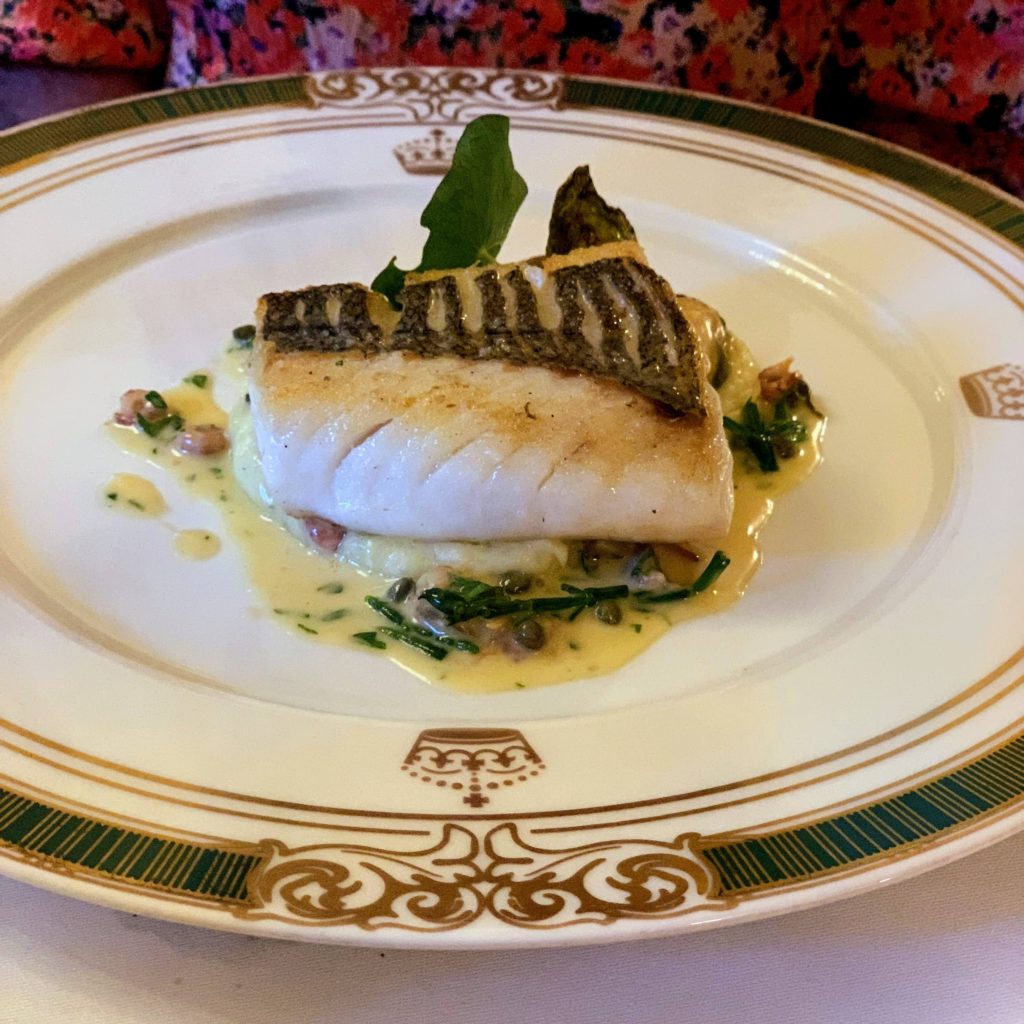
As a nod to Henry, I waive my usual rule of ‘no steak’ and have a big hunk of perfectly cooked fillet of beef accompanied by an elegant rosti, some bright carrot and tousled spinach. Across the table a rather complicated mix of hake, salt cod, clams, mussels and shrimp actually delivers simple pleasures, each element a star on its one and the combination a real winner.

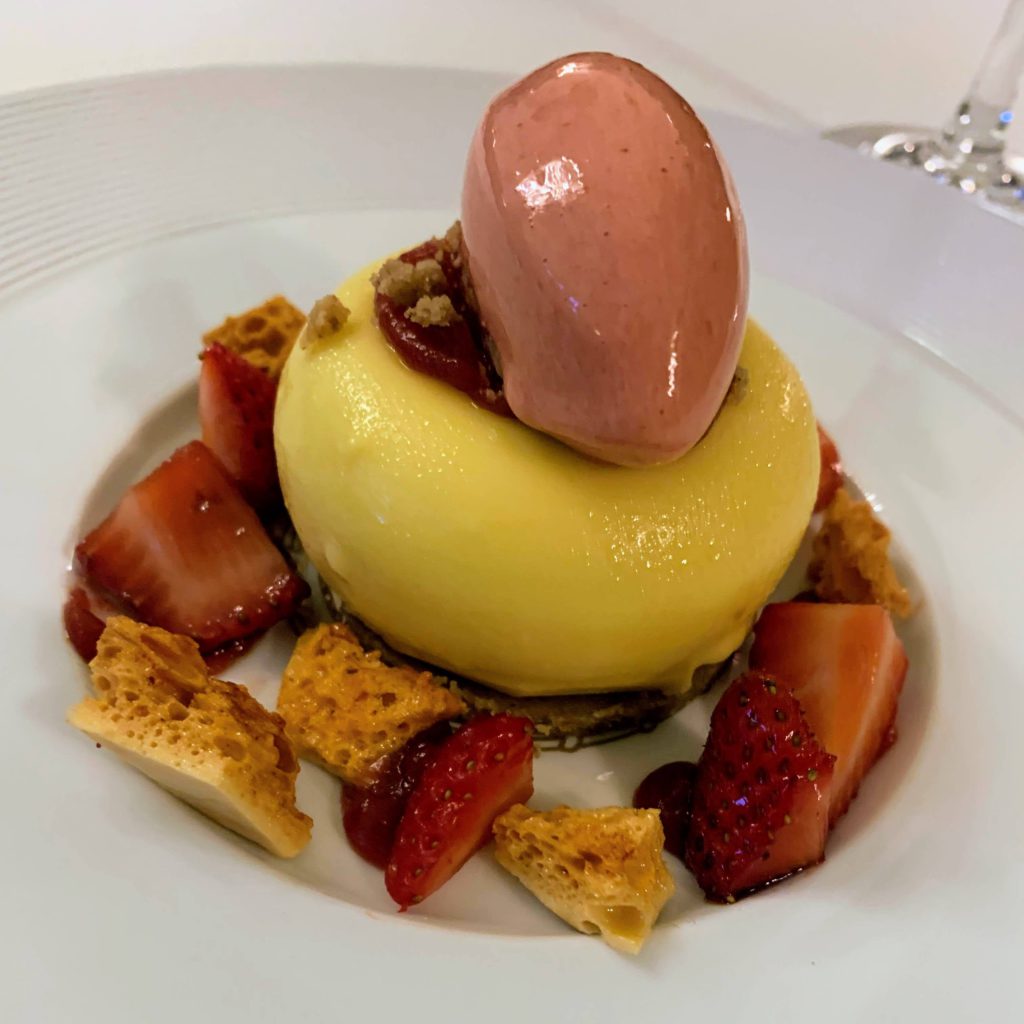
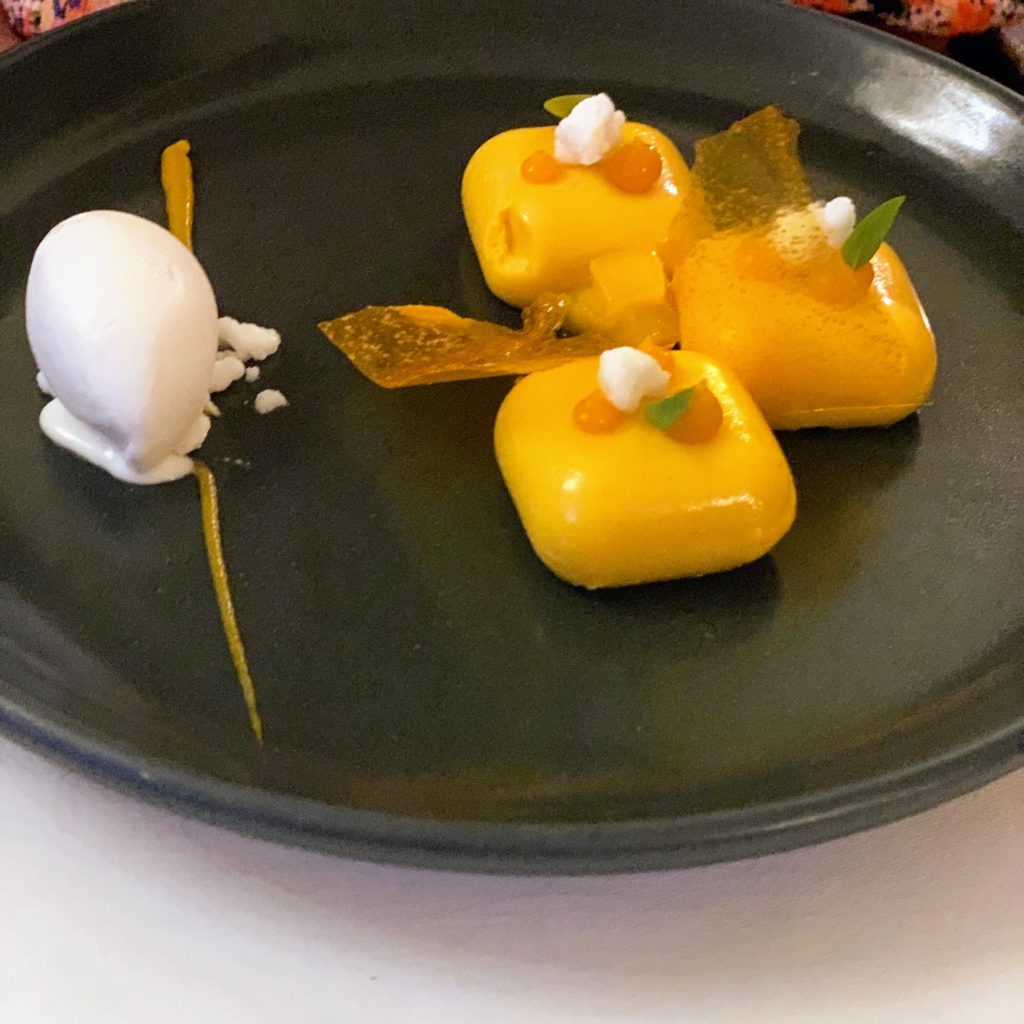
Mango cremeux with Thai basil and coconut ice cream is beautiful to look at and eat, while vanilla and strawberry cheesecake is stylish and refreshing.

Staff throughout have been conscientious without being cloying, there when needed and away when not. Over attentive waiting breaks conversations up annoyingly.

So many gorgeous hotels fail to deliver on the food front, but not Thornbury Castle. The modern food is a contrast to the ancient stones and the price is reasonable for all you get by way of atmosphere and service.

Thornbury Castle
Castle St, Thornbury
Gloucestershire, BS35 1HH
+44 (0) 1454 281 182
reception@thornburycastle.co.uk
For more information and reservations please see the website.


You Be Chef. Light Up Your BBQ Game

These boxes of deliciousness from the Isle of Wight  are just the thing to make your barbecue sing

Okay yes I know, the weather has been a bit awful. Not that it ever stops me BBQ’ing though because I have the best BBQ in the world, the Weber Kettle, and it has a lid.

In the UK we tend to refer to anything cooked over charcoal as BBQ but, to be more accurate, what we Brits tend to do is grill.


BBQ means the food is not cooking directly over the charcoal, but instead is ‘oven cooking’ with the BBQ lid on, This is what traps the delicious smoky aromas and is perfect for large pieces of meat. That lid also means you can cook in the rain. I also have a remote thermometer so I can monitor the temperature inside the meat without leaving the house. Cunning, eh?

So we got ready to cook with one eye on the sky and the lid at the ready.

You Be Chef comes from the Isle of Wight, via chef Robert Thompson. Not only does he have an MBE, but he also won a Michelin star in 2007.

Robert is a champion of Isle of Wight produce, and is a big part of the Island’s food scene. His idea was to take the island’s produce, write recipes around it, and send the food and instructions all over the UK.

Our trial chilled box arrived on the hottest day of the year (so far) and was thoughtfully left on the front doorstep, in the blazing sun, by a delivery driver who obviously didn’t think it was worth ringing our bell.

Luckily he did at least send me a text and so I was able to call my wife to rescue the parcel before it melted away, or became victim to our local ‘porch pirates’. They will pinch anything round here, even though they have no idea what it is they’re nicking.

Unboxing was fun, each panel revealing a message, and it was good to see most of the items were in recyclable packs, some sort of cardboard material. 

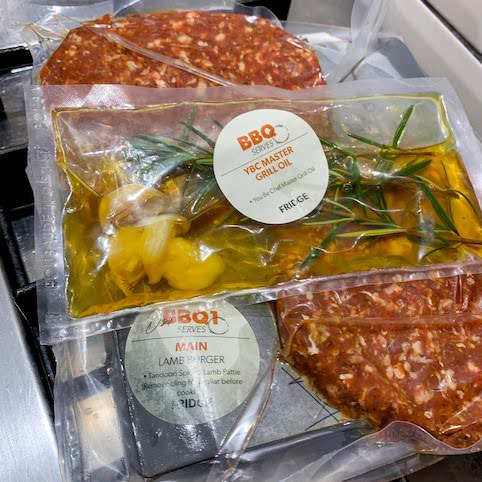
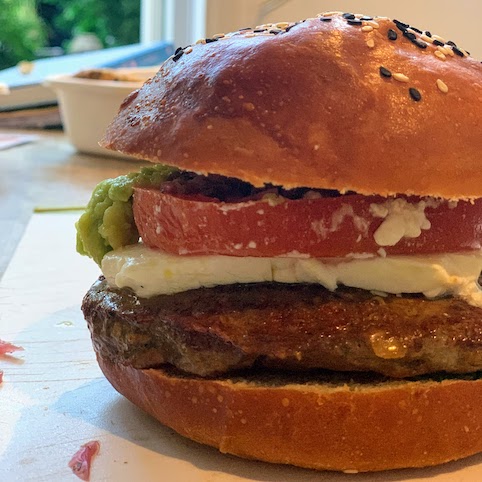
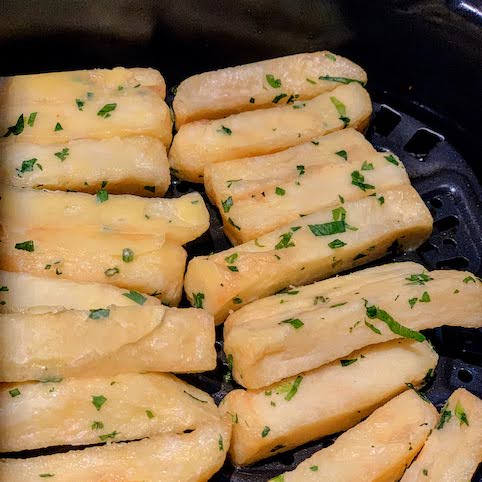
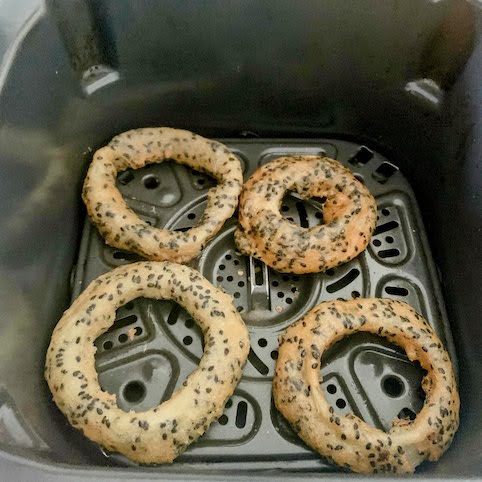
We had the Tandoori Lamb Burger for two. So we had the burgers (natch), and then in various packs – Sesame Challah Buns,  Pont Neuf Potatoes with Garlic and Flat Parsley Butter; Onion Rings – Fried in Curious IPA Beer Batter with Black Onion Seeds; Rose Harissa Hummus; and Crushed Avocado with Lime, Beef Tomato slices, Feta, and Baby Gem Lettuce. Oh and there was Red Onion, Mint and Lime Salad and flavoured grilling oil.

It all appeared good, but for the lettuce leaves, which clearly had not enjoyed their journey and were rather limp and tired looking.

Juggling the oven times for the chips and the onion rings was a bit tricky. After some thought we cooked the rings first in our brilliant Ninja Foodie,  then took them out and kept them warm while we cooked the chips, then we put the rings back on top for the final minutes to get them hot again.

The burgers were a large diameter, I had my doubts they would fit in the buns, but once cooked they became the right size.

Now I am no chef, but I was surprised when the instructions said to give the burgers six minutes a side. I was so doubtful, that after rubbing them with the supplied grill oil,  I only gave them three minutes a side, after which time my trusty Thermapen read 62C in the centre, which is just right. I suspect there may be a typo in the instructions and it really means six minutes in total.

We added, as per instructions, the feta to the top of the meat for the last minute to warm it up, then split our buns (ooo err madam) toasted them lightly, and put the lettuce on the bottom (it’s important to ‘waterproof’ the bun from the juices), then added all the other ingredients to create an impressively stacked burger.


I’m a survivor of the burger craze which swept social media a few years back, ending only when the biggest influencers realised they were killing themselves eating so many monster burgers a week and gave up, so I know what to look for and this burger was perfect.

It had size, but with heavy pressure it was compressed to be eatable. And very good it was too, with the lamb superbly juicy and spicy. The other ingredients all added to the pleasure, particularly the salty feta and the limey avocado. The buns were a bit sweet for me, but fine.

The Red Onion, Mint and Lime Salad was rather like shredded pickled onion, no bad thing and mint is always an ideal partner for lamb.

The onion rings were crunchy and also sweet. We liked them a lot, but couldn’t eat all eight, and the chips were excellent, although dangerously hot inside so we had to leave them to cool for a bit. They were great dipped into the hummus, which was not as spicy as feared.

It really was a great BBQ blow out. Having everything ready made was a game changer and made it all so easy. And it didn’t rain.

Order your boxes at www.youbechef.com

Jamie Oliver Catherine Street Review

Jamie is all over the place, but his restaurants no longer are. I try a recent new one in the company of some actors

To be honest, I am not actually at the same table as the actors, but next door is a Very Well Known TV Actress and an equally Very Well Known TV Chef, plus some other people I vaguely recognise.

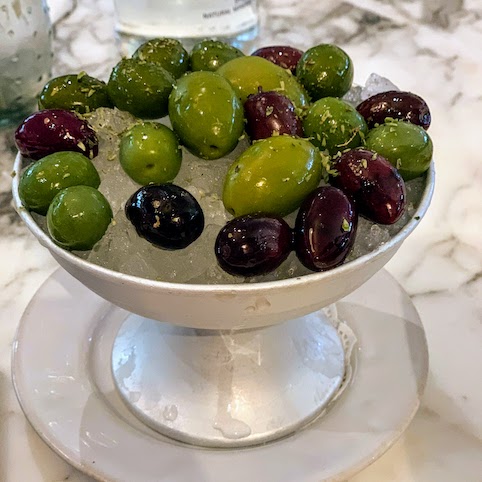
As I wait for my wingperson to turn up, while grazing a mix of olives dusted in oregano and  served, rather unusually, on ice, I also try to keep my own cool. Nonetheless when I momentarily glance over She looks up at the same time and our eyes meet. ‘ Big fan’, my eyes say, ‘Oh God, a stalker!’ say hers.

You’d expect to find actors in here for lunch though  as it adjoins the back of the Theatre Royal. A space between the buildings is now roofed over to create a spacious and airy mini dining atrium, so thesps only have to walk a few yards for a meal.


We are eating inside today though, in what was once the ground floor of an office block, not that you’d ever know it after a splendid refurb. The place has a Grand Cafe kind of buzz to it; classy without being snobby.

There are trendy artworks on the wall, classic old photos, unusual lighting, comfy banquettes plus Sade on the sound system. Apart from the latter it could almost be a Jeremy King joint, another restaurateur who has had his ups and downs.

It’s family friendly;  there are kids here and a kids’ menu. The seasonally changing menu itself is a one sided affair, colourful but disposable, it tells diners this is easy-eating. A two- or three-course set menu is available Monday–Saturday from 12–6pm, Sundays offer roasts with all the trimmings. 

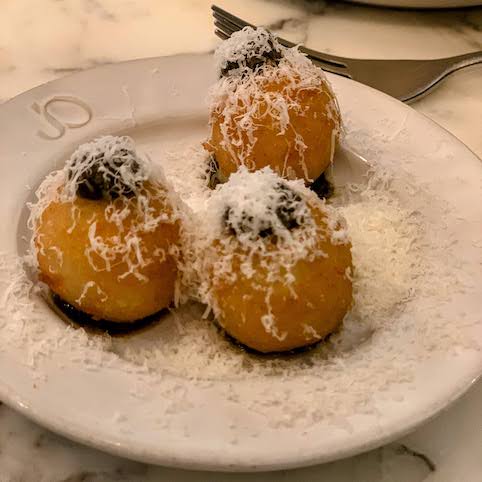
Apart from the icy olives there are other nibbles on offer.  Now that S has finally arrived  we try croquettes made with pureed Mrs Kirkham’s Lancashire cheese with leeks, and dobbed on top with pickled walnuts and they are one-bite tasty, the cheese gooey and sharp. Shame they are served in threes though and not twos or fours.

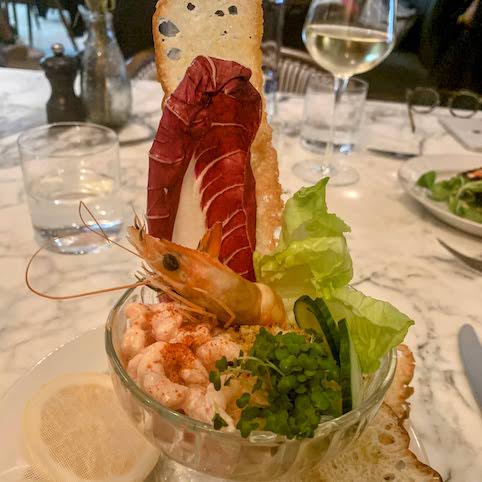
Jamie has said the food’s inspired by what he grew up eating at his parents’ pub, which explains the prawn cocktail on the menu, although it’s a bit more than that – it’s a seafood cocktail with British crab, brown shrimp, prawns, yuzu cucumber, Marie Rose sauce (natch) and focaccia crisps


It’s an impressive dish, the focaccia crisps are large sails powering the dish towards me. The prawns are a bit watery, the rest is good, especially the crab. I’d have liked some more Marie Rose sauce, my mother used to always sink our family Prawn Cocktails in the stuff and I used to also surreptitiously eat it out of the jar.

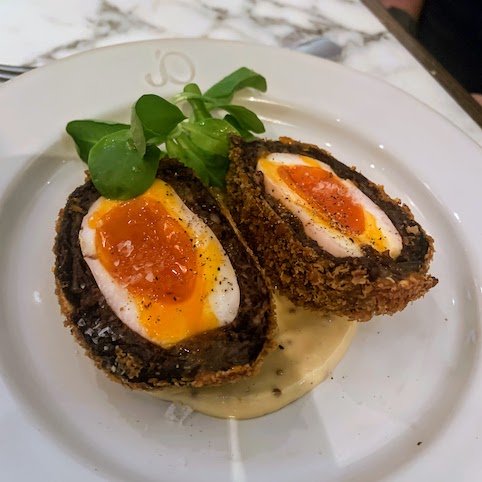
Mr Forty Minutes Late For Lunch has a Scotch Egg made with Stornoway Black Pudding, a Cacklebean egg and mustard mayo. It’s the sort of thing we ate a lot of in the late 80s and 90s, a Gastropub thing, and he reports it’s fine but not overly exciting. It’s a well-golden egg though and it is cooked perfectly.

The menu is full of Jamie’s other culinary memories and I recognise a few pasta dishes from the old BBC Executive Canteen, better known as the River Café, and some from legendary Fifteen as well. I go for the Dayboat Fish though, which today is Stone Bass, (or ‘Wreckfish’ or ‘Meagre’ ). A fish normally farmed and not caught, it comes swimming in a lake of “Champagne Cream Sauce, Dulse, Royal Kombu, Green Peppercorns, Herb Oil”. 

It’s a chunky fish, not quite as good as Sea Bass but firm and white and generously sized. The sauce is excellent, but it needs a spoon (or even a straw) to eat it. I instead use my ‘Koffman’s fries’ to blot it up. Good fries, but they needed more salt IMHO

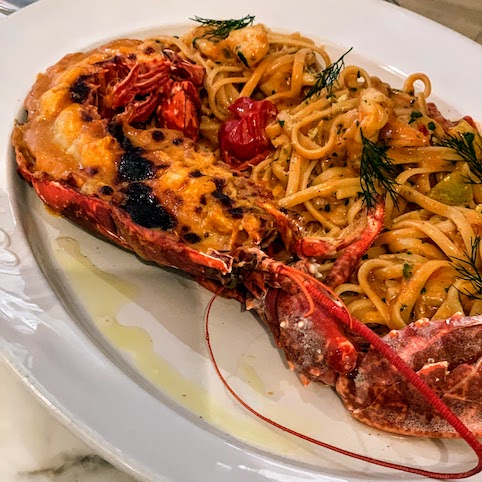
Also a day special is a whole split lobster with linguine and tomatoes. A big plateful, it rather intimidates S who finally has to admit defeat trying to eat it all. The pasta has absorbed lots of good juices from the tomato and shellfish, but it also makes it rather heavy going. He doesn’t regret trying though, it was a good lobster.

We’re drinking Pale Ale made by one of Jamie’s ‘mates’ in Walthamstow. Unlike most hipster ales it hasn’t gone overboard with the hops, so it doesn’t taste like drain cleaner. I like it so much I have two.

S is still suffering from lobster overload, so I have dessert alone, a rather nostalgic Jelly & Ice Cream, although this is very grown up jelly. Made with Provence Rosé, it wobbles like Keir Starmer being asked what a woman is, and raspberry and vanilla ice cream and summer berries finish it off. Really enjoyable.

This new Jamie puts bad memories of his Italians to bed, although there is a sense that the kitchen is being run by people doing a professional job and not a passionate one. With a menu that is obliged to cover all bases, from pasta to burgers, seafood to grills, that is perhaps not surprising though.

It’s certainly an excellent space and the food is highly competent, although the prices are somewhat higher than you might expect. The staff are charming, all commiserating with me as I waited and waited and waited for my guest to finally turn up.

And you may even get the chance to freak out a famous actress. What’s not to like?

6 Catherine St Covent Garden London WC2B 5JY
www.jamieolivercatherinest.com

Opening Times: Sunday to Wednesday: 12:00 – 10:30PM Thursday to Saturday: 12:00 – 11:00PM

Telephone: +44 (0) 20 3084 7565

Reservations: reservations@jamieolivercatherinest.com

When is a cow not a cow? When it’s a Txuleton

Before I begin, I assume none of you lovely readers are vegans or vegetarians? If so, you might want to stop reading now.

I myself eat meat, but not a lot. So, when I do eat it, I want something special.

Txuleton is that something special.Txuleton, or rib, steak usually comes from the Rubia Gallega cow.

It’s a cow from North West Spain that can be as old as 18 years before being turned into steaks.In the Basque country old dairy cows are used.

That is pretty old. I mean in the UK beef is usually slaughtered before the cow gets to three years.

Normally dairy cows past their milking prime are disposed of, but in the Basque country they are fattened up for eating.

So why are old cows so good?‘

Well’, says Sagardi Shoreditch’s meat selector Imanol Jaca, ‘it’s because mature muscle and fat tastes better and myoglobin in the muscles means a redder meat’.

Continue reading

Catching Up With Hastings Fish

Nick heads down to Hastings to do a bit of fishing for Xmas recipes and discover more about fish

Hastings sea front

Storm be a brewing

The wind and rain are lashing the Stade on Hastings’ seafront by the Old Town, with people being almost bowled over as they move between the ancient black net sheds and the spanking new Jerwood art gallery on the beach.

I have my head firmly down and my coat wrapped tight around me, my glasses are so covered in moisture that when I do look up it’s like being in a blurred psychedelic light show. Where am I? I ask in desperation, to no one in particular.

A passer by takes pity and directs me to my destination, the Classroom on the Coast on the Stade. Pushing open the heavy door and sliding inside I’m suddenly out of the elements and I feel as happy as a fisherman who’s managed to get below deck in a Force 10.

Which is apt as there is an old fisherman waiting inside; John ‘Tush’ Hamilton is one of the last of the Hastings fish ‘hawkers’. Continue reading

Going out for a beer, or several, in Slovenia

There’s a burgeoning beer scene in Slovenia and some wonderful scenery too. Nick sees if something can successfully be organised in a brewery.


The men in the ‘pub’ of the Union Brewery in Ljubljana are in fine voice tonight. As a woman cranks rousing tunes out of an accordion that’s almost as big as she is, they roar out the choruses whilst waving mugs of beer to the beat.

It’s all sung in Slovenian of course, so I have no idea what the words mean, but I’m happy to raise my own glass and cheer loudly at the end of each song. The conviviality meter has gone off the scale here in this packed bar/restaurant.

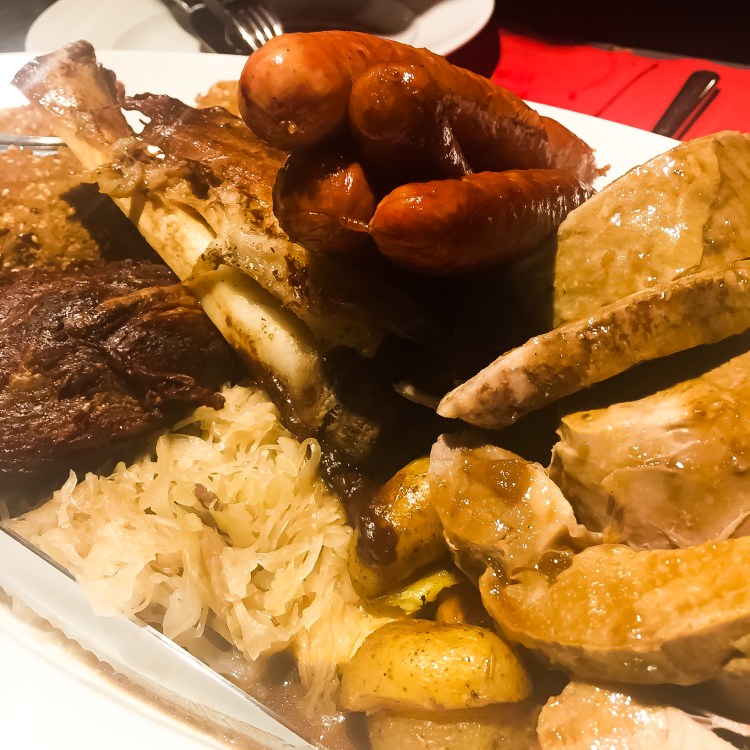
Also off the scale is the platter of meat in front of me featuring slabs of pork, tangles of spicy sausages, juicy spare ribs and more all piled onto sauerkraut and baked potatoes. Continue reading

Sun, sea and sustainability in Ibiza

Known for its club culture, there’s also a different beat in Ibiza, one that’s all about sustainability, Zero Kilometre sourcing and the rise of the female chef.

A wild and lonely place

‘Skreeeeek, skreeek, skreeek’, I’m watching a man laboriously pull in his fishing net by hand. His small ancient local boat, called a Llaut, is bobbing about on the water between Ibiza and its smaller neighbour, Formentera. The net, all 5km of it is being slowly retrieved using a large wheel as a capstan. It’s badly in need of some WD40, hence the ‘fingernails down blackboard’ noise it’s making.
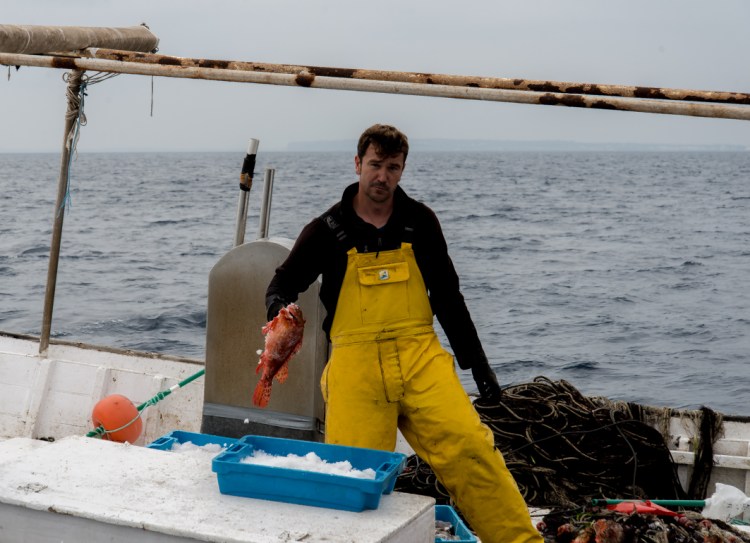
Not a large catch

Every now and then the fisherman bends down to retrieve a fish from his net. If it’s too small, it goes back over the side otherwise it goes into the cold box. His nets are only left out for an hour each time to avoid any chance of the fish being crushed to death when the haul is good.

As a method of fishing it’s old and ineffective, but that’s the point. The fishermen of Ibiza have embraced the need for sustainability.
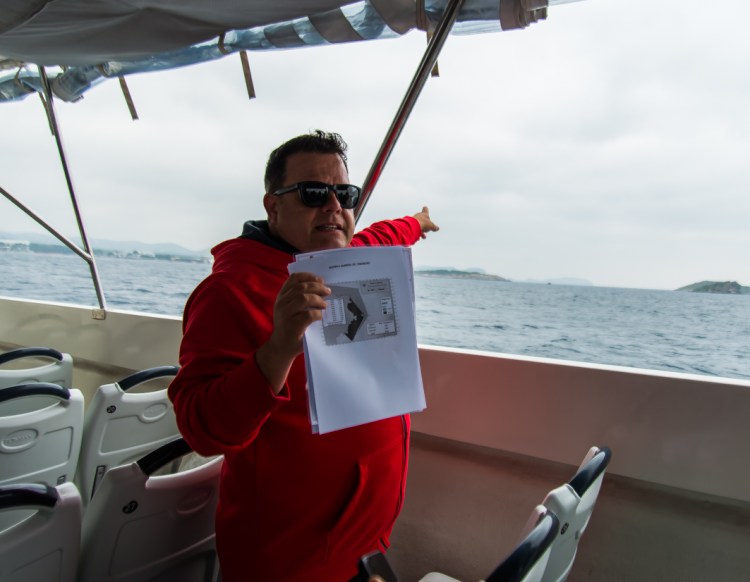
You can fish over there!

On our boat, Pere Valera who heads the Ibizan Fishermen Guild, pulls out a chart and shows me where in the local waters large scale trawl fishing can take place, where it has to be done only in this old style and where it is totally banned so that the fish can breed in peace. This last area is Es Freus Marine Reserve of Ibiza and Formentera, which was set up in 1999.

It takes in the far south of Ibiza, the north, the west coast of Formentera and the space that separates them with a total area of 13,617 marine hectares, making it the second largest protected marine area in the Spanish Mediterranean.

Back on shore, at the Guild headquarters where all fish are processed, he shows me some more of how the system works. The fisherman all signed up in 2008 to an initiative called Peix Nostrum – Our Fish.
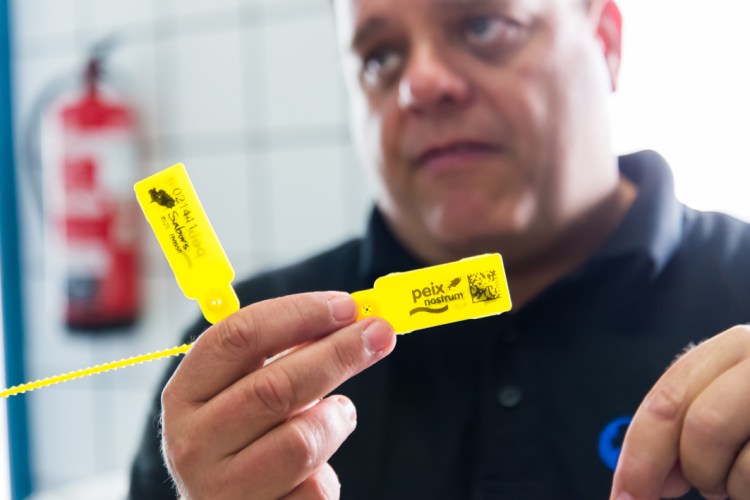
Bagged and tagged

Under this ‘brand’ bright yellow tags are clipped to each fish and lobster and these must remain attached all the way to the market, and the fish must arrive within four hours of being caught.

The tag gives information on where the fish was caught, precisely when it was caught and by whom, as well as guaranteeing it has been processed correctly.
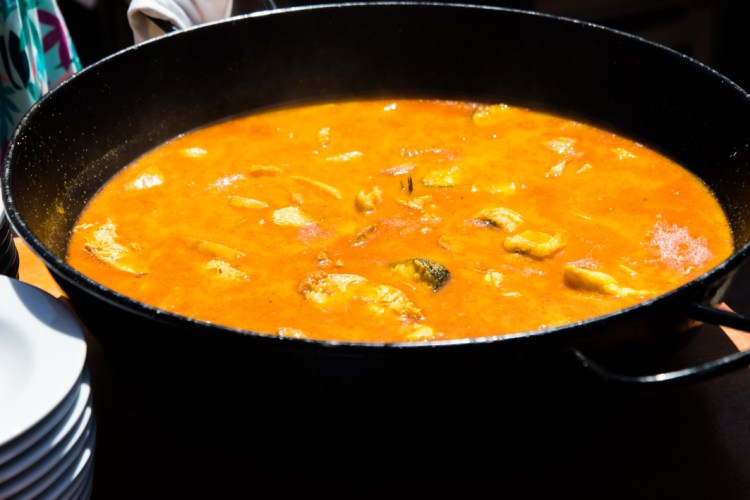
Bullet de Peix

This means that every restaurant on the island can be confident its fish has been supplied in a sustainable manner. And that matters, both to the chefs and to their customers. Everyone loves the local fish stew Bullit de Peix and they want to know it’s been made with care.

‘None of the fishermen in Peix Nostrum wants to empty the sea,’ Pere says, waving a fish about. ‘We want fishing to continue for our children and grandchildren, so we only catch reasonable amounts of fish and shellfish. And it works. We’re the only part of the Mediterranean where the lobster is not disappearing, for example.
Eco and very friendly

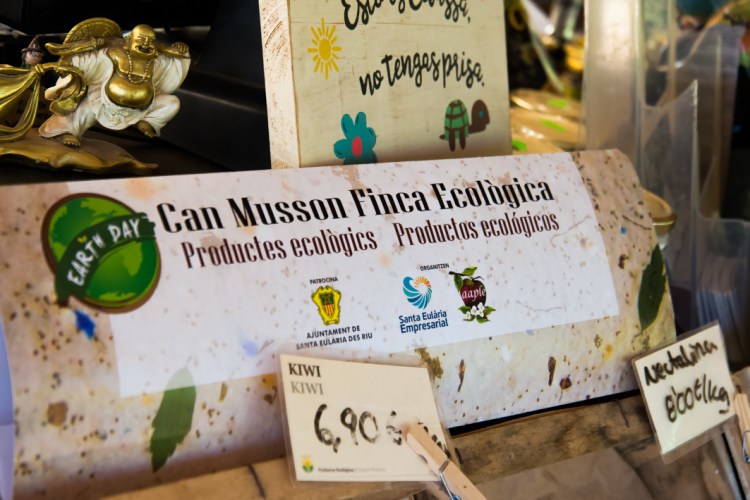
Back on dry land to the west of the town of Santa Eulalia Del Rio, is Can Musón. Founder and driving force María Marí Colomar was about to retire from her work as a fashion designer when she was horrified to find a local child, when asked to draw a chicken, drew a box instead.

So, she picked up a spade and not a pen and created a wonderful place to teach the upcoming generations the importance of sustainability of local produce and of rare breeds.

Mari

Here on her 65,000 sq. eco farm she grows organic fruit and vegetables in profusion, as well as many herbs too. She also raises rabbits, pigs and goats, most of them local breeds that need protecting from dying out.

The produce is all sold out the front from a large market stall, as well as served in the simple but delicious cafe. This area is discreetly wealthy with plenty of expat and second-home Brits around. They have a very Notting Hill vibe about them, with the women drifting about in floaty boho dresses and hats, all topped off with subtle designer sunglasses.

They help keep the farm paid for, its main purpose being to educate the children who come out on regular trips to the farm school – S’al lot Verd (it means ‘the green youngster’ in Catalan), to see where food comes from and to be schooled in the need for sustainability.

A digestif

Mari puts me to work making a bottle of Hierbas, the local post-meal stomach calmer. Into a bottle of spirit go 21 fresh herbs from the farm, these will then steep for as long as possible to bring all manner of complex flavours and remedial qualities to the drink.

I screw the top on tight and hope baggage handling doesn’t turn the Hierbas into a big mess in my suitcase. That would really give me an upset stomach.

Zero Km sourcing is big with Ibizan restaurants. The closer the produce is to the plate, the better. Not just for the taste of course, but also for the freshness and the fact that no transport but Shank’s Pony is needed, which cuts helps pollution on the White Island.

People who cook in glass houses

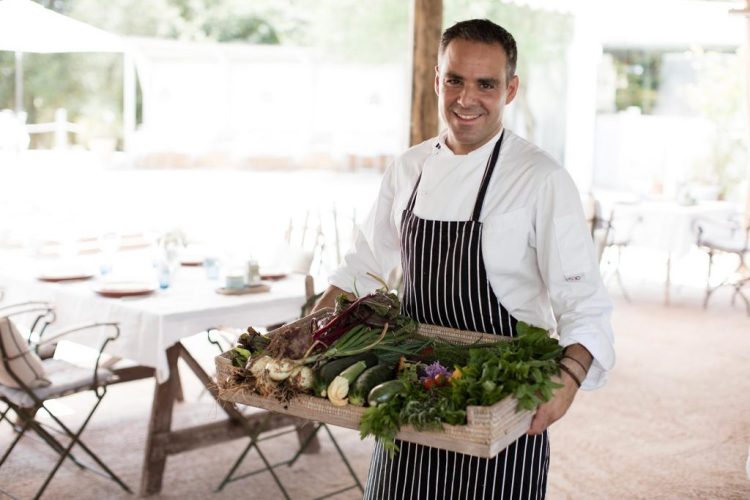
At Can Domo restaurant, a beautiful Agroturismo hotel and restaurant created from a 17th Century hilltop farm by a husband and wife team and located up an axle-breaking dirt road in the north of the island, 18 km from Ibiza town, they have over 600 olive trees surrounding them. Arbequina olive trees and Picual olive trees are all tended organically to produce the award-winning fruity, floral oils they use to cook with and also sell.
A chef and his produce

They also have a vegetable plot that produces almost all chef Pau Barba needs to create his stunning dishes for his farm-to-table restaurant located in a glass-walled room across from his semi open-air kitchen. He cooks and his wife takes care of the design and running of the hotel with its 8 rustic-chic individually decorated rooms in whitewashed stone outbuildings

The wine served is from Ibiza; ‘of course’ you might say, but in fact it’s something you’d not have said twenty or so years ago because Ibiza just didn’t make wine then. Today though the island has around seven wine producers and one of the most successful is Can Rich.

Earthy goodness

Since starting up in 1997, Can Rich now produce only organic wines, and were one of the first people to make wine in Ibiza since the Phoenicians left about 2000 years ago.

Can Rich, like all Ibizan wines, differs from other Spanish wines. The almost non-stop continual sunshine of Ibiza means the red Monastrell grapes can be harvested earlier and so escape the full blasting heat of summer, and there are minerals in the grapes unique to the island, all characteristics which come out on the nose and the palate.

Monastrell produces a very earthy, vegetal smelling wine. I thought my wine was corked when first served it, but soon grew to love it and drank little else after.
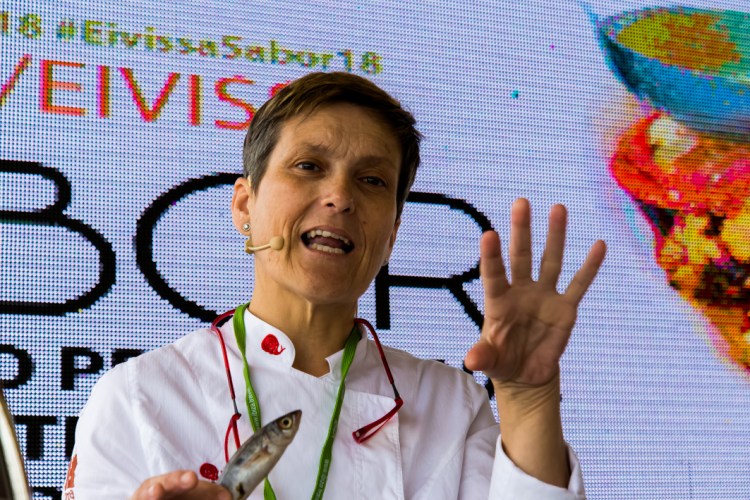
Chef Sílvia Anglada

The sun is beating down at Club Nautic Sant Antoni and Ibiza Sabor 2018 is under way and packed with chefs, trainee chefs, suppliers and press. I can see Pere who waves cheerfully as well various other chefs I’ve met over the past few days.
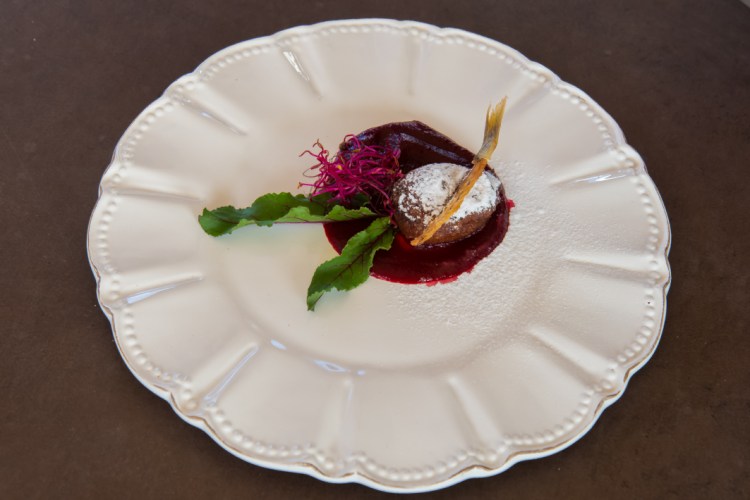
A beetroot donut

It’s very much focused on sustainability and has a focus too on female chefs. Sílvia Anglada of restaurant Es Tast de na Sílvia, in Ciutadella, Minorca runs her restaurant on strict eco lines and demonstrates one of her signature dishes, a kind of cheese doughnut with a beetroot jam

Coca bread topped with roasted tomatoes

She’s followed by Marga Coll from restaurant Miceli, in Majorca who tells us her restaurant never has a fixed menu and is driven entirely by what she finds in the morning market. As she talks she creates a dish of coca bread topped with roasted tomatoes, dried fish and cheese from Can Caus an artisan producer.

Not your average Mr Whippy

Alejandra Rivas runs Gelateria Rocambolesc, a project of the Roca brothers of El Celler de Can Roca fame, and she is married to Jordi Roca. Her demonstration of novel ways with ice-cream, both sweet and salty, was refreshing and it’s easy to see why she now has four gelaterias in Spain.
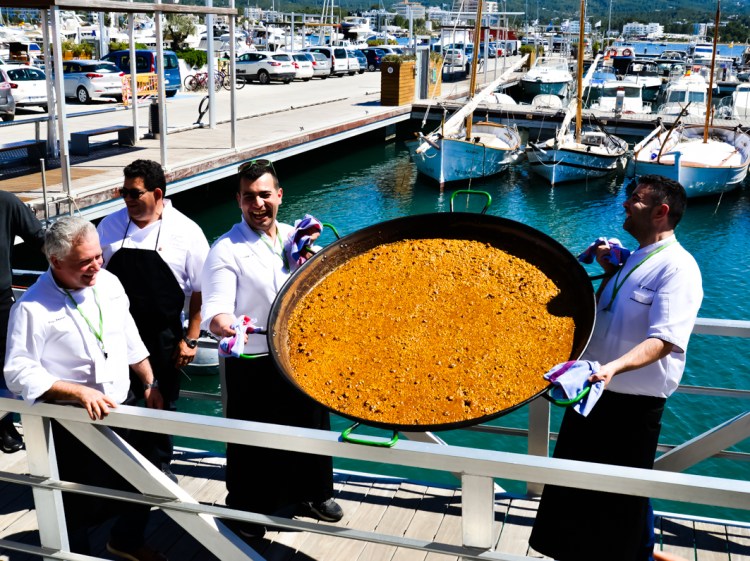
Paella all round

Lunch, of 12 courses, each prepared by one of the chefs, was a triumphant celebration of the Balearic produce, the passion for sustainability and the talent of the islands’ chefs. The giant paella finally served was the icing on the cake,

If you’ve been putting off going to Ibiza because you don’t dance that much anymore, think again. That side of the island is one very small part of what it does, so pack a knife and fork and leave the glowsticks at home.

Our thanks to my hosts Ibiza Travel and to all the marvellous chefs and producers of the White Island who work so hard every day.

Can Domo images sourced from their website
Delta Force

The eco-conscious Ebre Delta in Tarragona is unlike any other part of Spain. I took a few days to explore the rice, the food, the wine and even the sake.

DSC_6624

Paella is taken very seriously in the paddy fields

‘In a few square kilometres, I can find everything I need to eat,’ says local legend Senor Polet, as his friend stirs an enormous paella in the kitchen.

Outside the ancient house, a barraca style that’s typical of the area, the paddyfields of the Ebre Delta stretch away, stopping only at the base of the distant mountains in one direction and the nearby Mediterranean sea in the other. Continue reading

The Unbeatable Barley of Holkham

Barley is indispensable to brewing and for the best brews only the best barley will do. Nick visits the Earl of Leicester’s Holkham Estate to see how they grow the finest barley for the varied beers of Marston’s Brewery.

Holkham Hall

Holkham Hall. Palladian Perfection

‘We listen out for geese at night, you wake up sweating’. Holkham Farm Manager James Beamish is telling me in his wonderful Norfolk accent how natural predators such as geese can undo months of work. The flying pests can eat a lot of barley and in a very short time.

It’s a natural hazard they have to deal with at Holkham, the massive estate of the Earl of Leicester made up of 10,000 hectares of farmed land of which 1000 acres are are give over to game, pasture and conservation.

Rotating, not standing still

At Holkham they use the crop rotation system created back in the late 18th Century by the Earl’s ancestor Coke of Norfolk, which is basically swapping crop after crop through the year to make best use of the land and naturally increase productivity.

Barley grains

Barely a tiny percent of all the Barley

Back then it was four crops, now it’s six including potatoes, sugar beet and of course barley. Coke’s name by the way is pronounced Cook, ‘so it is!’ says James, who ends most of his statements with this rather charming second-affirmative, presumably a local dialect.

Holkham Farm Manager James Beamish

Holkham Farm Manager James Beamish, so it is

Crop rotation, when done properly alongside other organic techniques, reduces the need for artificial fertiliser and pesticides. It feeds the soil and puts it in balance so as to cut disease, build nutrients, and grow yields all in a natural un-forced manner.

As we drink warming mugs of home-made ‘Horlicks’ (made from farm barley) Director of Farming Poul Hoveson explains that when he first arrived on the estate the roads and lanes were swimming in the run off of artificially-applied nitrates, while the soil itself looked barren and sad. Not anymore. Careful, sensitive stewardship of the land has made it very productive and one of their special crops is the Flagon variety of barley.

.

Bringing in the barley

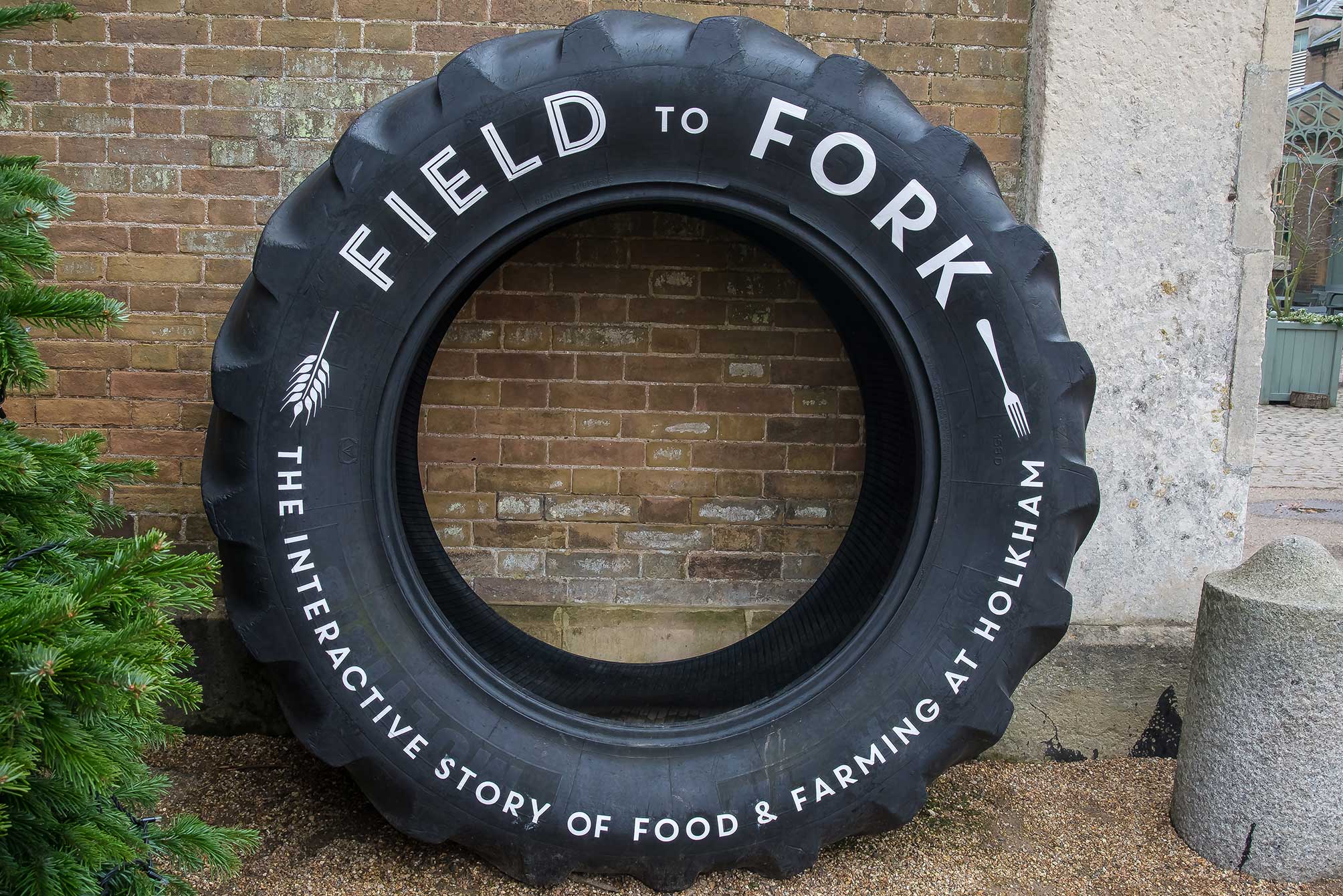
Field to Fork

You never tyre of a good pun

It’s special because here in Norfolk, where frosts are virtually unheard of, they can grow this winter barley ensuring supply to their biggest customer Marston’s Brewery who have been at the brewing game since 1834 and work closely with the barley growers. Malt which comes from barley is indispensable to brewing, the barley is dampened until it begins to produce tiny sprouts then gently kilned for an alluring ‘Horlicks-like flavou.

The sugars of the barley feed the yeast that creates the alcohol in the beer, as well as delivering the flavours. It’s a massive operation with the barley stored in huge hangars after harvest. The unwanted parts of the plant are fed into two giant anaerobic digesters, ‘basically enormous cows’ stomachs,’ says Paul, that convert it all into methane gas which is sold to the national grid. All very green.

The estate he’s in

Estate Sign

Green Is Good

Management of the estate in an ecologically sound way is important to the 4th Earl who pops up, rather like Ralph from the Fast Show, in videos playing in the fascinating Farm to Fork exhibition at his ancestral home Holkham Hall, a beautiful mansion at Wells Next The Sea.

Much of the land on the estate is set aside for wild growth to encourage birds, insects and small creatures who all help defend against pests. Larger animals such as cows are chosen by breed to graze on suitable land for their needs and the sheep are also the ‘Golden Hoof’ of ancient times; their movement, and their bowel movements, all helping to naturally till the earth and fertilise it. And when the mechanical plough is needed, it digs very shallowly to preserve the soil structure.

Shooting off to lunch

It’s all rather fascinating but what about some beer? We head off to an old shooting lodge called The Temple in the Holkham woods near to the Hall to have a spot of lunch and some liquid refreshment as Marston’s brewer Callum Turner has turned up with a lot of samples.

Pigeon Pie

Pie eyed, not legless

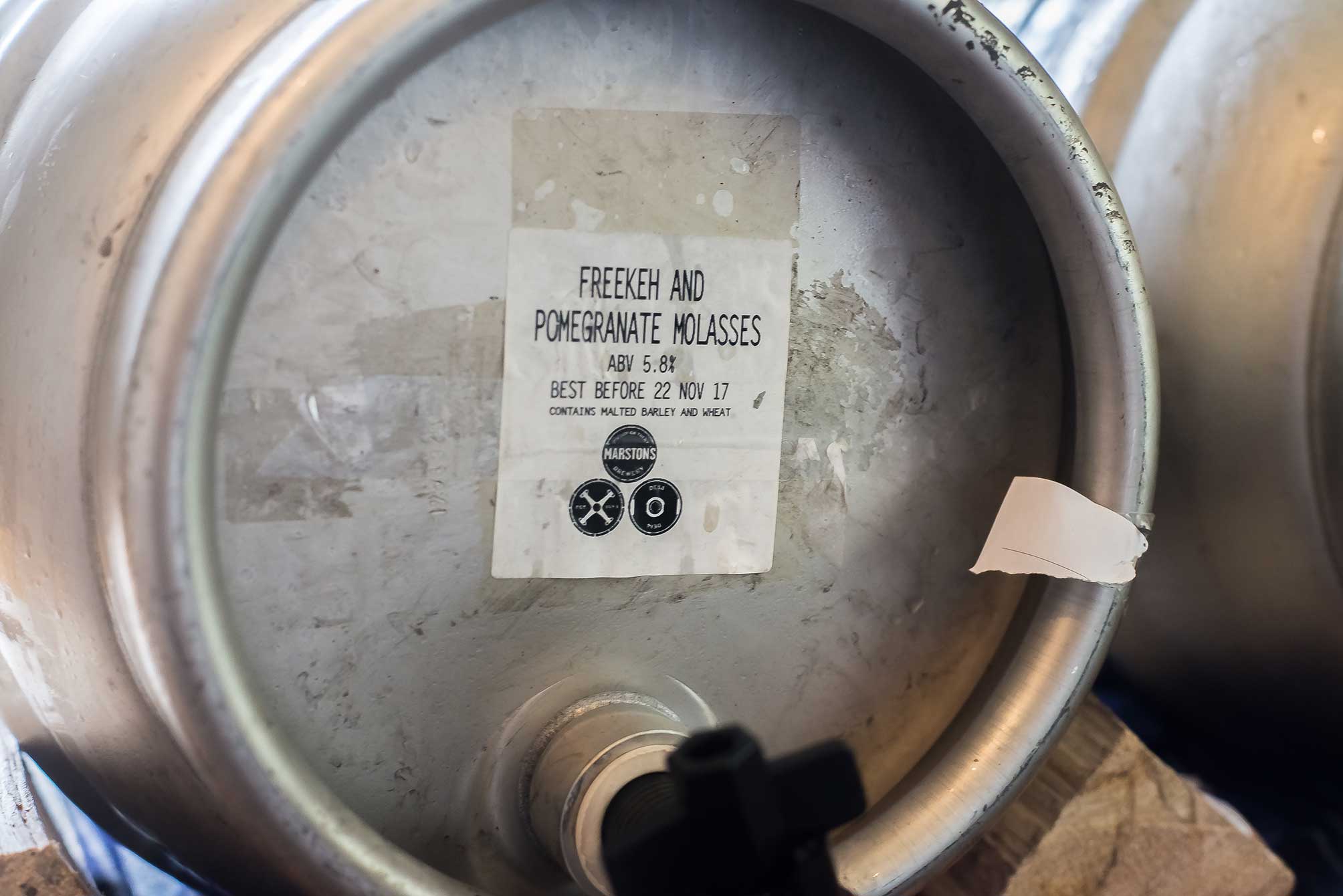
Two small batch beers from the Marston’s DE14 nano brew kit are served up with Chef Michael Chamberlain from The Victoria Inn’s venison sausage and pigeon pie in front of a toasty-warm wood burner.  Freekeh and pomegranate molasses beer is an interesting one, freekeh being an ancient form of grain picked while still green. The molasses adds a sweetness that works with the game meat.

Molasses Beer

Not your everyday beer

Similarly effective is a second beer made from smoked wheat and honey, which tastes rather like mead. Neither perhaps will ever get to mass-market, but are examples of Marston’s constant desire to experiment and innovate in order to excite the nation’s beer enthusiasts.

Sand and sea

We decamp to beautiful Holkham Beach, where Gwyneth Paltrow once ambled in the film Shakespeare In Love and where locals hint that you can occasionally see Her Other Majesty, Elizabeth II, walking the dogs. It’s stunning and kept that way by the Holkham Estate’s careful management so that it’s a paradise for dog walkers, birds and for bird watchers or twitchers as they’re known.

Holkham Beach

Wide skied and not legless

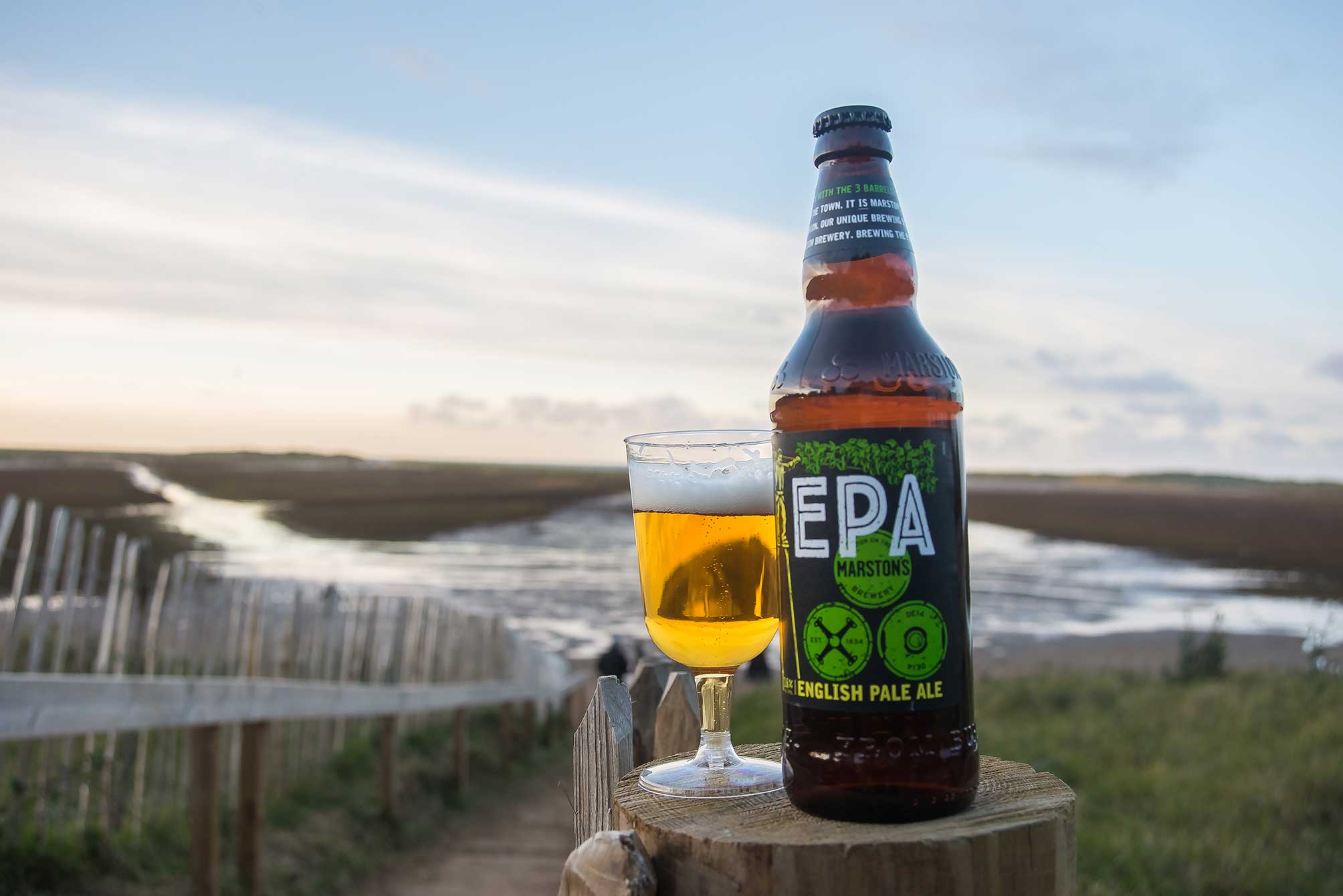
I’m a bit twitchy myself, thirsting for some more Marston’s, so we crack some bottles of Marston’s EPA (English Pale Ale) a light, citrusy, beer that’s very refreshing, although perhaps not best drunk in the freezing dusk wind that’s now storming inland. We head back to the nearby Victoria Inn for some cold beer in a warm bar with a beer-matched dinner to follow.

Marstons EPA

Naturally Chilled

The Victoria Inn sits just at the gates of Holkham Nature Reserve and the beach, a perfect place to stay any time of year. Inside it’s all roaring fires and classic country hotel charm largely unchanged in feel since it was built in 1837. The window in my room looked like it was still the Victorian original.

In the kitchen Chef Michael uses fish and shellfish from the north Norfolk coast, beef from Holkham farms, lamb and pork from farm tenants, wild game from the family shoot, and today venison from the estate’s herd of Fallow Deer.

We start with a pike terrine with fennel, warm potato salad with winter barley-malt bread and chef’s Honey beer bread, all with that other Norfolk famous product, mustard.


Pike Terrine

Don’t tell ’em Pike!

I’ve always found pike to be a terribly bony fish, as well as a rather terrifying one, but this dish shows its solid, meaty, side. It’s paired with more of that hoppy Marston’s EPA,  English hops, by the way, so that’s good for a post Brexit pint, and Marston’s 61 Deep which uses American and Australian hops.

The 61 Deep gets its name from the depth of the well at the Marston Brewery; it’s fruity and floral and works best when drunk after a forkful of food laden with that fiery mustard dressing. A beer to drink with anything spicy – Mexican Indian, Thai, you know the drill.

Second up are Marston’s Pedigree and Marston’s Old Empire IPA . Most beer drinkers know Pedigree, it’s sold on draft all over the place, but the Old Empire may be new. It is actually very old recipe, the beer that fuelled the Empire now faithfully recreated for the modern world where Britannia no longer rules the waves.

Venison Dish

Deer but not Dear

Both beers went well with roasted loin and braised haunch of venison, turnip dauphinoise, kale and redcurrant jus, the loin well cooked, i.e. pretty rare. I preferred the IPA for its complexity, Pedigree is fine by the pint but for me it’s not a dining beer.

And so to dessert with the barley appearing in a barley pudding with along with a ginger malt crunch biscuit, doughnut muffin and a malt milkshake. This was washed down with Marston’s Pearl Jet Stout, and Marston’s Cherry Head.

Dessert at The Victoria Inn

Just Desserts

The latter’s label promises a cherry stout with hints of chocolate malt and Black Forest gateau and there was definitely cherry there, but it wasn’t to my taste. The pearl jet stout was more my thing, a bitter-sweet experience that helped the sugars go down a treat.

And what a treat it was to sample Marston’s Beers at the place their barley comes from and see how modern farming needn’t be destructive or unsustainable, just as long as you listen out for the honking of geese.

Thanks to:
The Holkham Estate www.holkham.co.uk

Marston’s Brewery www.marstons.co.uk

The Victoria Inn, Holkham, Wells-next-the-Sea


Balearic Eats

Time to go raving in Ibiza, raving over the food that is.

The view from Hotel Torre del Mar

The view from Hotel Torre del Mar

A large poster catches my eye on the way in from the airport, it’s of Fat Boy Slim heavily photoshopped to be both very fat and very slim at the same time. He’s looking his age either way, which is in fact my age. That he can get a massive room full of people to wave their hands in the air is quite remarkable, as is the massive fee he reportedly gets for doing it.

Ibiza is of course well known as clubbers’ island; posters for the various venues are more numerous than posters advertising cars, washing powders or indeed anything else. My plane had boasted plenty of stags and hens already deep in the party spirit, while the despairing cabin staff tried to keep order. Ordering a drunk man dressed as a giant chicken to sit down is never easy.

View over the almond orchards

The inner beauty of Ibiza

There is more to Ibiza than drink and dancing though. It’s a beautiful place once you get away from the epicentres of E consumption, with lots of hidden, quiet beaches and small inland villages. Continue reading