Exploring Sicily’s DOC Wines: A New Age of Quality

Sicily DOC wines are exciting, fresh and a world waiting to be explored. I visit the island to discover a new age of quality that’s all in the family.
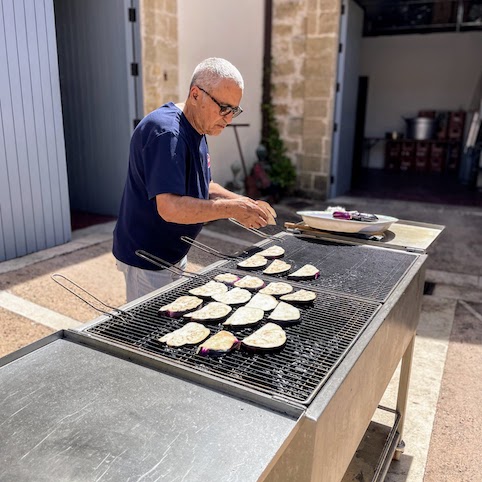
In the “baglio” or traditional central courtyard of Tonnio Baglio Ceuso, the father of the winery is frying aubergine slices and fennel sausages over glowing charcoal. The aroma is fantastic but, not speaking any Italian I can only give him a thumbs up and get one back with an accompanying grin.

Now semi-retired, he enjoys watching his descendants do most of the wine work while he offers sage advice that I’m sure is warmly welcomed, although perhaps not always, but hey, that’s families the world over.

I’m discovering a new generation of Sicilian wine makers, the sons, daughters and even great grandchildren, of the originals, who are now front and centre in Sicily, and that’s a good thing for Sicilian wine. The island’s wine scene is no longer dominated by the production of cheap, generic, wines, as it has been for so long.

The big name red grapes such as Nero d’Avolo, Nerello Mascalese and Frappato ‘fruity’ are still king of course. Whilst for whites, Cataratto (now named Lucido, because apparently we non-Italians can’t pronounce Cataratto) can still be found across the island, and crisp, savoury Grillo (used to make Masala) is now a fine white wine all on its own. Winemakers are using these grapes to make exciting new style wines, as well as growing ‘international’ grapes such as Syrah, Merlot and Chardonnay for blending and single grape production

There is power in a union
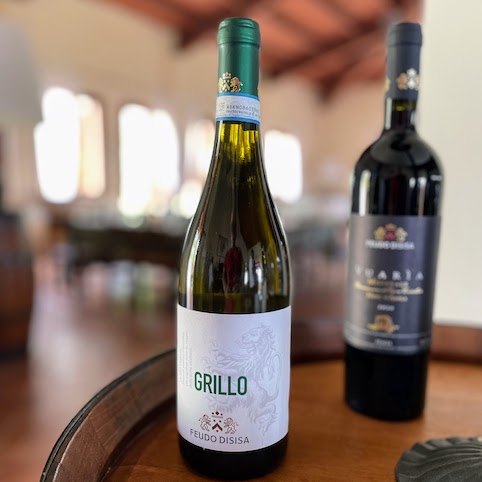
Around 450 forward thinking Sicilian wine makers came together in 2011 to promote  tradition, innovation, and quality over quantity in Sicilian wine, as well as to support each other in what can be challenging times, by creating Consorzio di Tutela Vini Sicilia DOC which now numbers 7,000 winemakers and more than 530 bottlers.

One problem they all face is climate change.  A young winemaker showed me a photo taken last year of the lake that has always irrigated his vines, ‘this year,’ he said drawing with his finger, ‘this….’. He indicated an area of water so reduced it was hard to believe it was the same lake. The patches of blackened undergrowth I saw all over the island also witness the lack of rain this year and the outbreaks of devastating fires.

Positivity is the main vibe from all the winemakers I met though, even when grumbling slightly about how big UK importers are still adamant they only want cheap plonk.  They are reluctant to buy the more expensive quality wines these winemakers have dedicated themselves to, but that’s changing as UK wine lovers wake up to the new Sicilian scene and its amazing options.

The island can have four different climates over a vineyard surface that’s three times that of New Zealand’s, which allows for a lot of wine variety, but all over the DOC portfolio, quality and organic farming is key.

Sicily is now the top producer of organic grapevines in Italy. By leveraging the natural climatic conditions of the island, fewer treatments are needed. One winemaker told me how he is trialling a natural insecticide derived from local cacti as a cheap and effective crop protection solution.

Don’t walk away René
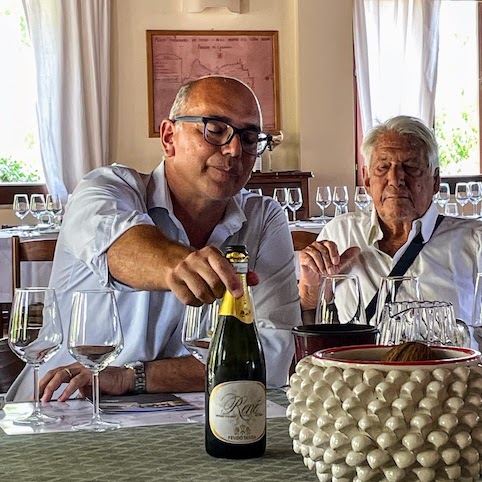
At Fuedo Diso, a fifth generation winery, the Di Lorenzo family were the first registered company to produce Chardonnay in Sicily. They’ve owned the winery, whose Baglio dates back to to the 17th Century, since around 1867, and whilst the buildings are gorgeously ancient, the equipment they use is state of the art.

Their Grillo, Chara, Nero d’Avola and Adhara wines are fresh and revitalising. Their particularly deliciously crisp Grillo is a star wine, while their sparkling wine René, named after the patriarch, comes  from the oldest Chardonnay vineyard in the Feudo. As we taste through their range of wines, René is front and centre with his glass, and he’s not spitting any out. Mind you, neither am I.

Vinifying up a storm 

The fresh energy at the Tola winery is also palpable. As I tasted the wines in their ultra modern building south east of Palermo, the skies darkened and the giant windows framed dramatic lightning storms over the gulf of Castellamare to the north.

The winery crackles with life – all white surfaces and sharp angles it’s run by Francesco Tola almost 400m above sea level. This makes the temperature moderate –  it can actually be very cold at night – with sea breezes bringing salinity to his classic Sicilian grapes of Nero d’Avola, Syrah, Grillo, Catarratto, Insolia and Zibibbo, as well his international vines of Chardonnay, Sauvignon Blanc and Pinot Noir.
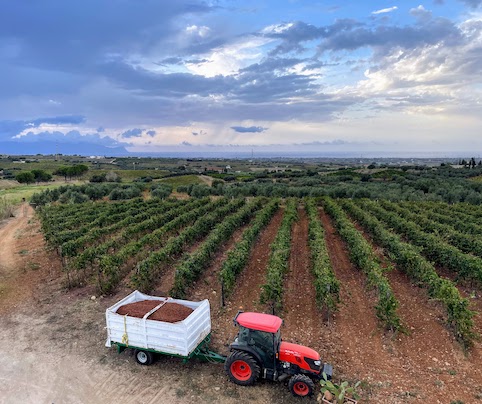
He uses steel tanks a lot, to keep the freshness of the grapes alive to produce light, zesty Nero d’Avola and, as a very modern winemaker, he is happy to use the latest machinery for efficiency, while keeping his CO2 emissions low. 

Out back a machine is processing just picked grapes, blowing streams of stems into a pile to be composted. I can’t help but notice the workers here are all wearing Kippahs. ‘ Ah yes,’ says Mimmo, ‘this batch is for kosher wine and so can be only touched by Sabbath-observant Jews from the harvest to the bottling’. An interesting example of finding markets for his second division grapes.

His flagship red wine Black Label – Nero d’Avola Doc Sicilia – though is traditionally made from the best hand harvested grapes and is an intensely fruity example, while his sparkling wine, made from Catarratto and Grillo grapes, gets its fizz from the Charmat Method, where the second fermentation that gives the lovely bubbles is created by using large pressurised tanks, and not bottle ‘dosage’, as used for Champagne. This makes for wonderfully bright bright fruit flavours

Concrete Proof of change
Concrete often gets a bad rep. In the old Soviet Union it was used for shoddy buildings that fell down a lot, usually due to the ‘concrete’ being made of flour, water and potato peelings.

However for a long time proper concrete was the storage vessel of choice for winemakers –  cheap, easy to clean, stable and hardwearing, it’s also slightly porous and its thickness makes the wine inside less susceptible to temperature changes or ‘shock’. 

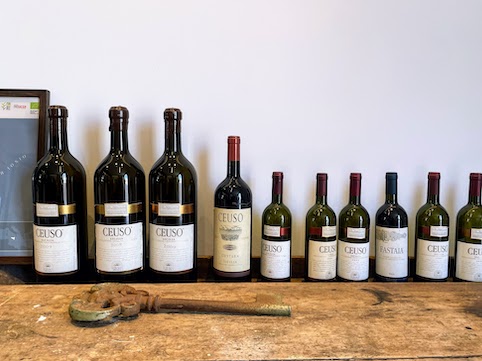
Stainless steel seduced many winemakers in the 1980s and lots of old concrete tanks were literally smashed up. Back at  Tonnino Baglio Ceuso, with the aubergines eaten, I went with the chef’s daughter, Francesca, to see the usual steel vats, but also their row of concrete tanks that were still in place when they took over in 2023.

Their flagship wine Ceuso, created by enologist Giacomo Tachis in the 90s, is a modern blend of Nero d’Avola, Cabernet Sauvignon and Merlot. After fermentation, the wine is sent to mature in these old cement tanks before moving on to Seguin Moreau barrels. The result is an exceptional wine with velvet tannins and which can be aged for years in your own ‘cellar’.
They also produce a delicious dessert wine, ZIBÒ Made from their best Zibibbo grapes, it’s a reimagined Sicilian classic being fresh and balanced and not as cloying as older styles.

The variety of wines at each winery was remarkable. Innovation was everywhere and this was confirmed at a final tasting in town with twenty six producers and their wines present. It was head-spinning and not just because of the wine being drunk.

Twenty six passionate (yes, for once that word is appropriate) winemakers is a big crowd and whilst I tried to sample every wine, it was impossible. So many superb wines in one place was a remarkable one off event, and all the winemakers were lively and refreshingly young and keen. I naively asked some of them if they had ever wanted a different job from the family business and not one said ‘yes’ and no wonder.

The work is undoubtedly hard; it can be heart-breaking when a year fails to meet expectations, or an experiment with planting fails, but the joy of creating something superb cannot be beaten.  Sicilia DOC wines are moving forward at pace, the bad old days are over, and their wines should be on everyone’s oenological shopping list

The sausages, by the way, were delicious!

La cuina dels genis. The cooking of the geniuses.

Discovering the Catalan dishes and landscape that inspired Gaudi, Picasso, Miro and Casals.

I’m holding a large loaf that I’ve just hollowed out, it’s now filled with herring, roasted tomatoes and garlic and a very great deal of olive oil.

Biting into it I temporarily lose sight of the beautiful convent  at the foot of the mountain across the fields from the village of Horta de Sant Joan in Catalunya.

Bread completely fills my vision and olive oil runs down my sleeves. Now this is what I call a sandwich. Continue reading

From little acorns – how the finest jamon is created

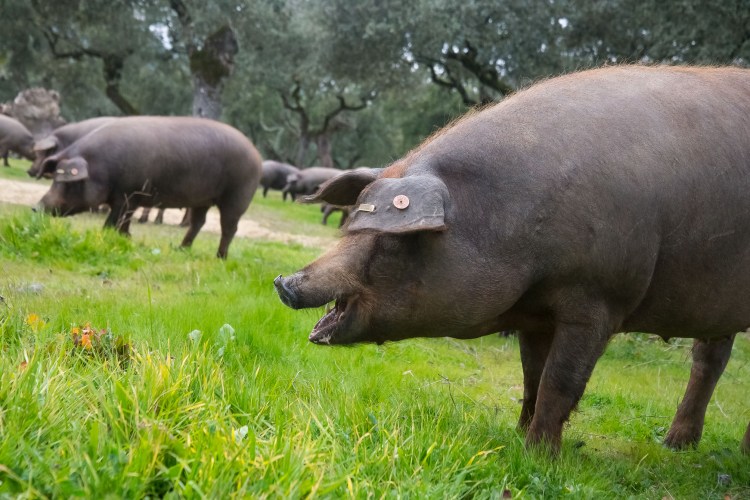
While we are all still on a plant based diet kick right now, there is still room for meat that is ethically and responsibly sourced, traditionally made and totally delicious.

Away in the distance, under the hundreds of Spanish oak trees, large dark shapes are moving. An occasional grunt or squeal drifts our way and Antonio Hernández of the Dehasa ‘Los Pinos’ answers back with strange noises.

The black Iberian pigs prick up their ears, or they would if their ears weren’t so charmingly floppy, and a mob begins to move toward us. Continue reading

Sun, sea and sustainability in Ibiza

Known for its club culture, there’s also a different beat in Ibiza, one that’s all about sustainability, Zero Kilometre sourcing and the rise of the female chef.

A wild and lonely place

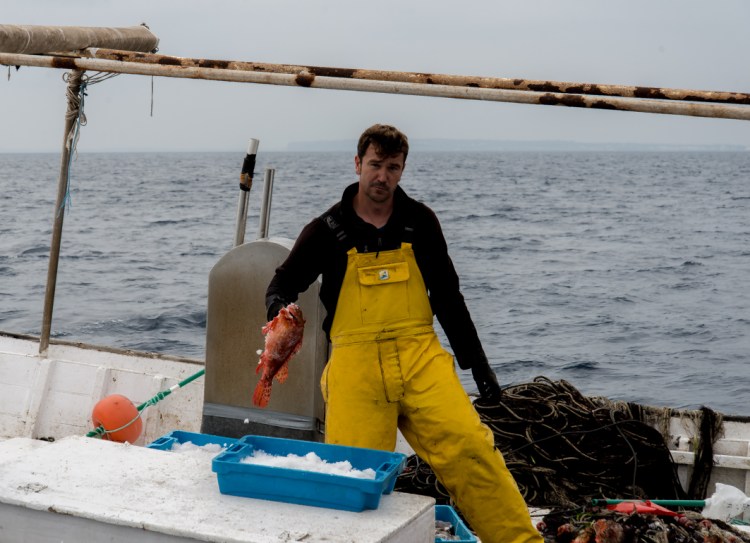
‘Skreeeeek, skreeek, skreeek’, I’m watching a man laboriously pull in his fishing net by hand. His small ancient local boat, called a Llaut, is bobbing about on the water between Ibiza and its smaller neighbour, Formentera. The net, all 5km of it is being slowly retrieved using a large wheel as a capstan. It’s badly in need of some WD40, hence the ‘fingernails down blackboard’ noise it’s making.

Not a large catch

Every now and then the fisherman bends down to retrieve a fish from his net. If it’s too small, it goes back over the side otherwise it goes into the cold box. His nets are only left out for an hour each time to avoid any chance of the fish being crushed to death when the haul is good.

As a method of fishing it’s old and ineffective, but that’s the point. The fishermen of Ibiza have embraced the need for sustainability.

You can fish over there!

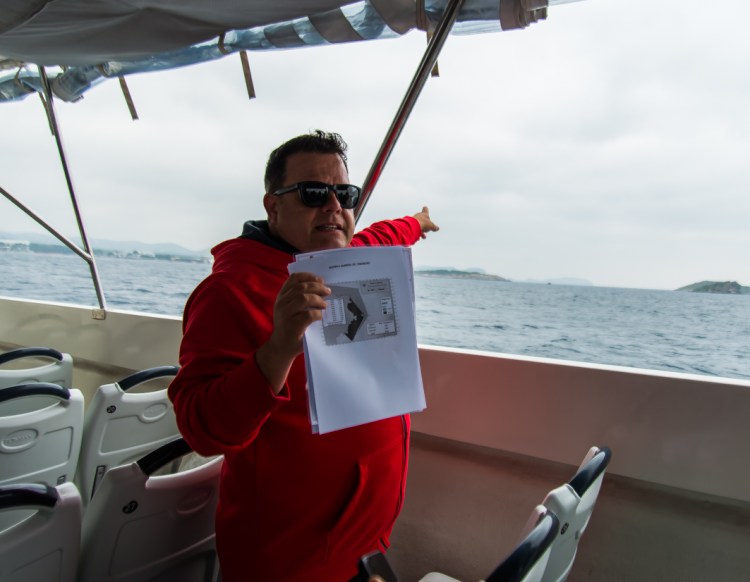
On our boat, Pere Valera who heads the Ibizan Fishermen Guild, pulls out a chart and shows me where in the local waters large scale trawl fishing can take place, where it has to be done only in this old style and where it is totally banned so that the fish can breed in peace. This last area is Es Freus Marine Reserve of Ibiza and Formentera, which was set up in 1999.

It takes in the far south of Ibiza, the north, the west coast of Formentera and the space that separates them with a total area of 13,617 marine hectares, making it the second largest protected marine area in the Spanish Mediterranean.

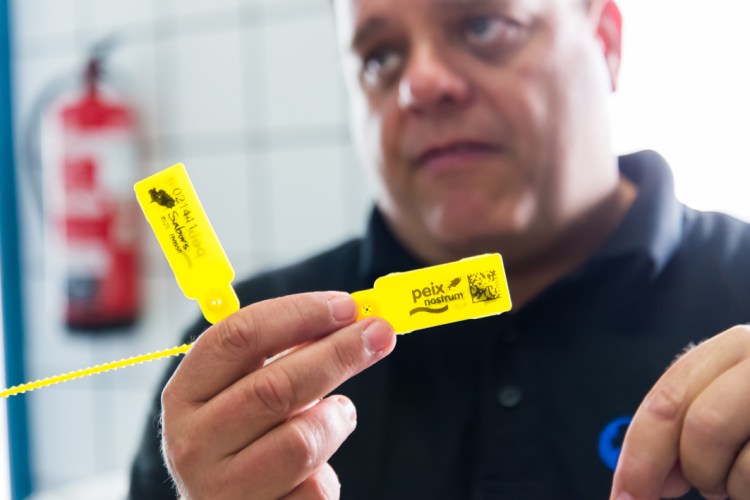
Back on shore, at the Guild headquarters where all fish are processed, he shows me some more of how the system works. The fisherman all signed up in 2008 to an initiative called Peix Nostrum – Our Fish.

Bagged and tagged

Under this ‘brand’ bright yellow tags are clipped to each fish and lobster and these must remain attached all the way to the market, and the fish must arrive within four hours of being caught.

The tag gives information on where the fish was caught, precisely when it was caught and by whom, as well as guaranteeing it has been processed correctly.

Bullet de Peix

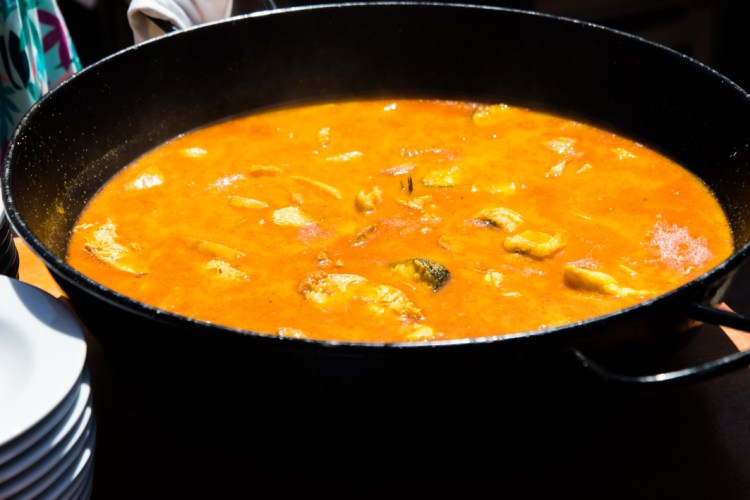
This means that every restaurant on the island can be confident its fish has been supplied in a sustainable manner. And that matters, both to the chefs and to their customers. Everyone loves the local fish stew Bullit de Peix and they want to know it’s been made with care.

‘None of the fishermen in Peix Nostrum wants to empty the sea,’ Pere says, waving a fish about. ‘We want fishing to continue for our children and grandchildren, so we only catch reasonable amounts of fish and shellfish. And it works. We’re the only part of the Mediterranean where the lobster is not disappearing, for example.

Eco and very friendly

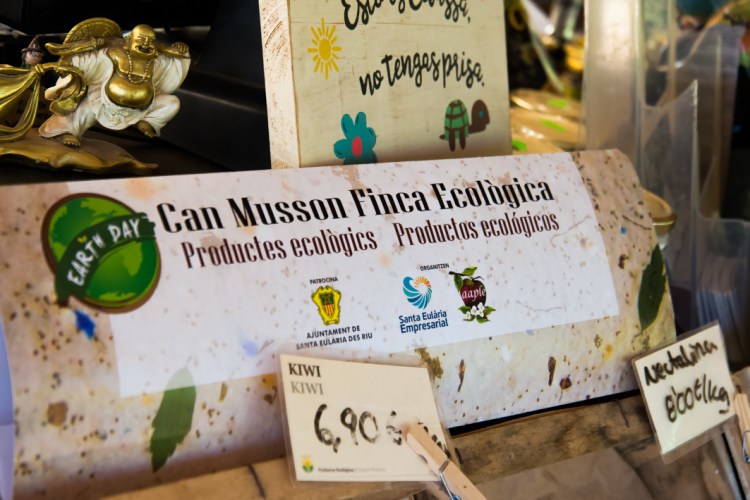
Back on dry land to the west of the town of Santa Eulalia Del Rio, is Can Musón. Founder and driving force María Marí Colomar was about to retire from her work as a fashion designer when she was horrified to find a local child, when asked to draw a chicken, drew a box instead.

So, she picked up a spade and not a pen and created a wonderful place to teach the upcoming generations the importance of sustainability of local produce and of rare breeds.

Mari

Here on her 65,000 sq. eco farm she grows organic fruit and vegetables in profusion, as well as many herbs too. She also raises rabbits, pigs and goats, most of them local breeds that need protecting from dying out.

The produce is all sold out the front from a large market stall, as well as served in the simple but delicious cafe. This area is discreetly wealthy with plenty of expat and second-home Brits around. They have a very Notting Hill vibe about them, with the women drifting about in floaty boho dresses and hats, all topped off with subtle designer sunglasses.

They help keep the farm paid for, its main purpose being to educate the children who come out on regular trips to the farm school – S’al lot Verd (it means ‘the green youngster’ in Catalan), to see where food comes from and to be schooled in the need for sustainability.

A digestif

Mari puts me to work making a bottle of Hierbas, the local post-meal stomach calmer. Into a bottle of spirit go 21 fresh herbs from the farm, these will then steep for as long as possible to bring all manner of complex flavours and remedial qualities to the drink.

I screw the top on tight and hope baggage handling doesn’t turn the Hierbas into a big mess in my suitcase. That would really give me an upset stomach.

Zero Km sourcing is big with Ibizan restaurants. The closer the produce is to the plate, the better. Not just for the taste of course, but also for the freshness and the fact that no transport but Shank’s Pony is needed, which cuts helps pollution on the White Island.

People who cook in glass houses

At Can Domo restaurant, a beautiful Agroturismo hotel and restaurant created from a 17th Century hilltop farm by a husband and wife team and located up an axle-breaking dirt road in the north of the island, 18 km from Ibiza town, they have over 600 olive trees surrounding them. Arbequina olive trees and Picual olive trees are all tended organically to produce the award-winning fruity, floral oils they use to cook with and also sell.

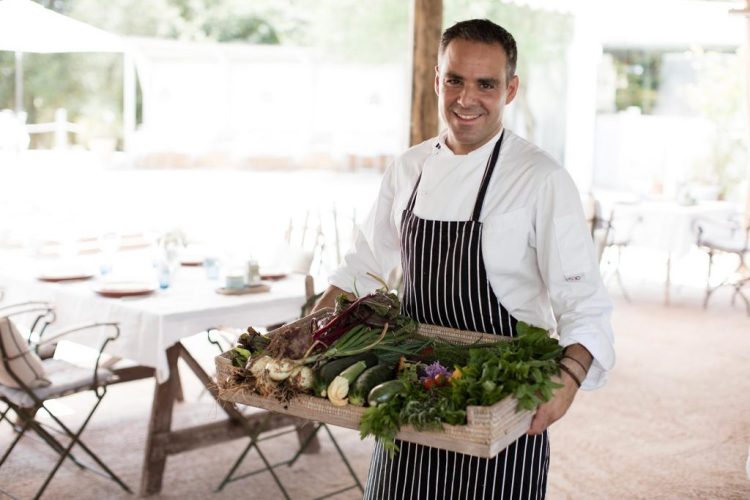
A chef and his produce

They also have a vegetable plot that produces almost all chef Pau Barba needs to create his stunning dishes for his farm-to-table restaurant located in a glass-walled room across from his semi open-air kitchen. He cooks and his wife takes care of the design and running of the hotel with its 8 rustic-chic individually decorated rooms in whitewashed stone outbuildings

The wine served is from Ibiza; ‘of course’ you might say, but in fact it’s something you’d not have said twenty or so years ago because Ibiza just didn’t make wine then. Today though the island has around seven wine producers and one of the most successful is Can Rich.

Earthy goodness

Since starting up in 1997, Can Rich now produce only organic wines, and were one of the first people to make wine in Ibiza since the Phoenicians left about 2000 years ago.

Can Rich, like all Ibizan wines, differs from other Spanish wines. The almost non-stop continual sunshine of Ibiza means the red Monastrell grapes can be harvested earlier and so escape the full blasting heat of summer, and there are minerals in the grapes unique to the island, all characteristics which come out on the nose and the palate.

Monastrell produces a very earthy, vegetal smelling wine. I thought my wine was corked when first served it, but soon grew to love it and drank little else after.

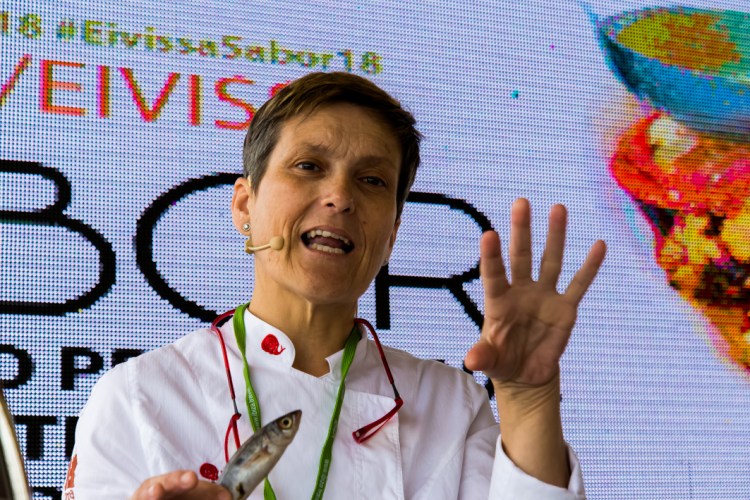
Chef Sílvia Anglada

The sun is beating down at Club Nautic Sant Antoni and Ibiza Sabor 2018 is under way and packed with chefs, trainee chefs, suppliers and press. I can see Pere who waves cheerfully as well various other chefs I’ve met over the past few days.

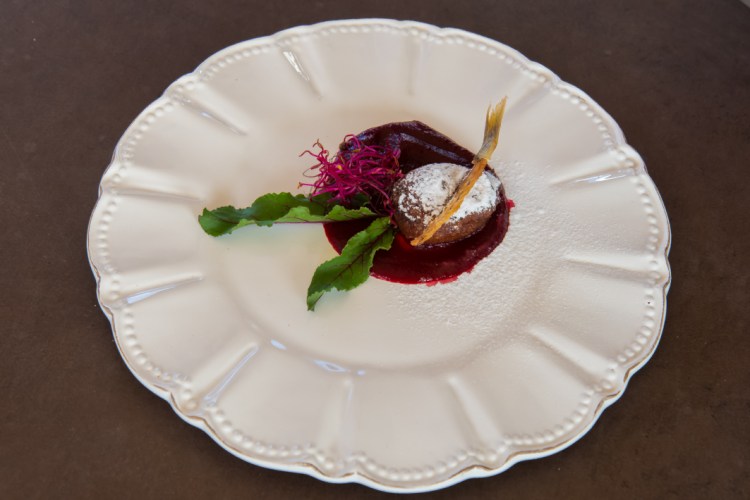
A beetroot donut

It’s very much focused on sustainability and has a focus too on female chefs. Sílvia Anglada of restaurant Es Tast de na Sílvia, in Ciutadella, Minorca runs her restaurant on strict eco lines and demonstrates one of her signature dishes, a kind of cheese doughnut with a beetroot jam

Coca bread topped with roasted tomatoes

She’s followed by Marga Coll from restaurant Miceli, in Majorca who tells us her restaurant never has a fixed menu and is driven entirely by what she finds in the morning market. As she talks she creates a dish of coca bread topped with roasted tomatoes, dried fish and cheese from Can Caus an artisan producer.

Not your average Mr Whippy

Alejandra Rivas runs Gelateria Rocambolesc, a project of the Roca brothers of El Celler de Can Roca fame, and she is married to Jordi Roca. Her demonstration of novel ways with ice-cream, both sweet and salty, was refreshing and it’s easy to see why she now has four gelaterias in Spain.

Paella all round

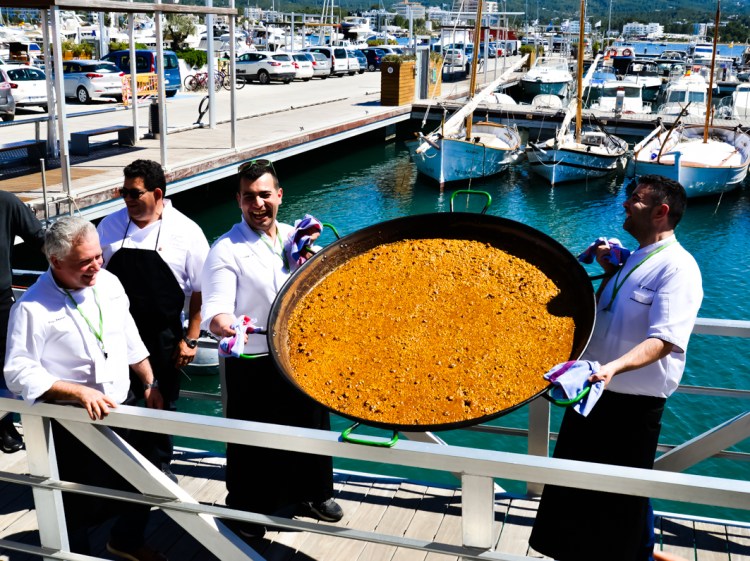
Lunch, of 12 courses, each prepared by one of the chefs, was a triumphant celebration of the Balearic produce, the passion for sustainability and the talent of the islands’ chefs. The giant paella finally served was the icing on the cake,

If you’ve been putting off going to Ibiza because you don’t dance that much anymore, think again. That side of the island is one very small part of what it does, so pack a knife and fork and leave the glowsticks at home.

Our thanks to my hosts Ibiza Travel and to all the marvellous chefs and producers of the White Island who work so hard every day.

Can Domo images sourced from their website

Get Your Modena Running

Fast cars, fat singers, fine food and fizzy Lambrusco, in Modena you get to experience it all.

Ferrari California in Marranelo

Man and Machine

‘Push! Push! Push!’, cries the man in the passenger seat and so I obligingly push down hard on the accelerator. The bright red Ferrari California makes a noise like Pavarotti getting his fingers caught in a door and £160,000 worth of supercar hurls itself forward as I frantically work the paddle gear change to keep up. The speedo needle rushes toward the motorway limit and then past it, but it isn’t even a fifth of the way around its elegant dial yet.

‘Piano, piano,’ ‘gently, gently’, advises my Italian co-pilot as the rear of a giant lorry suddenly fills the windscreen, so I let off the pedal, dab the brakes and the car majestically slows down as if a giant hand has grasped it.  Continue reading

Balearic Eats

Time to go raving in Ibiza, raving over the food that is.

The view from Hotel Torre del Mar

The view from Hotel Torre del Mar

A large poster catches my eye on the way in from the airport, it’s of Fat Boy Slim heavily photoshopped to be both very fat and very slim at the same time. He’s looking his age either way, which is in fact my age. That he can get a massive room full of people to wave their hands in the air is quite remarkable, as is the massive fee he reportedly gets for doing it.

Ibiza is of course well known as clubbers’ island; posters for the various venues are more numerous than posters advertising cars, washing powders or indeed anything else. My plane had boasted plenty of stags and hens already deep in the party spirit, while the despairing cabin staff tried to keep order. Ordering a drunk man dressed as a giant chicken to sit down is never easy.

View over the almond orchards

The inner beauty of Ibiza

There is more to Ibiza than drink and dancing though. It’s a beautiful place once you get away from the epicentres of E consumption, with lots of hidden, quiet beaches and small inland villages. Continue reading

Abruzzo. The Italian region ready to be revealed

Nun’s naughty bits, a wine that’s not a cheese, wine boxes that aren’t square and vino that flows from a drinking fountain, Nick finds Abruzzo is an Italian region that’s full of surprises.

Nuns Breast, a patisserie from Abruzzo

A lovely bun

“They’re called ‘Nun’s’ Breasts’, “Sise delle Monache” in Italian, says Valentina di Camillo unveiling a tray of freshly made pastries in the garden overlooking her family’s glorious vineyards. The origins of the pastry’s name are vague, they were first called ‘Three Mountains’ owing to their triple peaks but the new name came about when a nun… well, let’s leave it there.

Liver sausage

Liver sausage, goes great with red wine.

They are delicious, soft as can be and stuffed to bursting with sinful crème patissiere. One of these and a black coffee and your morning is off to a good start. Personally I am eating them just after an al fresco breakfast consisting of superb cured meats, pungent cheeses and a fair few glasses of Valentina’s lovely wines, so I am using the coffee and sugar to offset the alcohol I’ve knocked back. Continue reading

Snuffling for truffles in Spain

Italy? Yes. France? Of course. But Spain? Discover a region where the truffles and mushrooms aren’t just delicious but one of the area’s biggest industries and tourist attractions.

dsc_7194

Gourmet’s best friend

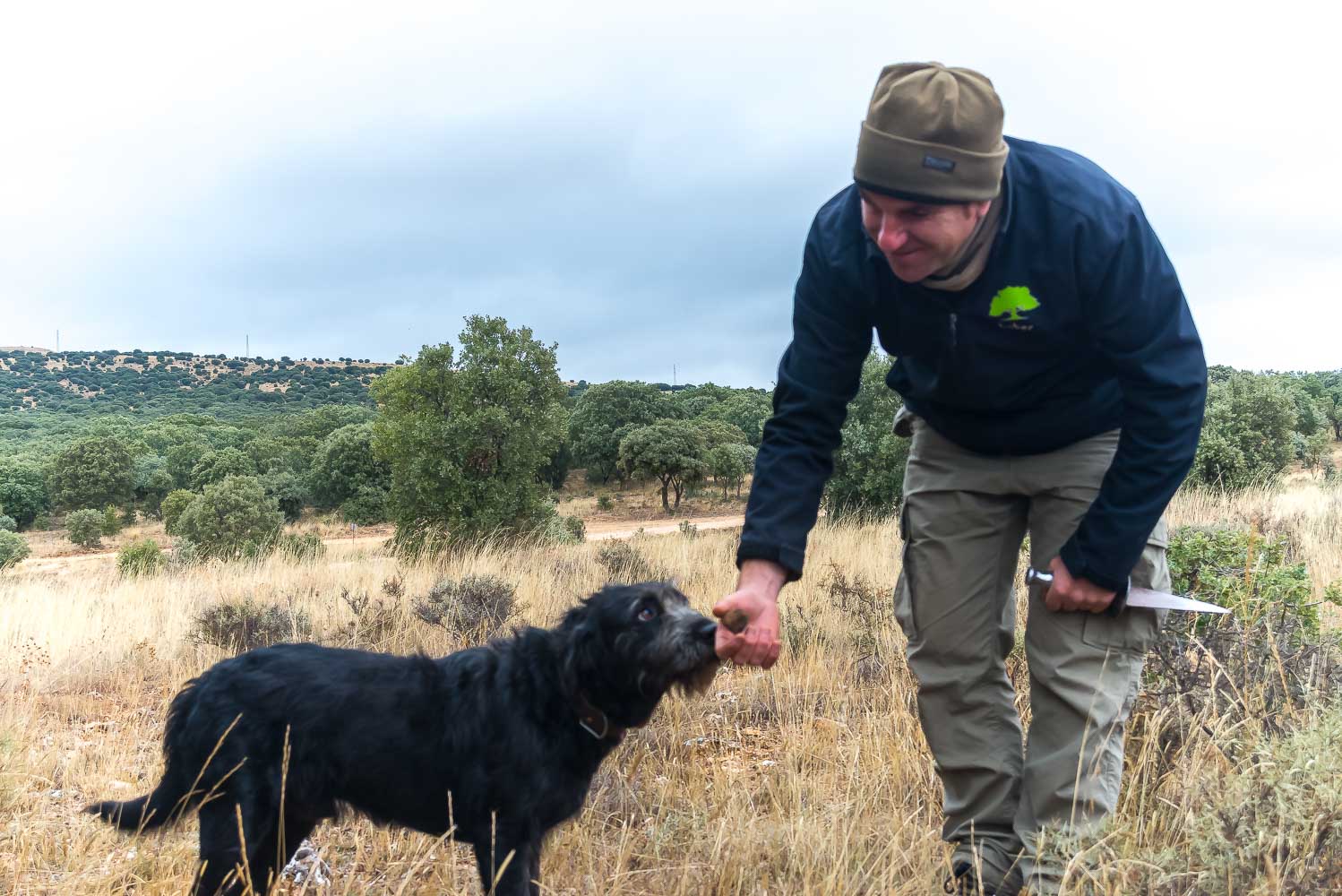
‘He got bitten by a snake out here a few months ago, he almost died!’ The man from the company Tuber Viveros ruffles the neck of his dog with affection, ‘but he’s okay now and happy back at work.’ His dog looks up at him adoringly, keen to get on with his job.

That job is to sniff out truffles, because somewhere in this massive plantation of trees stretching out in all directions, the black gold lies buried. The dog’s work is made a little easier by the fact that every tree is almost certain have a truffle or two amongst its roots, some ripe some not. That’s because the element of chance was reduced by a discovery back in the 1970s. Continue reading

The world’s biggest buffet

Eat for England.  Les Grands Buffets, Narbonne, France

Remorseless eating machines | The world’s biggest buffet

I agreed to it for a laugh, really. “The world’s biggest buffet”? Well that surely had to be a barn-door target for some snarky reviewing.

At first we couldn’t get to the place to even mock it from the outside. Instead we sped with increasing impatience up and down the fast two-lane on the industrial outskirts of Narbonne, trying to find a way in. Massive signs advertised furniture stores,car exhaust fitters and flooring warehouses, but the only way to access the area seemed to be to drive the wrong way around a roundabout and then floor it down a one-way street against oncoming Renault Twingos.

So we did that and made our way on foot across an airfield’s worth of tarmac to an enormous building that also seemed to house an ice-rink or a roller-rink. It was hard to tell: it was closed and dark, just like every other “grand surface” in the area.

Les Grands Buffets

Continue reading

Sharp and sweet. The vinegars of La Guinelle

Foodies talk a lot about balsamic vinegar and its amazingness, but in the South of France I find an artisan making something a drop more interesting and rare
DSC_3109
‘You need good wine to make good vinegar,’ says Nathalie gazing watchfully over her militarily ranked wooden casks. The south of France sun is beating down on the covers that shade the casks from the full heat, her dog is flopped out on the road outside. It’s too hot to do much. Time moves slowly here. Continue reading