Greek Pig Panigyri Feast: A Unique Dining Experience

Just because it’s winter, doesn’t mean you can’t enjoy the summery warmth of a Greek Pig Panigyri Feast

They’ve got the electric heaters going full blast at Pyro tonight, Mad Ed Milliband would be livid if he knew about it in his luxury hotel in Brazil.

They do need them though, because even on this unseasonably warm November evening, I blame Climate Change of course, there’s a bit of a chill breeze blowing around our legs.

Pyro’s veranda is not a bricks and mortar structure, but a kind of large ‘beach hut’ with walls made of clear plastic that roll down for the winter. This would be effective, were it not for the fact that the one next to our table stops a good thirty cm short of the ground and the breeze is making my trouser legs flap like sails.


I don’t care, we’ve soon got cosy rugs wrapped around our legs and we’re enjoying ourselves too much to be put off by a draft. The whole place is welcoming, warmly lit, charmingly decorated and with a great Greek feel to it. If the sun was shining you really could be in an island taverna, and not simply south of London Bridge.,

Chef Yiannis Mexis is the man behind Pyro, and he cooks on live fire, which is always a good way to cook. I can see the practical benefits of induction hobs in modern kitchens, but they add nothing to the flavour.
At Pyro every Wednesday from now and going forward, it’s the Pig Panigyri Feast, a Greek village festival. Inspired by Gournopoula, the Messinian tradition of roasting suckling pig over an open fire.It’’s a set menu designed to be shared with friends, although couples can also enjoy it just as much. We actually sat with two strangers and it couldn’t have been nicer, as we bonded over crackling, pork fat and Greek wine and the terrace filled up with other pork afficianados.


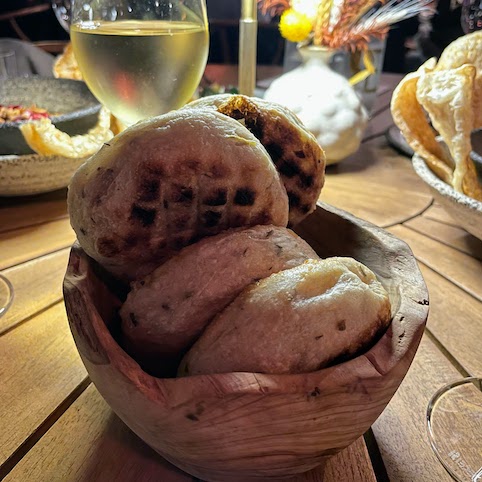
There are two cocktails for the set price. Pre feast was a Midas, a great combo of cinnamon infused tequila and aperol which set us up nicely for the arrival of sourdough potato pittas cooked on the griddle and with a good helping of syglino, a smoked pork fat.

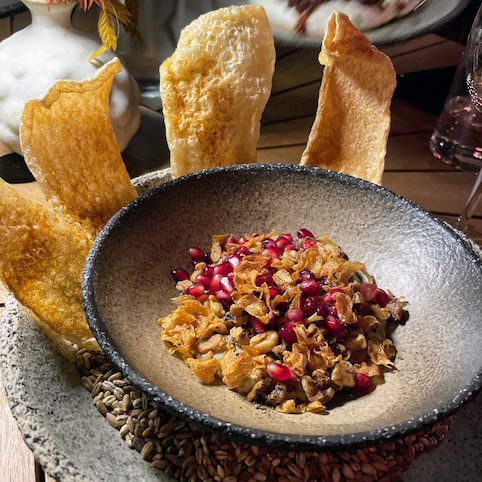
These pittas are fat and round and delicious and prove perfect for loading up with the creamy sheep’s milk labneh with pork and a smattering of chick peas. Superb, as is the smoked aubergine puree with roasted garlic, this time scooped up with perfect crispy tranches of crackling. A dusting of pomegranate seeds add colour, but do get caught in my teeth.

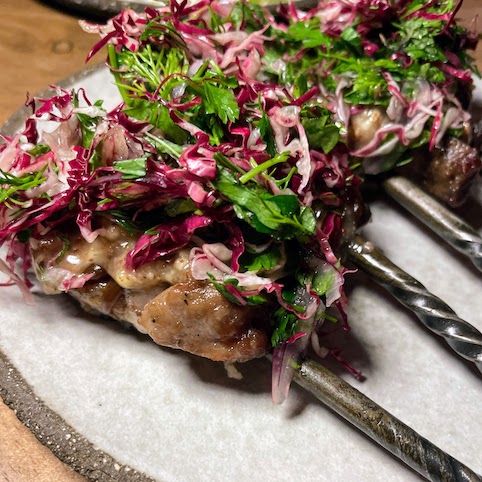
If you only know souvlaki from the excellent album by Slowdive, you can’t have been to Greece where you find it all over the place. Meat grilled on a skewer over charcoal, it’s often served in a pitta with toppings. Here some Iberico pork’s goodness is further enhanced by sweet smoked prunes, almonds and an inspired topping of sour apple and radicchio. Another winner dish.


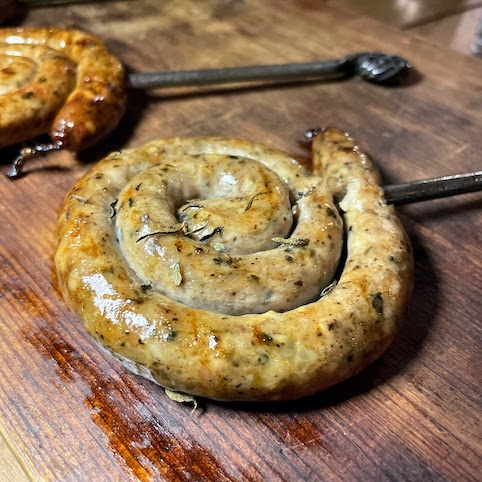
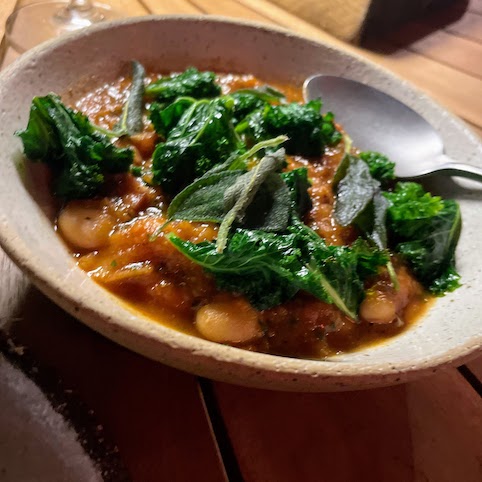
And from out of the fire comes more, this time a ‘Mykonian’ style sausage, curled like a Cumberland, it’s porky perfect and you can taste the fresh herbs embedded inside. An accompanying stew of butter beans, or ‘gigantes’ offers up super soft beans infused with flavour and cheerfully doing the backstroke in a rich tomato sauce topped with barely cooked kale and lots of lovely sage.

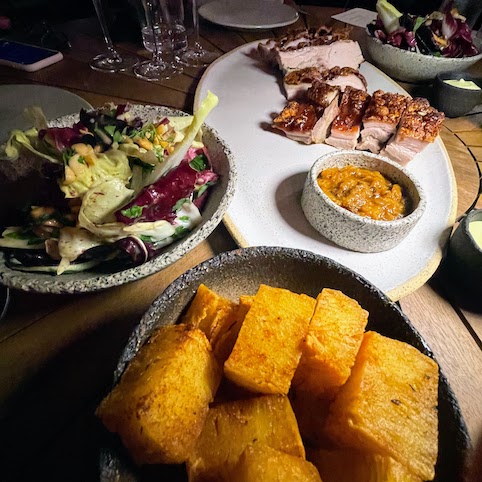
And the main event arrives, suckling pig (s) have been spit roasted over myrtle, an evergreen shrub found all over Greece. Suckling pig is not something for anyone who’s in denial about where meat comes from, I find it a bit hard to look at myself so I didn’t watch for long and waited for it to arrive portioned at our table.


Succulent, quite fatty, very tasty and set off by burnt clementine chutney and partnered with potato cooked in pork fat served with skordalia, which is a garlicky puree with potatoes and nuts, plus a fat-cutting salad of bitter leaves it did a great job of leaving us sated.

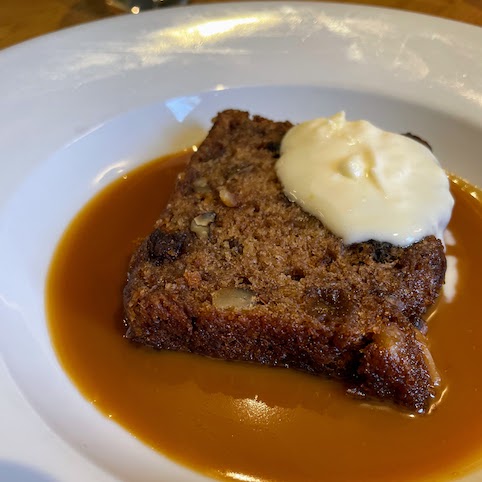
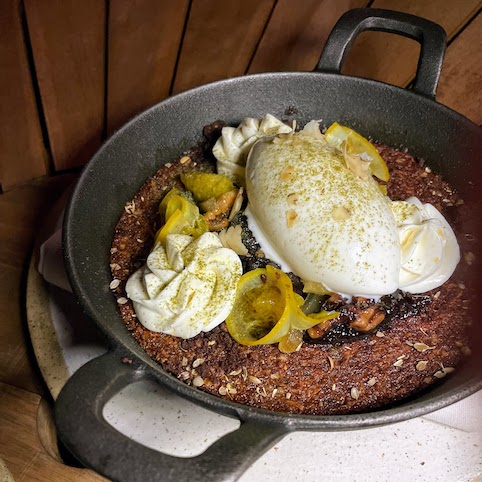
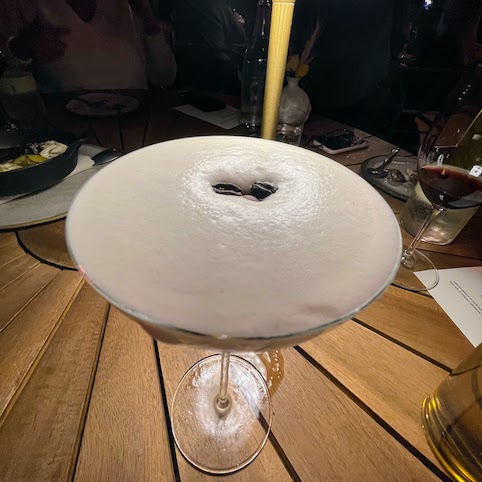
We managed to still eat Greek walnut cake, or karydopita, with creme fraiche before washing it down with Aegina, a crazily creamy vodka cocktail bursting with Greek yoghurt foam.


It really was a proper  feast and a celebration of pig,  and I really recommend you get your trotters in the trough asap.

53b Southwark St, London SE1 1RU

pyrorestaurant.co.uk/

Proper Parmesan Takes Its Time

If your cheap parmesan tastes terrible it’s because it’s not the real thing. I went to Parma to see how genuine, PDO protected, proper Parmigiano Reggiano is made and why it has a premium price tag.

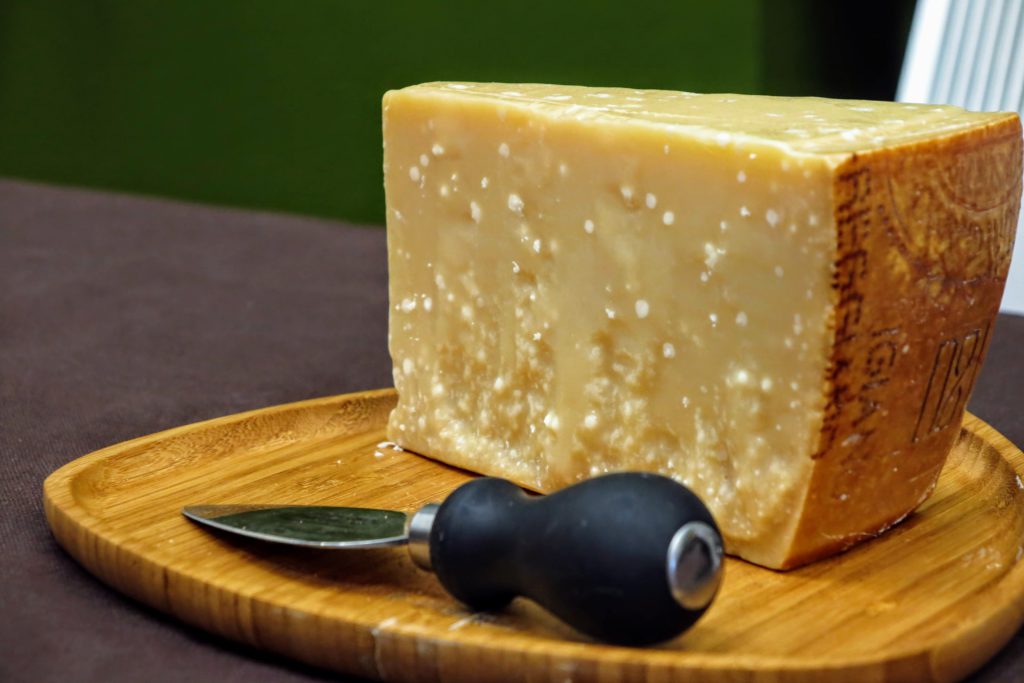
‘So this cheese is twelve years old,’ says Simone Ficarelli, the international marketing officer of Parmigiano Reggiano, expertly wielding the short, stubby, knife that’s the traditional tool used to break off chunks from the giant wedges.

There are white lumps in it, a distinct mark of a mature cheese. These are calcium lactate crystals, and are perfectly safe to eat. In fact the crystals in Parmigiano Reggiano cheese are a sign that the cheese has been properly aged. When you eat the cheese the crystals spark out a nutty flavour that complements the saltiness.

DOP Parmigiano Reggiano has been made for over 900 years and is only produced in the provinces of Parma, Reggio Emilia, Modena, Bologna to the left of the Reno river, and Mantua to the right of the Po river. This is the area of the farms where the cattle for the milk are fed on locally grown forage. It can only be made with this skimmed cow’s milk, salt, and rennet for curdling.

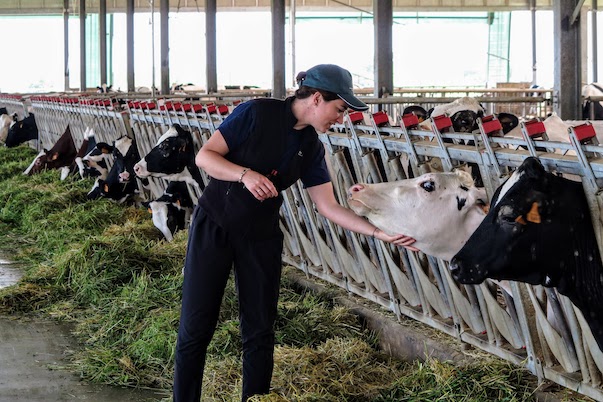
The cows live in airy open-sided barns, with extra fan cooling in summer, and they eat bundles of the lush grass that surrounds them. Strict rules ban the use of silage, fermented feeds and animal flour. They seem very happy, with plenty of room to move, and their waste is regularly pushed out and used for the farmlands. Water is carefully rationed for cleaning, no more than is necessary. This is an eco conscious process with rainwater collected from the giant roofs

Making milk into magic

TIn the dairy later, suitably attired in hair net and white coat, I learn more. Their milk then travels just a hundred metres to the next door dairy where, after being left long enough for the cream to rise and be skimmed off, it’s poured into traditional copper vats to be heated. It takes about 550 litres of milk to produce one wheel of Parmigiano Reggiano.

Rennet is added to curdle the milk and I watch the expert cheese makers sift the milk through their fingers to check the process. It’s a skill that a machine cannot emulate, only experience can work the magic.

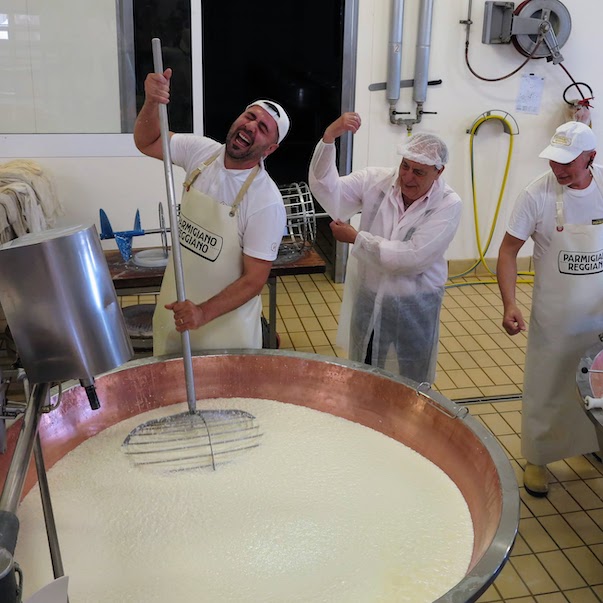
When the expert decides the time is right, a large ‘whisk’, a  traditional tool called a “spino”, is used to break up the curd into smaller pieces. It’s hard work but the men cheerfully put their backs into it. This isn’t just a job, this is a labour of love.

The cauldron is heated to 55 centigrade, and the granules slowly sink to the bottom forming a single mass. After about fifty minutes the large lump that’s formed is divided into two with a  large wooden paddle and these are lifted out in muslin bags. The remaining liquid, the aromatic whey, will be sent off to feed local pigs and give us delicious Parma ham.

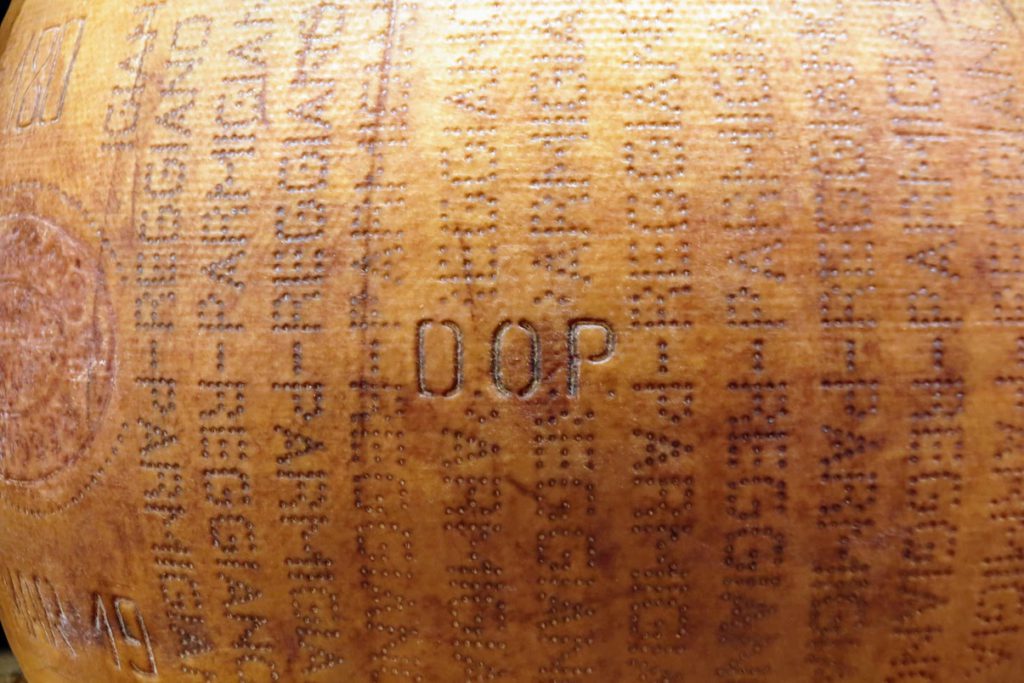
The next stage is to put each lump into the cheese moulds. These have a plastic lining embossed with all kinds of details of date, time and place, as well as a number that tells if the cheese was made in Reggio Emilia, Parma, Modena or Mantua 

This information embeds itself permanently into the rind as it forms, meaning the cheese has a ‘signature’ that’s impossible to fake or remove. Apparently though they are also experimenting with putting a microchip in the cheese to make it even easier to check provenance. As I say, there is big money in forgery and this product is so fine that the consumer has to be protected. 


The cheeses then head off for a relaxing salt bath for about three weeks. Here modern machinery is used to do the regular lifting and turning. These cheeses are very heavy at this point, being still full of moisture. In the old days it must have been very tough work.

Age is key

The cheeses once out of their briny bath are never aged for less than 12 months. At this stage the aroma is of fresh fruit, grass and flowers and the cheese is almost sliceable. After 24 months the crumbliness develops, while at 36 months spicier notes arrive. 36 months is usually the cut off point for general consumption, but some cheeses are pushed on to 48 which is a bit of a connoisseur’s cheese.

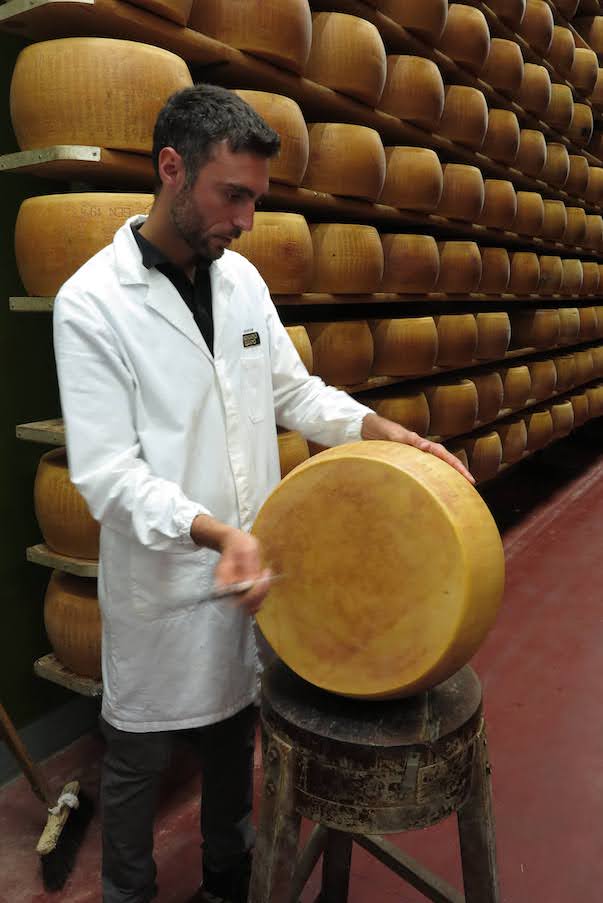
The cheeses are stored for all this time in vertiginous racks in massive temperature controlled rooms, and regularly tested by tapping them with a special hammer, as has been done down the ages.

The sound it makes is just a dull thud to my ears, but it tells the experts how well  the cheeses are maturing and any subtle tone variation will also reveal any fissures hidden inside the cheese. A fissure means the cheese, while perfectly good in every other way, must be rejected for sale as a whole cheese, the identifying rind will be removed and it will be broken up and used to make high quality ground Parmigiano Reggiano instead.

Cheese to please

The different ages result in cheeses for all occasions. The more mature being ideal for eating on their own as an aperitif, the irregular lumps really spreading the flavours onto the palate. Try some with a dab of honey and perhaps some walnuts.

Of course they are all delicious grated or shaved fresh onto salad or over pasta, but never please over seafood. Pasta with lots of butter, black pepper and grated Parmigiano Reggiano is a simple and delicious dish when made with such a quality ingredient.

It is of course delicious in a risotto, that final addition lifting all the flavours up

To keep a large block, which is a great investment, ideally wrap it in greaseproof paper, vac pack it, and put it in the fridge (never the freezer). It should be brought out to room temperature at least an hour before eating so the aromas and flavours reawaken.

If you have a large pestle and mortar then grate  Parmigiano Reggiano in, then add the best basil you can find, pine nuts, garlic and olive oil to make the very besto pesto.

So don’t just use Parmiggiano Reggiano for your spag bog! This versatile cheese has taken a long time to get to your kitchen, so take the time to make the very best of it.

#tasteofeurope #enjoyitsfromeurope #parmigianoreggiano #parmesan #euquality @parmigianoreggianouk