Proper Parmesan Takes Its Time

If your cheap parmesan tastes terrible it’s because it’s not the real thing. I went to Parma to see how genuine, PDO protected, proper Parmigiano Reggiano is made and why it has a premium price tag.

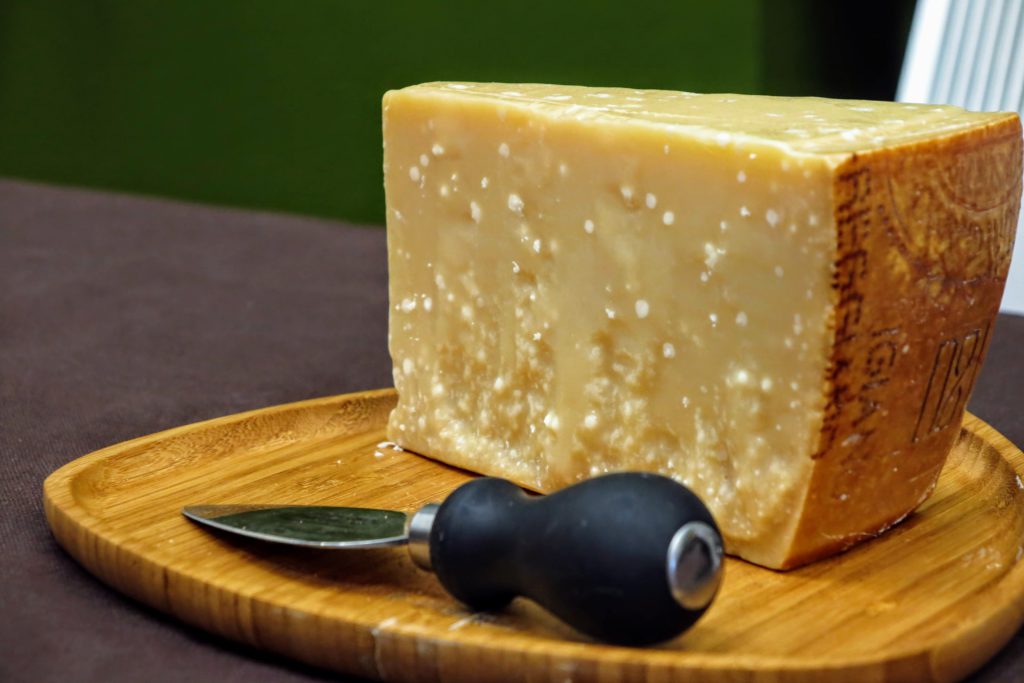
‘So this cheese is twelve years old,’ says Simone Ficarelli, the international marketing officer of Parmigiano Reggiano, expertly wielding the short, stubby, knife that’s the traditional tool used to break off chunks from the giant wedges.

There are white lumps in it, a distinct mark of a mature cheese. These are calcium lactate crystals, and are perfectly safe to eat. In fact the crystals in Parmigiano Reggiano cheese are a sign that the cheese has been properly aged. When you eat the cheese the crystals spark out a nutty flavour that complements the saltiness.
DOP Parmigiano Reggiano has been made for over 900 years and is only produced in the provinces of Parma, Reggio Emilia, Modena, Bologna to the left of the Reno river, and Mantua to the right of the Po river. This is the area of the farms where the cattle for the milk are fed on locally grown forage. It can only be made with this skimmed cow’s milk, salt, and rennet for curdling.
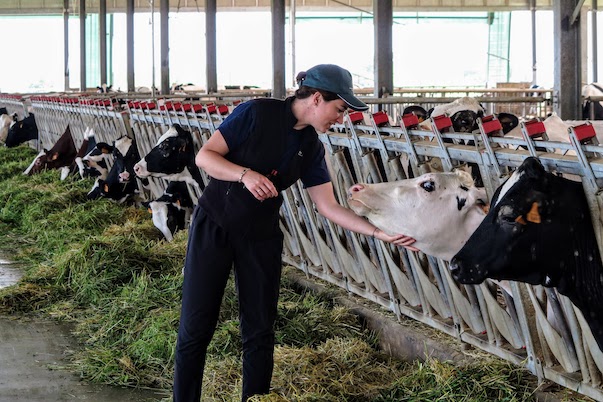
The cows live in airy open-sided barns, with extra fan cooling in summer, and they eat bundles of the lush grass that surrounds them. Strict rules ban the use of silage, fermented feeds and animal flour. They seem very happy, with plenty of room to move, and their waste is regularly pushed out and used for the farmlands. Water is carefully rationed for cleaning, no more than is necessary. This is an eco conscious process with rainwater collected from the giant roofs

Making milk into magic

TIn the dairy later, suitably attired in hair net and white coat, I learn more. Their milk then travels just a hundred metres to the next door dairy where, after being left long enough for the cream to rise and be skimmed off, it’s poured into traditional copper vats to be heated. It takes about 550 litres of milk to produce one wheel of Parmigiano Reggiano.

Rennet is added to curdle the milk and I watch the expert cheese makers sift the milk through their fingers to check the process. It’s a skill that a machine cannot emulate, only experience can work the magic.
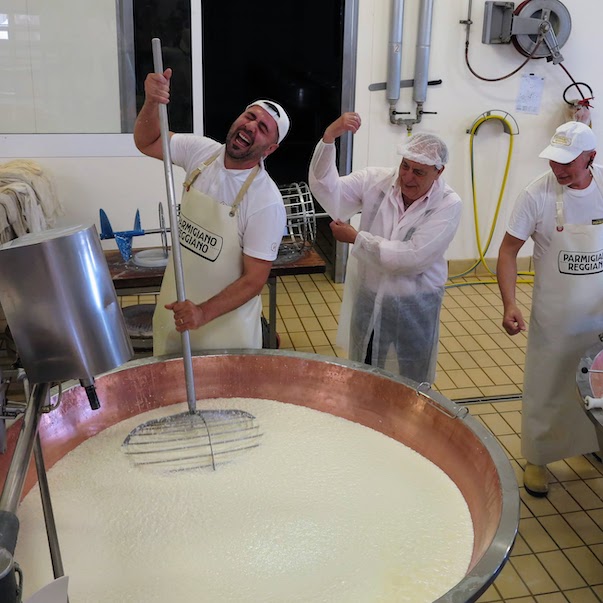
When the expert decides the time is right, a large ‘whisk’, a  traditional tool called a “spino”, is used to break up the curd into smaller pieces. It’s hard work but the men cheerfully put their backs into it. This isn’t just a job, this is a labour of love.

The cauldron is heated to 55 centigrade, and the granules slowly sink to the bottom forming a single mass. After about fifty minutes the large lump that’s formed is divided into two with a  large wooden paddle and these are lifted out in muslin bags. The remaining liquid, the aromatic whey, will be sent off to feed local pigs and give us delicious Parma ham.

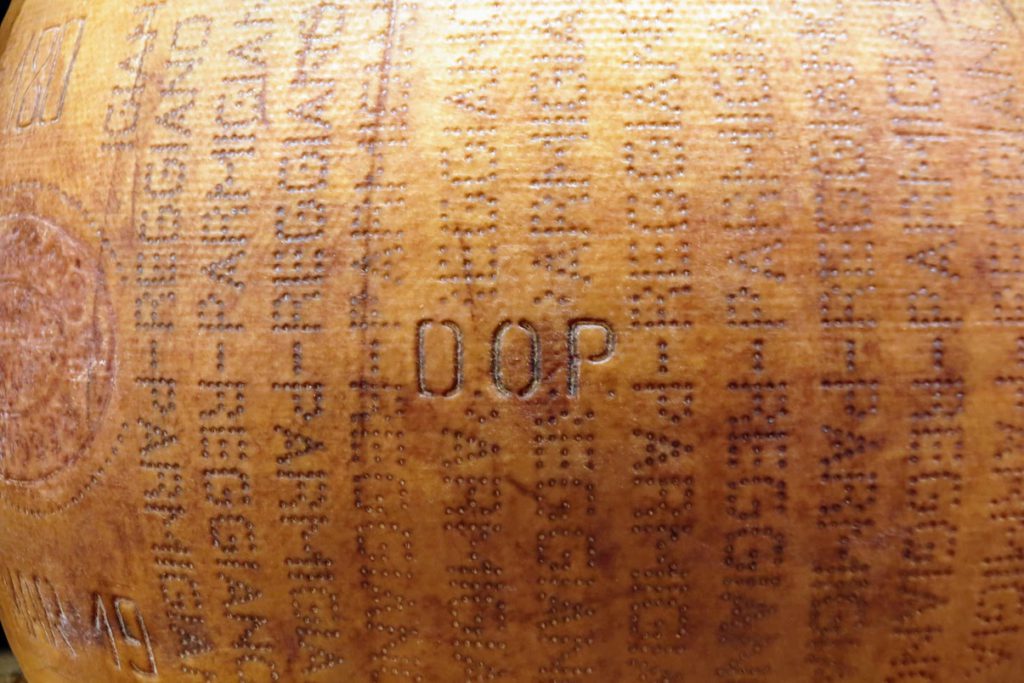
The next stage is to put each lump into the cheese moulds. These have a plastic lining embossed with all kinds of details of date, time and place, as well as a number that tells if the cheese was made in Reggio Emilia, Parma, Modena or Mantua 

This information embeds itself permanently into the rind as it forms, meaning the cheese has a ‘signature’ that’s impossible to fake or remove. Apparently though they are also experimenting with putting a microchip in the cheese to make it even easier to check provenance. As I say, there is big money in forgery and this product is so fine that the consumer has to be protected. 


The cheeses then head off for a relaxing salt bath for about three weeks. Here modern machinery is used to do the regular lifting and turning. These cheeses are very heavy at this point, being still full of moisture. In the old days it must have been very tough work.

Age is key
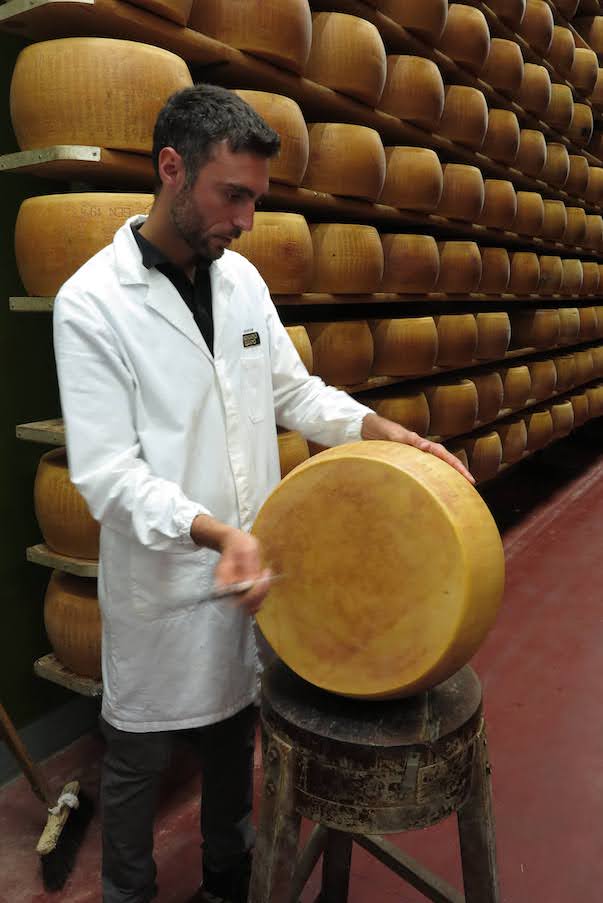
The cheeses once out of their briny bath are never aged for less than 12 months. At this stage the aroma is of fresh fruit, grass and flowers and the cheese is almost sliceable. After 24 months the crumbliness develops, while at 36 months spicier notes arrive. 36 months is usually the cut off point for general consumption, but some cheeses are pushed on to 48 which is a bit of a connoisseur’s cheese.

The cheeses are stored for all this time in vertiginous racks in massive temperature controlled rooms, and regularly tested by tapping them with a special hammer, as has been done down the ages.

The sound it makes is just a dull thud to my ears, but it tells the experts how well  the cheeses are maturing and any subtle tone variation will also reveal any fissures hidden inside the cheese. A fissure means the cheese, while perfectly good in every other way, must be rejected for sale as a whole cheese, the identifying rind will be removed and it will be broken up and used to make high quality ground Parmigiano Reggiano instead.

Cheese to please

The different ages result in cheeses for all occasions. The more mature being ideal for eating on their own as an aperitif, the irregular lumps really spreading the flavours onto the palate. Try some with a dab of honey and perhaps some walnuts.

Of course they are all delicious grated or shaved fresh onto salad or over pasta, but never please over seafood. Pasta with lots of butter, black pepper and grated Parmigiano Reggiano is a simple and delicious dish when made with such a quality ingredient.

It is of course delicious in a risotto, that final addition lifting all the flavours up

To keep a large block, which is a great investment, ideally wrap it in greaseproof paper, vac pack it, and put it in the fridge (never the freezer). It should be brought out to room temperature at least an hour before eating so the aromas and flavours reawaken.

If you have a large pestle and mortar then grate  Parmigiano Reggiano in, then add the best basil you can find, pine nuts, garlic and olive oil to make the very besto pesto.

So don’t just use Parmiggiano Reggiano for your spag bog! This versatile cheese has taken a long time to get to your kitchen, so take the time to make the very best of it.

#tasteofeurope #enjoyitsfromeurope #parmigianoreggiano #parmesan #euquality @parmigianoreggianouk
When is a cow not a cow? When it’s a Txuleton

Before I begin, I assume none of you lovely readers are vegans or vegetarians? If so, you might want to stop reading now.

I myself eat meat, but not a lot. So, when I do eat it, I want something special.

Txuleton is that something special.Txuleton, or rib, steak usually comes from the Rubia Gallega cow.

It’s a cow from North West Spain that can be as old as 18 years before being turned into steaks.In the Basque country old dairy cows are used.

That is pretty old. I mean in the UK beef is usually slaughtered before the cow gets to three years.

Normally dairy cows past their milking prime are disposed of, but in the Basque country they are fattened up for eating.

So why are old cows so good?‘

Well’, says Sagardi Shoreditch’s meat selector Imanol Jaca, ‘it’s because mature muscle and fat tastes better and myoglobin in the muscles means a redder meat’.

Continue reading

Delta Force

The eco-conscious Ebre Delta in Tarragona is unlike any other part of Spain. I took a few days to explore the rice, the food, the wine and even the sake.

DSC_6624

Paella is taken very seriously in the paddy fields

‘In a few square kilometres, I can find everything I need to eat,’ says local legend Senor Polet, as his friend stirs an enormous paella in the kitchen.

Outside the ancient house, a barraca style that’s typical of the area, the paddyfields of the Ebre Delta stretch away, stopping only at the base of the distant mountains in one direction and the nearby Mediterranean sea in the other. Continue reading

Tack For The Memory. Sweden On A Plate

Forget fika, there’s more to Swedish gastronomy than coffee and buns. Nick takes the plane north to dig down into the food-rich region of Jämtland Härjedalen

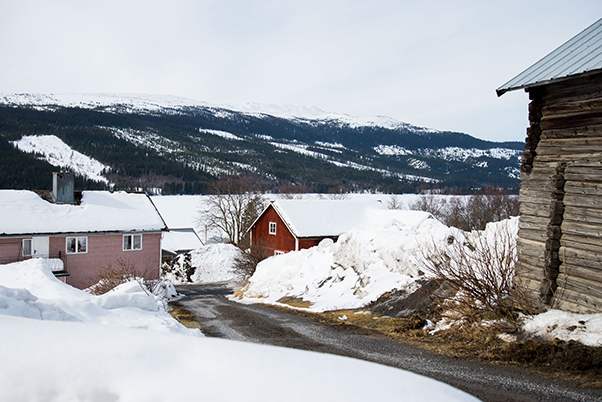
Frozen lake near Östersund Sweden

The Sound Of Silence

It takes two airplanes to get to Östersund, the capital and only city in Jämtland Härjedalen. The final descent out of a clear blue sky reveals a countryside that seems more lakes than land, with the lakes still frozen in April and blanketed in thick snow.

The melt is beginning though and soon the locals will put away their skis, the area is famous for its skiing, and begin to cycle and hike through their forests and fields. The Swedish here love to be outdoors whatever the weather.

And they love to eat well, the region is dotted with over 200 artisan food and drink producers, as well as restaurants and chefs that take inspiration and ingredients from the land and water around them.  Self-sufficiency is real here, not a fashion.

Frozen lake near Östersund Sweden

The Frozen North

Östersund on the edge of Lake Storsjön is a lively, friendly place and geographically it’s celebrated as the very centre of Sweden. The bars and restaurants don’t compete for business, they share it and as I move around the town I find the same faces –  bartenders, chefs, shop owners and local food entrepreneurs lall waving cheerfully as they slip and slide on the snow.

All that Jazz

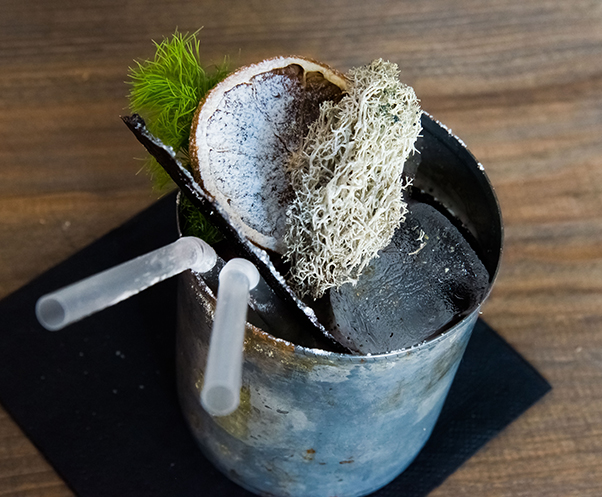
A cocktail in Jazzkoket in Östersund Sweden

Drink it or wear it?

In the centre of this centre of Sweden is Jazzköket, which means ‘Jazz Cuisine’ in English. Tucked away in a hidden courtyard, its open kitchen radiates heat and bonhomie and, typically for Sweden, there are all ages enjoying its eclectic interior design and delicious food.

From the bakery in the cellar comes out superb sourdough and chefs cook with beef from mountain cows, as well as ‘Fangsten’, which means whatever seafood has been caught and brought to them that day.

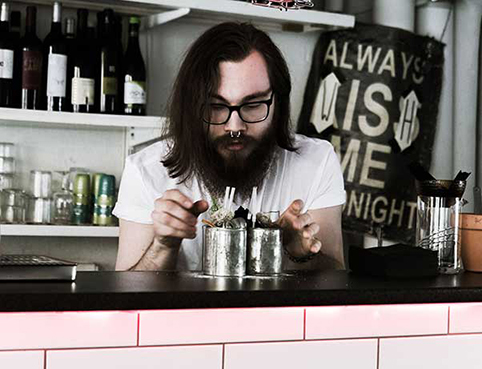
A bartender making a cocktail in Jazzkoket in Östersund Sweden

A Swedish Hipster?

Across the courtyard is a cellar bar, where the team create esoteric cocktails based on local ingredients and invite guests to choose their own music from a stash of vinyl in the corner.

Having a browse, I find the oeuvre of Saxon features strongly, Swedish men may all look like Hoxton hipsters but they do like ‘the metal’ all the same.

The hip bartender makes up a selection of cocktails for me to try, including a marvellous one made with moss and a food dish whose name is tongue twister, but with its salty fish roe totally blows me away with its depths of flavours and sheer Swedishness.

a dish of salmon, potato, carrot and dill at Lilla Saluhallen

It doesn’t get much more Swedish

Although for a classic Swedish lunch you’d be hard pressed to find better than the salmon, potato, carrot and dill I happily eat at Lilla Saluhallen later, a delicatessen and casual restaurant combined and run by the partner of the man who runs the Jazzkoket bar.

The menu board at Lilla Saluhallen in Sweden

It was all Greek to me

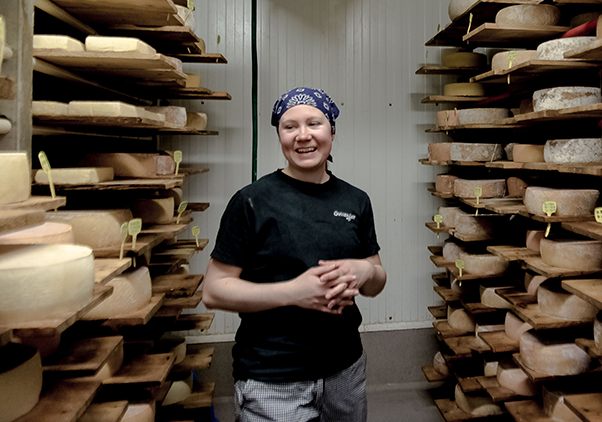
In her well-stocked shop of local produce, I taste some superb cheeses that came from Oviken Ost,a nearby dairy that makes its artisan cheeses from cows and sheep with the milk either from their own herd or sourced locally.

So, good was the cheese that I have to meet the makers, so I drive up to the dairy in blazing sunshine and blue skies that belie the 5C temperature outside.

A cheesemaker in the dairy at Oviken Ost Sweden

Say Cheese

‘We couldn’t get the sheep’s milk we wanted at first,’ I’m told as I am shown around, ‘so we began crossing Nordic ewes with purebred East Friesian dairy rams’. They have over 90 acres and 200 hectares of managed forest around them and the whole dairy here is eco-friendly with heat coming from a wood chip boiler that uses wood from their forest. The cheese they make is so good it’s served at Magnus Faviken’s restaurant not far away, as well as at Noma.

Cheese platter in Sweden

Delicious on crispbread

The milk is left unpasteurised to get every bit of the flavour out and the cheeses, which range from hard to soft, are a real treat. This is how cheese ought to taste all the time.

Pork matters

‘They look like Rastafarian pigs,’ laughs the chef at Slaktarn i Östersund AB, ‘they have long furry coats’.  I’m looking down at perhaps the finest pork chop I have ever seen on a plate.

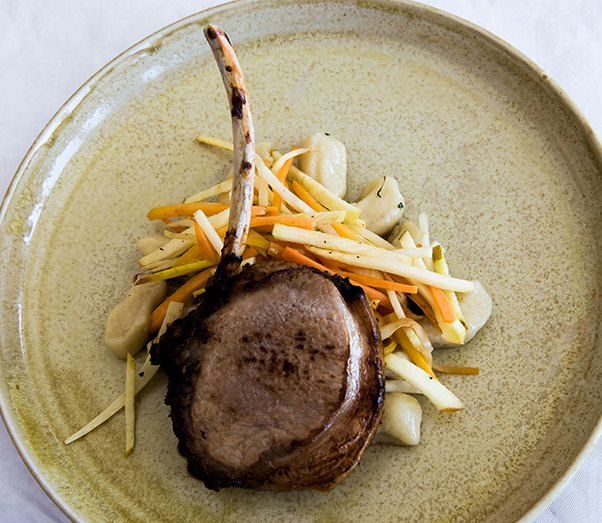
As thick as an old phone book, it’s perfectly cooked and simply served with crisp apple shards and local artisan beers Jämtlands Steamer and Jämtlands India Pale Ale. Here with the latter they know better than to overhop and create refreshing brews that are balanced and very drinkable.

A pork chop in Sweden

Chop chop

The guys at Slaktarn i Östersund AB are young men driven by a desire for proper meat.  The animals come from local farmers who all focus on providing natural lives for their animals, all grown to proper maturity and fed naturally from what the animals themselves choose to eat as they wander about freely.

The soil is monitored for organic quality and slaughter is carried out to the most humane methods, with the meat then aged slowly and carefully. The result is meat selected by all the best shops and restaurants in the area. And yes, that includes that place Faviken again.

Ice age

Nick Harman fishing on a frozen lake in Sweden

The smallest fishing rod ever

Of course, if you really want to get fresh food, you need to catch it yourself. Which is why the next day I find myself lying face down in the snow peering into a metre-deep hole we’ve just drilled through the lake ice.

Ice drilling in Sweden

Just a few more feet to go

A thirty minutes ride as passenger, and for a glorious fifteen minutes as a driver, on a powerful snowmobile with local hotel owner and mountain rescue expert Richard, has brought me out to the middle of a giant lake where the guides brew our coffee on fires made from scavenged wood and proffer slices of cured reindeer to keep us fed until the fish bite.

Nick Harman fishing on a frozen lake in Sweden

Not dead, just fishing

The rod is tiny, I look like a garden gnome. I can see the fish when I peer down, but they don’t want to be caught. We pack up and motor to a restaurant a few kilometres away deep in the Sami, the indigenous peoples, land.

The restaurant Hävvi in Glen is part of the Tossåsens Sami village in the Oviken mountains 50 km from Östersund and chef Elaine is married into a Sami family. The Sami people have lived from, and with, nature since time began and sustainability is their natural way of life.

A large bearskin pinned to the ceiling suggests that their attitude to nature is also pragmatic.

We eat Sami appetisers, a platter of smoked and cured reindeer components – heart, tongue, liver, that sort of thing – and then smoked mountain char, sea buckthorn, fried angelica, mayonnaise with apple vinegar, roasted bone marrow, fried fish skin and cloudberries, a plate redolent of this part of Sweden.

Chef Elaine at Hävvi in Glen Sweden

Plating up the Elk’s nose

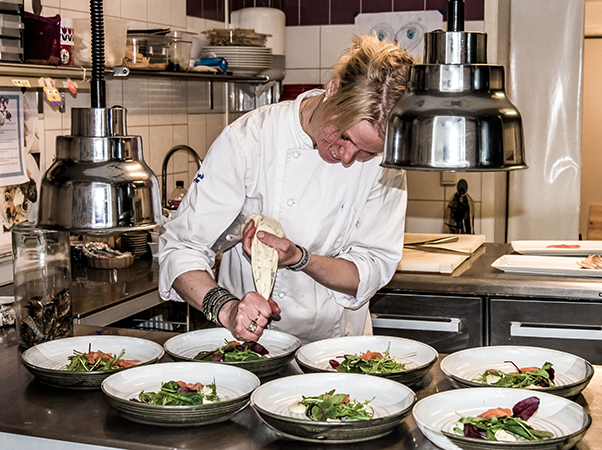
Then it’s tempered suovas with slow baked swede, spring vegetables, blueberries and creamed black chanterelle mushrooms and crispy elknose. Suovas is dry-salted meat smoked by the Sami over an open fire.

Crispy elknose is like pork scratchings, but a great deal tastier and we end with a palate cleansing sorbet made from cloudberries and sea buckthorn. It’s a meal that anywhere else would be served surrounded by pomposity, pretentiousness and with chef posing at the pass. Here Elaine just cooks the food she likes to eat, and it is excellent.

Drinking songs

Bottles of snaps at the Buustamon hotel Sweden

Snaps

The sound of singing is loud in the basement of the Buustamon hotel and we’ve only had a few drinks. Helan Går, roughly Chug It Down, is one song being belted out and I wish I could join in.

Snapsvisor (drinking songs) are popular with all ages and classes in Sweden and where better to get the tonsils twitching then in a distillery?

The exterior of of the Buustamon hotel Sweden

Where the Spirits live

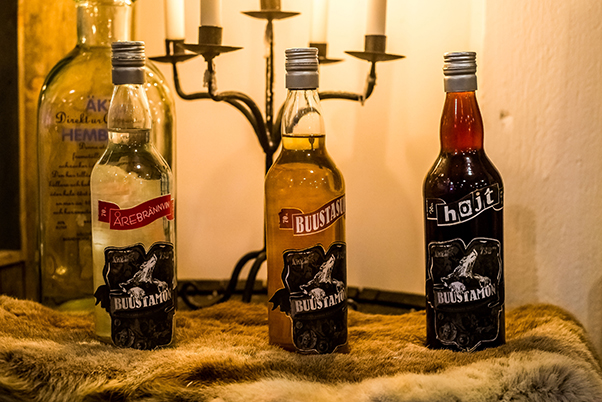
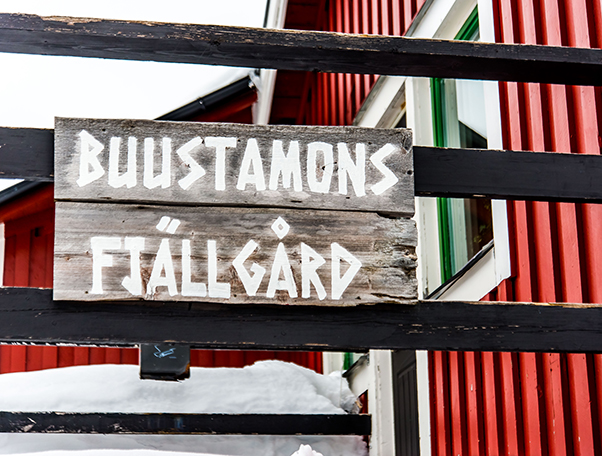
Snaps is a shot of aquavit, an ingrained part of Swedish culture and in this charming hotel and farm, halfway up Areskutan and accessible only by a bumpy but fun ride in a snowcat, they make their own –  all the way from the mash to the bottle labels. Beautiful freshwater, lingonberries, elderflower and all kinds of local herbs and spices are used between spring and autumn, any other time the water is frozen solid, to make their range of snaps – Arevodka, Buustasup, and Hojt.

Cured meat platter on a lake in Sweden

Snow snacks

It took them a long time to get the distilling permit under Sweden’s somewhat draconian alcohol laws, and rather bizarrely you still can’t actually buy a bottle at the hotel. No matter, I wobble up the stairs to the restaurant to a superb dinner of local produce in the wood heavy dining room.

Jämtland Härjedalen has certainly left me singing inside my head, with its wonderful people, food, drink and of course fabulous scenery. This amazing region is a place I could very happily call home and I can’t wait to come back again.

Chef in Sweden

The foraging chef

Big takt (thanks) to:

The Jämtland Härjedalen Tourist Board

Visit Sweden

www.Jht.se

www.Adventuresweden.com

Buustamon Hotel

Copperhill Mountain Lodge

www.are.se

Wikners i Persåsen Hotel

Mountains of magic

Nick finds out of ski season Switzerland is all about lush landscapes, fine vistas and plenty of cheese and chocolate.

dsc_6014

Interlaken is a centre for tandem parasailing

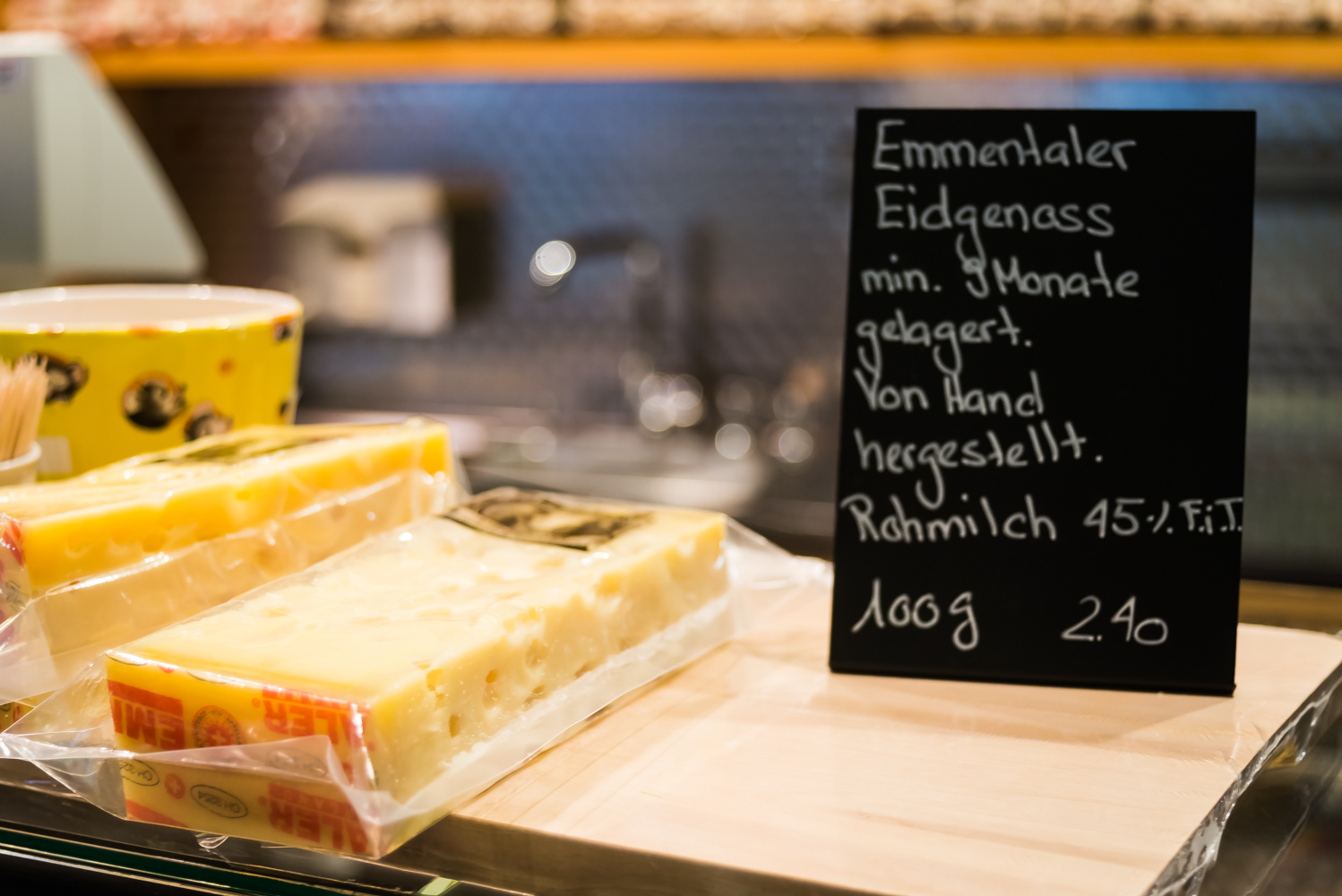
The parasailers circle over town like colourful vultures, perhaps lured by the smell of cheese? It’s hard to avoid the aromas of Emmentaler in a country where it’s eaten as often as we eat cheddar.

dsc_5762

The holes are made by the trapped gases during maturation

Emmentaler with its classic ‘cartoon’ holes is often regarded as a cheese suitable only for children, but Emmental eaten in Switzerland is another taste experience altogether.The milk of course is crucial, in Switzerland it comes from cows that graze on grass made lush by the snow melt. Continue reading