Jamie Oliver Catherine Street Review

Jamie is all over the place, but his restaurants no longer are. I try a recent new one in the company of some actors

To be honest, I am not actually at the same table as the actors, but next door is a Very Well Known TV Actress and an equally Very Well Known TV Chef, plus some other people I vaguely recognise.

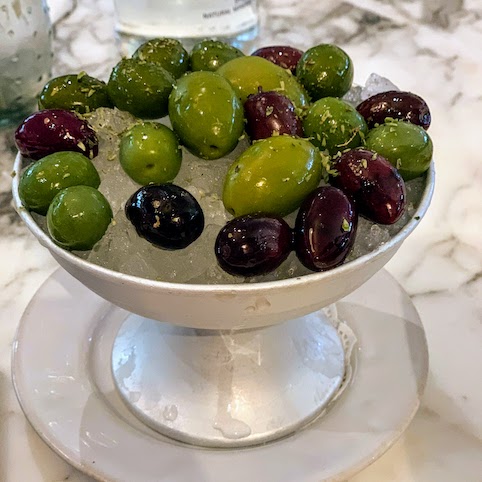
As I wait for my wingperson to turn up, while grazing a mix of olives dusted in oregano and  served, rather unusually, on ice, I also try to keep my own cool. Nonetheless when I momentarily glance over She looks up at the same time and our eyes meet. ‘ Big fan’, my eyes say, ‘Oh God, a stalker!’ say hers.

You’d expect to find actors in here for lunch though  as it adjoins the back of the Theatre Royal. A space between the buildings is now roofed over to create a spacious and airy mini dining atrium, so thesps only have to walk a few yards for a meal.


We are eating inside today though, in what was once the ground floor of an office block, not that you’d ever know it after a splendid refurb. The place has a Grand Cafe kind of buzz to it; classy without being snobby.

There are trendy artworks on the wall, classic old photos, unusual lighting, comfy banquettes plus Sade on the sound system. Apart from the latter it could almost be a Jeremy King joint, another restaurateur who has had his ups and downs.

It’s family friendly;  there are kids here and a kids’ menu. The seasonally changing menu itself is a one sided affair, colourful but disposable, it tells diners this is easy-eating. A two- or three-course set menu is available Monday–Saturday from 12–6pm, Sundays offer roasts with all the trimmings. 

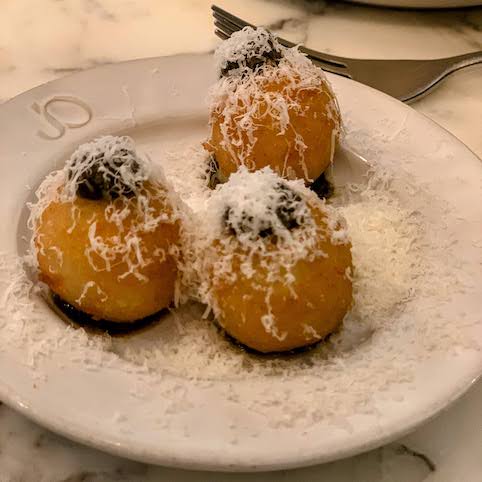
Apart from the icy olives there are other nibbles on offer.  Now that S has finally arrived  we try croquettes made with pureed Mrs Kirkham’s Lancashire cheese with leeks, and dobbed on top with pickled walnuts and they are one-bite tasty, the cheese gooey and sharp. Shame they are served in threes though and not twos or fours.

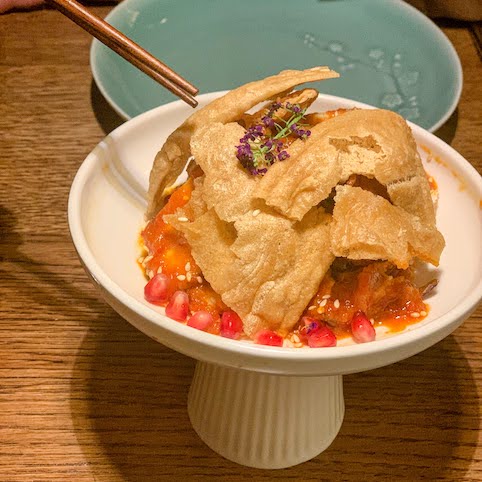
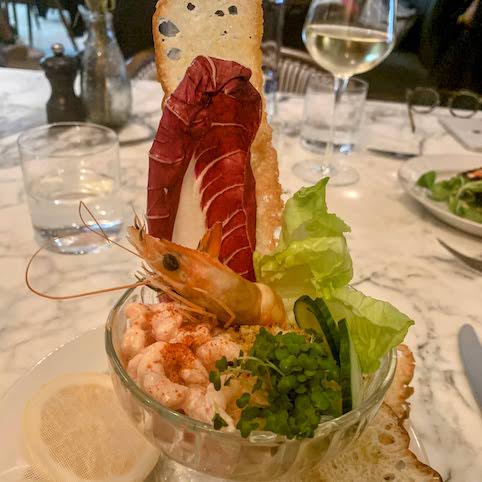
Jamie has said the food’s inspired by what he grew up eating at his parents’ pub, which explains the prawn cocktail on the menu, although it’s a bit more than that – it’s a seafood cocktail with British crab, brown shrimp, prawns, yuzu cucumber, Marie Rose sauce (natch) and focaccia crisps


It’s an impressive dish, the focaccia crisps are large sails powering the dish towards me. The prawns are a bit watery, the rest is good, especially the crab. I’d have liked some more Marie Rose sauce, my mother used to always sink our family Prawn Cocktails in the stuff and I used to also surreptitiously eat it out of the jar.

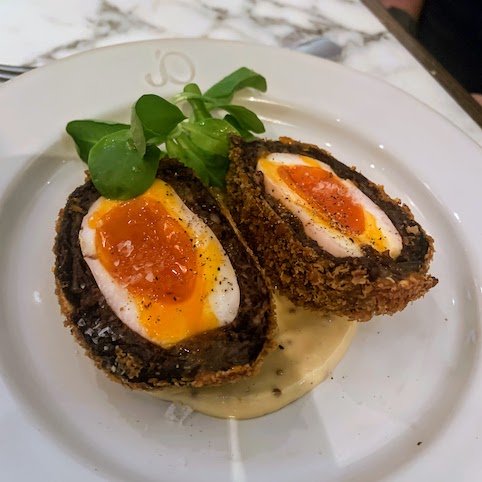
Mr Forty Minutes Late For Lunch has a Scotch Egg made with Stornoway Black Pudding, a Cacklebean egg and mustard mayo. It’s the sort of thing we ate a lot of in the late 80s and 90s, a Gastropub thing, and he reports it’s fine but not overly exciting. It’s a well-golden egg though and it is cooked perfectly.

The menu is full of Jamie’s other culinary memories and I recognise a few pasta dishes from the old BBC Executive Canteen, better known as the River Café, and some from legendary Fifteen as well. I go for the Dayboat Fish though, which today is Stone Bass, (or ‘Wreckfish’ or ‘Meagre’ ). A fish normally farmed and not caught, it comes swimming in a lake of “Champagne Cream Sauce, Dulse, Royal Kombu, Green Peppercorns, Herb Oil”. 

It’s a chunky fish, not quite as good as Sea Bass but firm and white and generously sized. The sauce is excellent, but it needs a spoon (or even a straw) to eat it. I instead use my ‘Koffman’s fries’ to blot it up. Good fries, but they needed more salt IMHO

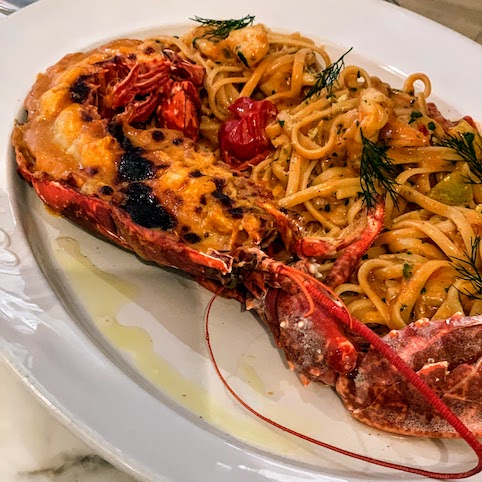
Also a day special is a whole split lobster with linguine and tomatoes. A big plateful, it rather intimidates S who finally has to admit defeat trying to eat it all. The pasta has absorbed lots of good juices from the tomato and shellfish, but it also makes it rather heavy going. He doesn’t regret trying though, it was a good lobster.

We’re drinking Pale Ale made by one of Jamie’s ‘mates’ in Walthamstow. Unlike most hipster ales it hasn’t gone overboard with the hops, so it doesn’t taste like drain cleaner. I like it so much I have two.

S is still suffering from lobster overload, so I have dessert alone, a rather nostalgic Jelly & Ice Cream, although this is very grown up jelly. Made with Provence Rosé, it wobbles like Keir Starmer being asked what a woman is, and raspberry and vanilla ice cream and summer berries finish it off. Really enjoyable.

This new Jamie puts bad memories of his Italians to bed, although there is a sense that the kitchen is being run by people doing a professional job and not a passionate one. With a menu that is obliged to cover all bases, from pasta to burgers, seafood to grills, that is perhaps not surprising though.

It’s certainly an excellent space and the food is highly competent, although the prices are somewhat higher than you might expect. The staff are charming, all commiserating with me as I waited and waited and waited for my guest to finally turn up.

And you may even get the chance to freak out a famous actress. What’s not to like?

6 Catherine St Covent Garden London WC2B 5JY
www.jamieolivercatherinest.com
Opening Times: Sunday to Wednesday: 12:00 – 10:30PM Thursday to Saturday: 12:00 – 11:00PM

Telephone: +44 (0) 20 3084 7565

Reservations: reservations@jamieolivercatherinest.com
Tacos and Steaks At Number 8

This special deal is a cracker, but, like the government,  you have to go to the country

On one of the hottest days so far, we get in the car and head out from South London to Sevenoaks. We can’t stand another sticky evening, or standing over a hot stove, so the lure of the country is strong.
It’s an area I know quite well, all my school friends lived out that way, while I lived a bit further in. Driving out this evening  I drove my wife mad as memories came flooding back of sixth form trips to pubs, to teenage parties and the time we rolled an overloaded Bond Bug down a local steep hill and it broke in half lengthways, leaving us all lying in a field wondering what had just happened.
Sevenoaks is a lovely old market town, the buildings well-preserved above the shop plimsoll line. Why do people ruin perfectly good old shops with plate glass? What do they have inside that’s so wonderful that it requires a clear view? I am talking about you, Nationwide.

In the centre, Number 8 is a venerable building from the outside with a charming open space in front. Once perhaps a rich merchant’s house, or a local dignitary’s

Inside it’s modern and chic, it reminds me of a boutique hotel. Everything is sparkling clean, it’s clearly a tightly-run ship with active staff and a warm welcome.

No surprise perhaps as Stuart Gillies who runs this, as well as the excellent Bank House, was CEO of The Gordon Ramsay Group for seven years and before that was chef at Michelin-starred restaurants including Daniel in New York, Hotel Lord Byron in Rome and The Connaught alongside Angela Hartnett.

The menu here looks very interesting, but we’ve come for Taco and Steak night, Two courses £25 per person, every Wednesday.

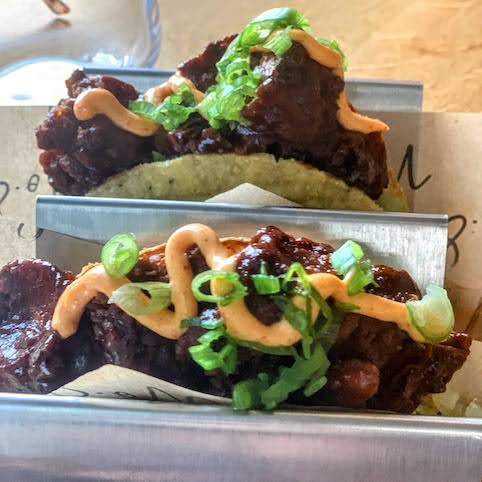
I like a simple choice and this couldn’t be simpler. Korean BBQ Buttermilk Fried Chicken, Cos Lettuce, Red Chilli Mayo tacos, or Crispy Beef Rib, Cos Lettuce, Grated Cheddar, Pineapple Salsa tacos. We order each.

Very delicious both, the chilli on the chicken is perfectly judged and all the taco shells are good and crunchy, but the crispy beef wins our hearts. It really is excellent and the pineapple salsa inspired.


Now the steak. Opinions vary on best cuts. Fillet I find boring, it’s okay en croute, indeed it’s the only viable option, but it lacks flavour. Rump, sirloin and all the other midfield players are fine, but if I want the back of the net I want onglet.

Or as I am delighted to see here, Picanha. This is a cut from the rump area, in the UK it can be often called Rump Cap. It’s very popular in Brazil and, let’s face it,  the boys from Brazil know their meat.

Also available are Chart Farm 28 Day Matured Rump Steak (£2 Supplement),  6oz Chart Farm 28 Day Matured Sirloin Steak (£3.5 Supplement), and for the veggies, Black Tiger Prawn, Coconut & Potato Curry with Grilled Flatbread. Sauces are supplemental, but why drown your steak?

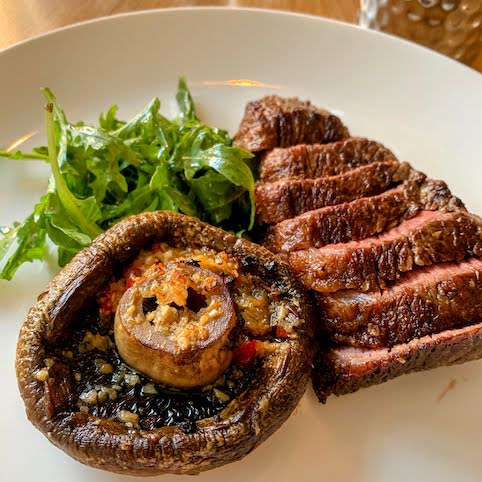
We both choose Picanha,  and what a great steak it is. It needs only careful cooking to medium rare, and, if the chef is good, it will have been cooked with its fat cap on which will be removed before serving, and it will have had a sprinkle of rock salt. This is all done right, it’s delicious.

Full marks for the chips too, which have bits of potato skin on them so, unless it’s a very determined piece of forgery,  I’d say they`re home made. A mushroom loaded with garlic is enjoyable.

Number 8 has a really excellent wine list by the way. Nothing too expensive but everything’s a bit unusual. They even have some Orange Wines, but I think that particular trend ship sailed some years ago. We had a Crianza, an up-from-basic Rioja, which was perfect,

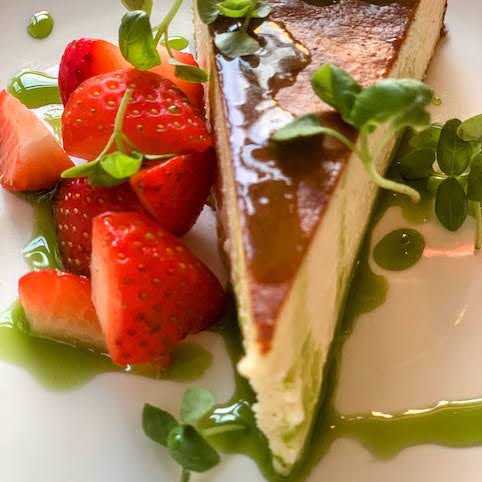
Dessert is not included in the set price, but we share a Basque cheesecake with Kentish Strawberries and a basil syrup. Again, really good. We loved that basil syrup against the strawberries.

Number 8 has all kinds of meal deals running all week, so it’s well worth keeping an eye on their website. This steak and tacos deal is a very good one.

If you’re local you probably know Number 8. If you’re not, then get in the car. Just be careful not to roll it down the hill.

8 London Rd, Sevenoaks TN13 1AJ

01732 448088

info@no8sevenoaks.com

Beef Brisket Mondays at Smith’s Bar and Grill Review

Low and slow is the recipe for success with this cut of meat. Smith’s Bar and Grill have pretty much nailed it

BBQ-ing brisket is a kind of religion in the US of A, especially in Texas. It’s a slow process, ten to twelve hours in a hot smoker, if it weighs around five kilos. Anything smaller will dry out.

It’s a labour of love and skill. I tried it once in my Weber Smokey Mountain and well after darkness had fallen the meat still wasn’t cooked and a small rebellion was going in our garden with guests demanding I go out and buy sausages as they were so hungry.

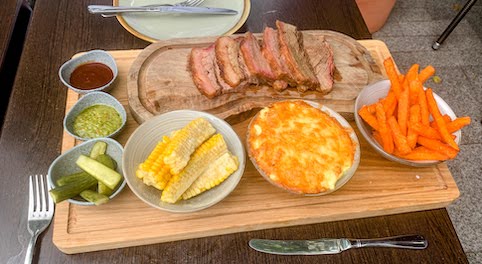
Available only on Mondays at Smith’s Bar and Grill restaurant in Paddington, this Beef Brisket Platter is slow-cooked for 13 hours and served with mac-n-cheese, pickles, corn and sweet potato fries.


I had to try it, to learn something about its cooking if nothing else, and on a hot day sitting by the Grand Union Canal seemed like a very good idea.

An idea that appeared to have occurred to a lot of people, as the terrace was full and the platters were flying out from Head Chef David Reyes’ kitchen at lunchtime.

It’s not terribly easy to find the canal when you leave Paddington Statio  if you’ve not done so before, or it’s been a while. So much has changed in a relatively short time. I went in a large frustrating circuit of the station and found myself pretty much back where I started, before a kind local put me straight.

It’s a lovely location with some houseboats bobbing on the water, some other boats converted into bars and restaurants, and well-heeled locals languorously drifting along what was once the towpath.

So the platter. £40 to share, which isn’t bad at all, and served on a wooden board as these things so often are

The corn has been sliced into quarters lengthwise, which is not a bad idea. It’s a lot easier to eat this way, less butter down the shirt. The mac n cheese is gooey in a good way, and who can resist a pickled gherkin? Not me.

The sweet potato fries I am not sure about, I like the taste, but they’re as limp as a politician’s handshake. I’d have preferred standard fries, but I know that Americsns do like sweet things with their meat.

Well what about that meat? I’m coming to that. I like to see a good ‘burned’ coat on slow cooked ribs and brisket but this didn’t have it. It’s called ‘bark’ and it comes from chemical reactions, as well the Maillard reaction and polymerization with the rub ingredients.

However there was ‘pinkness’ in the outer edges, clear evidence of smoke getting in, and it did taste very good. The meat was ‘cut with a spoon’ tender and with enough fat remaining to keep it all moist. We were actually rather impressed and tussled over the last slices, although there were plenty for two.

At £40 for two it’s a bit of a bargain and you can get a bottle of red or a white wine selected by Head Sommelier, Maurizio Titone, at 50% off every Monday. An opportunity to discover new fine wines at a fraction of the price.

Proper Parmesan Takes Its Time

If your cheap parmesan tastes terrible it’s because it’s not the real thing. I went to Parma to see how genuine, PDO protected, proper Parmigiano Reggiano is made and why it has a premium price tag.

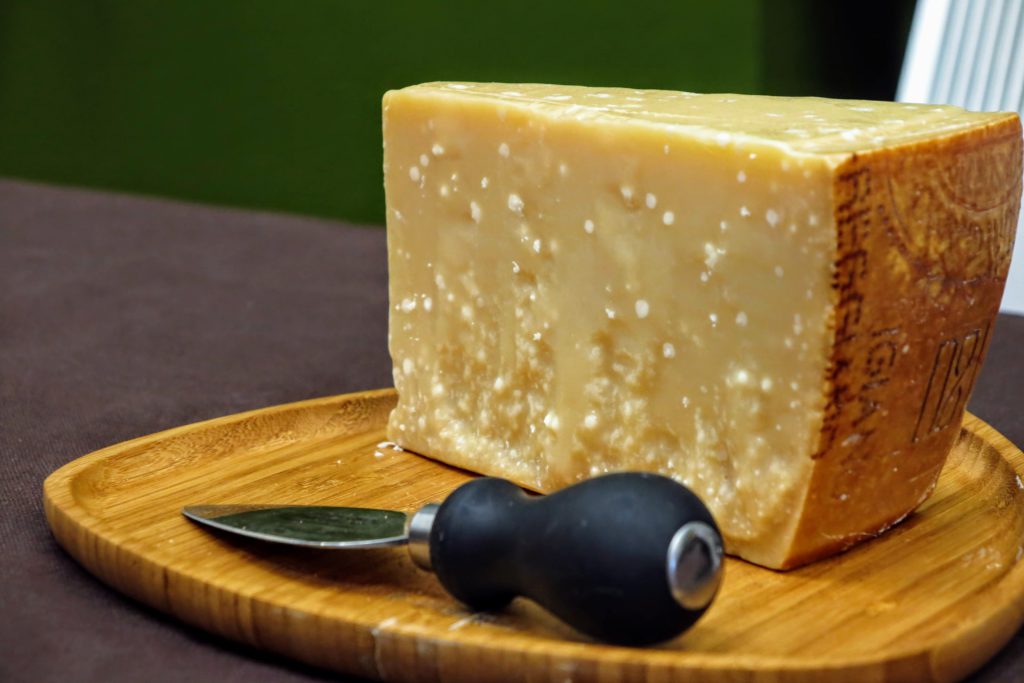
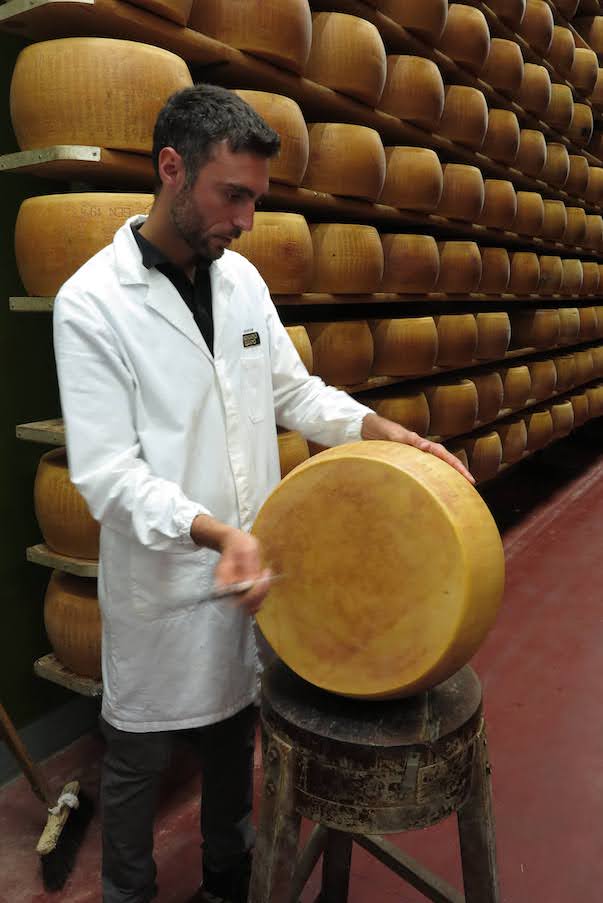
‘So this cheese is twelve years old,’ says Simone Ficarelli, the international marketing officer of Parmigiano Reggiano, expertly wielding the short, stubby, knife that’s the traditional tool used to break off chunks from the giant wedges.

There are white lumps in it, a distinct mark of a mature cheese. These are calcium lactate crystals, and are perfectly safe to eat. In fact the crystals in Parmigiano Reggiano cheese are a sign that the cheese has been properly aged. When you eat the cheese the crystals spark out a nutty flavour that complements the saltiness.

DOP Parmigiano Reggiano has been made for over 900 years and is only produced in the provinces of Parma, Reggio Emilia, Modena, Bologna to the left of the Reno river, and Mantua to the right of the Po river. This is the area of the farms where the cattle for the milk are fed on locally grown forage. It can only be made with this skimmed cow’s milk, salt, and rennet for curdling.

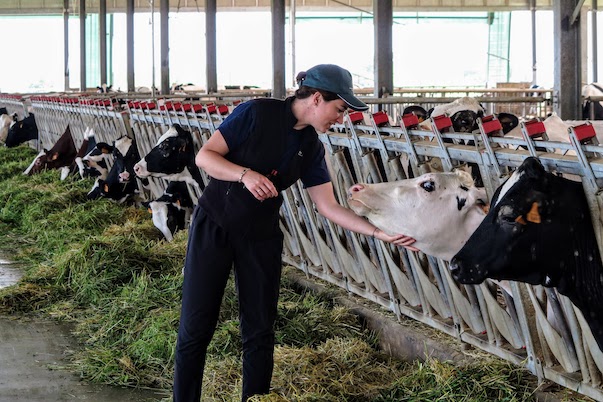
The cows live in airy open-sided barns, with extra fan cooling in summer, and they eat bundles of the lush grass that surrounds them. Strict rules ban the use of silage, fermented feeds and animal flour. They seem very happy, with plenty of room to move, and their waste is regularly pushed out and used for the farmlands. Water is carefully rationed for cleaning, no more than is necessary. This is an eco conscious process with rainwater collected from the giant roofs

Making milk into magic

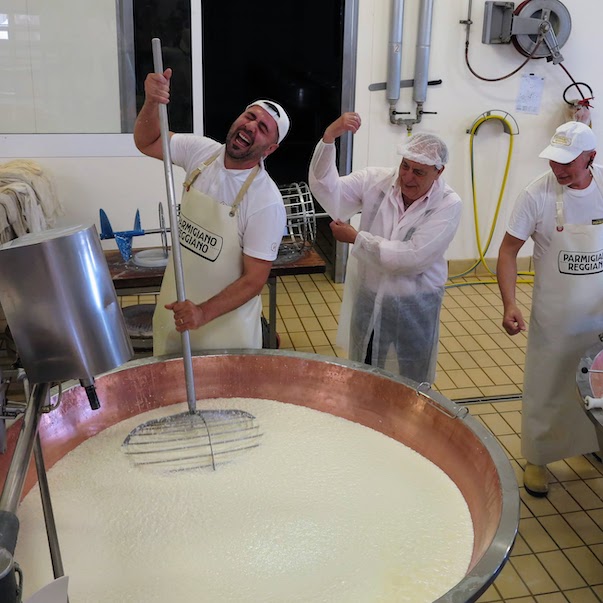
TIn the dairy later, suitably attired in hair net and white coat, I learn more. Their milk then travels just a hundred metres to the next door dairy where, after being left long enough for the cream to rise and be skimmed off, it’s poured into traditional copper vats to be heated. It takes about 550 litres of milk to produce one wheel of Parmigiano Reggiano.

Rennet is added to curdle the milk and I watch the expert cheese makers sift the milk through their fingers to check the process. It’s a skill that a machine cannot emulate, only experience can work the magic.

When the expert decides the time is right, a large ‘whisk’, a  traditional tool called a “spino”, is used to break up the curd into smaller pieces. It’s hard work but the men cheerfully put their backs into it. This isn’t just a job, this is a labour of love.

The cauldron is heated to 55 centigrade, and the granules slowly sink to the bottom forming a single mass. After about fifty minutes the large lump that’s formed is divided into two with a  large wooden paddle and these are lifted out in muslin bags. The remaining liquid, the aromatic whey, will be sent off to feed local pigs and give us delicious Parma ham.

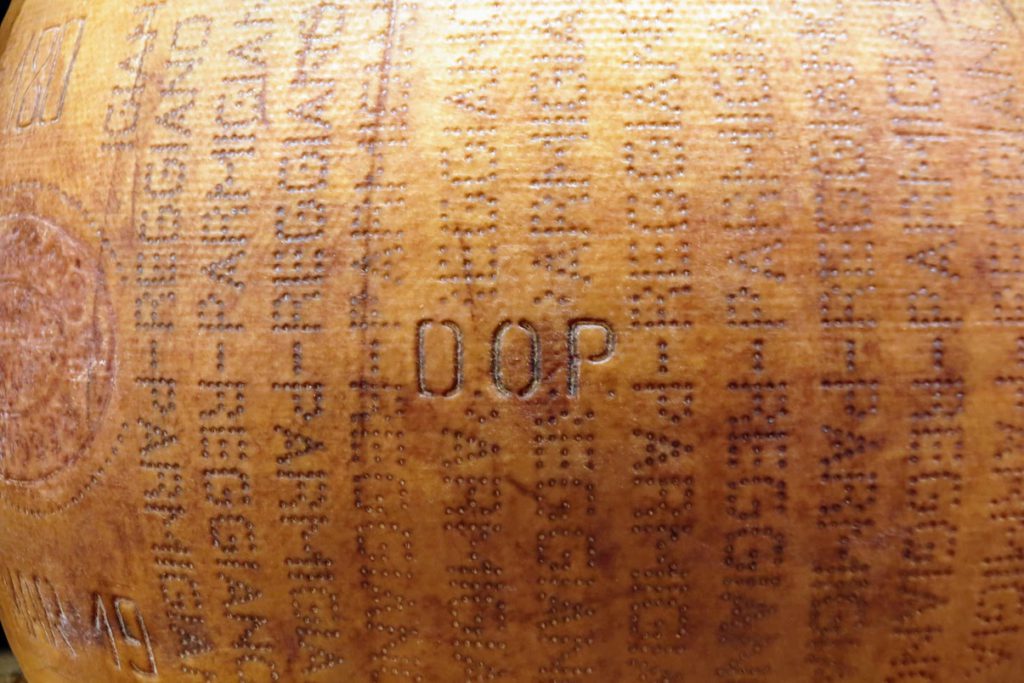
The next stage is to put each lump into the cheese moulds. These have a plastic lining embossed with all kinds of details of date, time and place, as well as a number that tells if the cheese was made in Reggio Emilia, Parma, Modena or Mantua 

This information embeds itself permanently into the rind as it forms, meaning the cheese has a ‘signature’ that’s impossible to fake or remove. Apparently though they are also experimenting with putting a microchip in the cheese to make it even easier to check provenance. As I say, there is big money in forgery and this product is so fine that the consumer has to be protected. 


The cheeses then head off for a relaxing salt bath for about three weeks. Here modern machinery is used to do the regular lifting and turning. These cheeses are very heavy at this point, being still full of moisture. In the old days it must have been very tough work.

Age is key

The cheeses once out of their briny bath are never aged for less than 12 months. At this stage the aroma is of fresh fruit, grass and flowers and the cheese is almost sliceable. After 24 months the crumbliness develops, while at 36 months spicier notes arrive. 36 months is usually the cut off point for general consumption, but some cheeses are pushed on to 48 which is a bit of a connoisseur’s cheese.

The cheeses are stored for all this time in vertiginous racks in massive temperature controlled rooms, and regularly tested by tapping them with a special hammer, as has been done down the ages.

The sound it makes is just a dull thud to my ears, but it tells the experts how well  the cheeses are maturing and any subtle tone variation will also reveal any fissures hidden inside the cheese. A fissure means the cheese, while perfectly good in every other way, must be rejected for sale as a whole cheese, the identifying rind will be removed and it will be broken up and used to make high quality ground Parmigiano Reggiano instead.

Cheese to please

The different ages result in cheeses for all occasions. The more mature being ideal for eating on their own as an aperitif, the irregular lumps really spreading the flavours onto the palate. Try some with a dab of honey and perhaps some walnuts.

Of course they are all delicious grated or shaved fresh onto salad or over pasta, but never please over seafood. Pasta with lots of butter, black pepper and grated Parmigiano Reggiano is a simple and delicious dish when made with such a quality ingredient.

It is of course delicious in a risotto, that final addition lifting all the flavours up

To keep a large block, which is a great investment, ideally wrap it in greaseproof paper, vac pack it, and put it in the fridge (never the freezer). It should be brought out to room temperature at least an hour before eating so the aromas and flavours reawaken.

If you have a large pestle and mortar then grate  Parmigiano Reggiano in, then add the best basil you can find, pine nuts, garlic and olive oil to make the very besto pesto.

So don’t just use Parmiggiano Reggiano for your spag bog! This versatile cheese has taken a long time to get to your kitchen, so take the time to make the very best of it.

#tasteofeurope #enjoyitsfromeurope #parmigianoreggiano #parmesan #euquality @parmigianoreggianouk

Yee-Hah! I sample SOUND London’s brand-new Americana menu

I’m not normally a fan of stereotypical American food, but I get kinda converted at a lavish preview

American food is often defined solely by the UK’s rather twisted lens. Watching TV we tend to think that all Americans ever eat is steaks bigger than plates and burgers so enormous you need to dislocate your jaw like an anaconda to fit them in.

Of course that’s not entirely unfair. Americans do things big and that includes food.

SOUND London is a very big space inside the Cumberland Hotel, so large it’s even got a London taxi in reception.

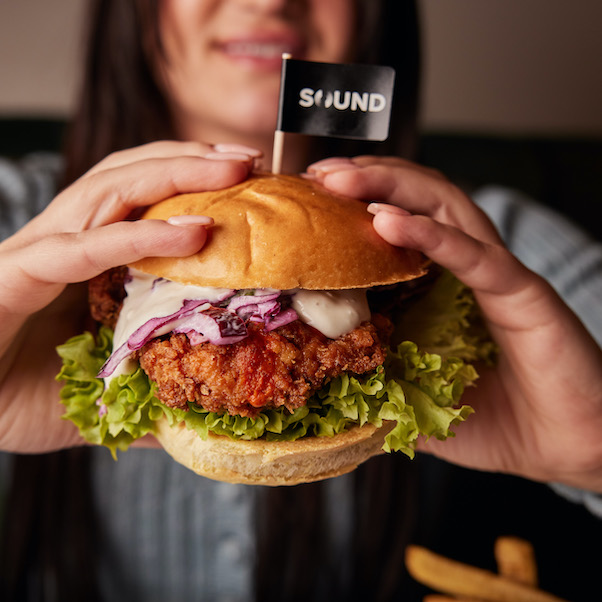
Walking in is like entering a classic bar in Florida, it’s all very colourful and bright and packed with people, and on the stage is a band. This is the kind of place usually called a Sports Bar where giant TV screens beam the big games with state of the art sound sound systems, and have live music at other times. The food is equallyloud and proudly Comfort American,

SOUND London at The Cumberland Hotel in Marble Arch now has a brand new Americana menu with lots of small plates, burgers, BBQ meat platters with sharing sides and gravy, and the mighty 20oz Tomahawk steak for sharing served with mash, chilli greens, baked tomato topped with a garlic and herb crumble, as well as salsa verde and red wine gravy.

So I starved myself all day in anticipation.

We skirted around the sweet little robot server trundling cheerfully up and down, and nabbed a table in front of the stage where an acoustic trio were competently playing all the hits and more. Rather oddly the two seat tables are arranged so one of you has his or her back to the stage, it would be better surely to have seats side-on so you both can see?

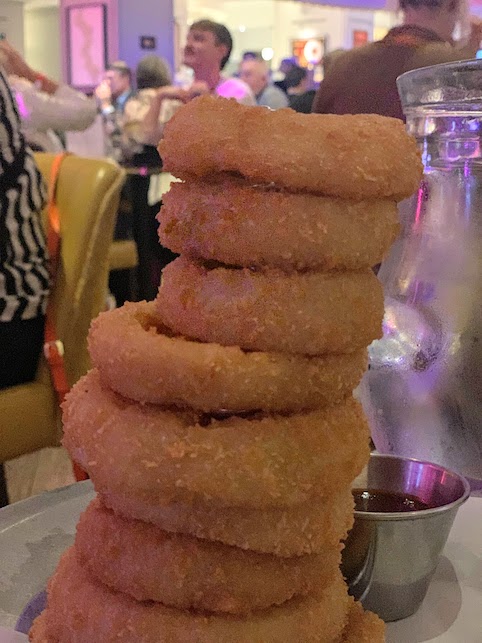
The menu is not massive ,but it certainly inspires big hunger. We had a cocktail each and were undecided for starters between Stuffed jalapeño poppers, Jumbo prawns with spicy mango salsa, Grilled corn ribs, Buttermilk Chicken Tenders and the ‘Ultimate Onion Ring Tower’.

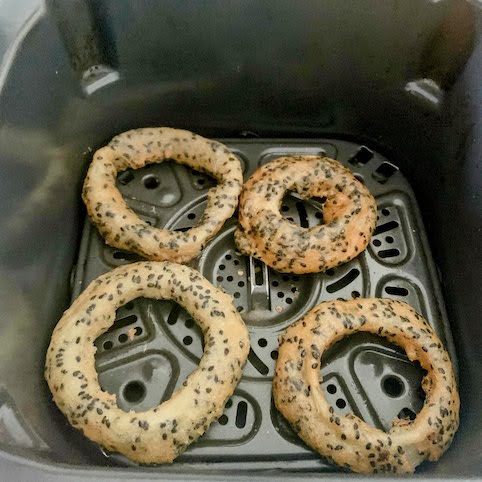
We had the peppers and the prawns and also succumbed to our server’s insistence to try the onion tower – well, when in the U.SA etc.

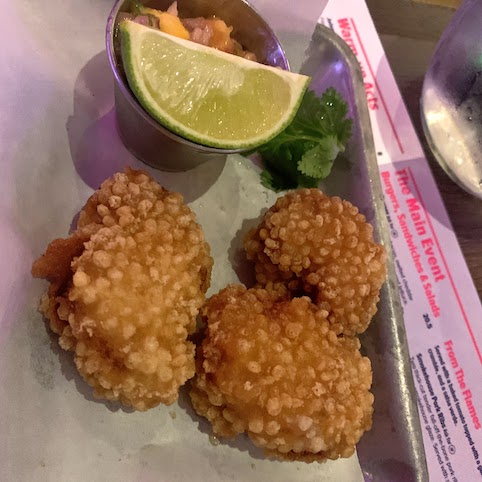
The peppers were great, ideal for accompanying drinks, ideally ice cold beers. The prawns fat and juicy, the batter crisp and fresh. And the onion rings? Well these were impressive and certainly towering.

They were also extremely, deadly, hot. We both had serious problems through taking too big a bite, the batter burning us and the onion inside annoyingly reluctant to be bitten through. We decided to let them cool down and concentrated on our other dishes. If your kids order the tower, and this is a kid friendly place, be careful.

We wanted the Tomahawk steak to share, who wouldn’t, but apparently it’s marinaded in red wine and J is allergic to tanins. We agree to share the The Smokehouse Platter instead – BBQ-glazed smoked beef feather blade, pulled pork shoulder, glazed pork ribs, Texas hot link sausage, grilled corn ribs, BBQ ranch beans, red cabbage slaw, pickles and tear ‘n’ share mezzaluna bread.

It’s brilliant, a real feast of America. The ribs fall apart perfectly, the shoulder easily falls to the fork and we devour it all hungrily as the band lurches into an acoustic version of Oasis’ Stand By Me.

Anyone not on the red meat train could go for the Big Bird Platter -BBQ-glazed skin-on chicken breast, slow-roasted chicken wings in a choice of BBQ or Buffalo Hot Sauce, buttermilk chicken tenders, grilled corn ribs, BBQ ranch beans, red cabbage slaw, pickles and tear ‘n’ share mezzaluna bread and it looks good,.

Sounds Big Burger

And if you want a burger well fear not because the Burger Studio has The London Double Decker, crispy buttermilk chicken Clucky and smokey BBQ Pulled Pork. And they are biggggggg!

We watch them go past rather wistfully, as we are now sated, and just about manage a House Apple Cobbler, and a thick Millionaires Brownie. We are stuffed and then some.

Take me home, country roads. Or rather, take me home Northern Line. I did enjoy our visit to America.

 https://sound.london/

@sound.london 

Great Cumberland Place, Marble Arch, London, W1H 7DL 

For more information please visit: https://www.guoman.com/the-cumberland  

#HITPLAY 

The Art of Afternoon Tea

A beautiful room and some seriously stunning cakes, this afternoon tea certainly made my day

They say English Afternoon tea originated in the 1840s, a light meal to tide over genteel ladies of quality until dinner at 8pm.

Lunch it seems was not an English thing back then, a posh person had a biggish breakfast and then toughed it out until the evening. No nipping down to the mansion, or the castle kitchen, for a sneaky snack.

So to combat afternoon energy drops, ladies began taking tea and delicate sandwiches at around four o’clock in the afternoon. Soon no society hostess could afford not to invite or be invited to tea, it was ‘the thing’.

Today it’s something many tourists actively seek out, a quintessentially British experience in London’s best hotels. With so many on offer though, many a disgraceful rip off, it pays to be selective.

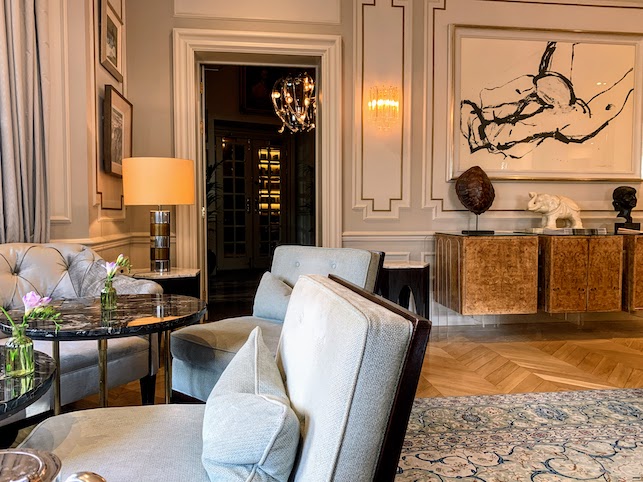
The Kensington, part of the Doyle Collection,  is one the very best. Just a short walk from South Kensington station and the Natural History Museum, Royal Albert Hall and V&A,  it appears to have been created by joining four elegant 19th Century stucco fronted houses together. Entering through the grand front door, held open by bowler hatted porters, you turn left into a gorgeous double aspect lounge.

On any day it’s a well lit room, warmed by a real fire, but on this sunny early Spring day it shines and dazzles. The furniture is a mix of modern and antique and just what you’d expect to find in the townhouse of a tasteful member of the aristocracy. Understated elegance.

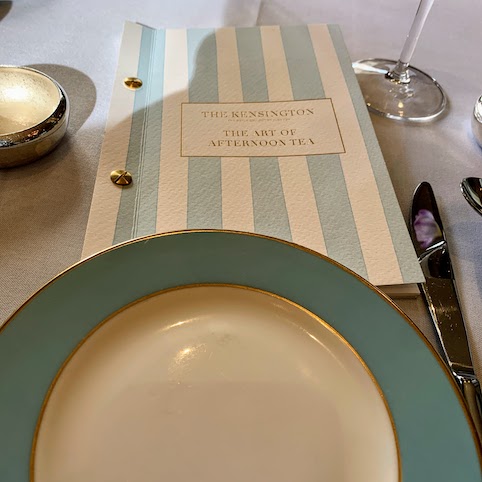
We take a table in one of the bay windows, noting the excellent china cups and saucers as well as the crisply folded napkins. Every detail matters when taking tea.

The menu offers a variety of The Rare Tea Company teas and infusions, from the classic ‘breakfast tea’ to exotic single suppliers. They are all the same price and are served ‘bottomless’, although you’d not utter such a common phrase here. A pre tea glass of champagne is appreciated, if not exactly traditional.

Up to a point the food is classic, which is a good thing. I’ve tried afternoon teas in places where they’ve gone crazy with the sandwiches, creating monsters that can’t be eaten without mess. The whole point of AT sandwiches is that they must be dainty, easy to hold and to nibble at.

Our tea arrives in silver pots too heavy to lift, which is okay as the charming staff are there to pour tea for us. Milk first or last? Last of course, because that way you have a chance to adjust the tea’s strength

I have delicious Rooibos while P has Cloud Tea, a fragrant black tea from the “Abode of Clouds” in the cloudy hills between Assam and Darjeeling. 

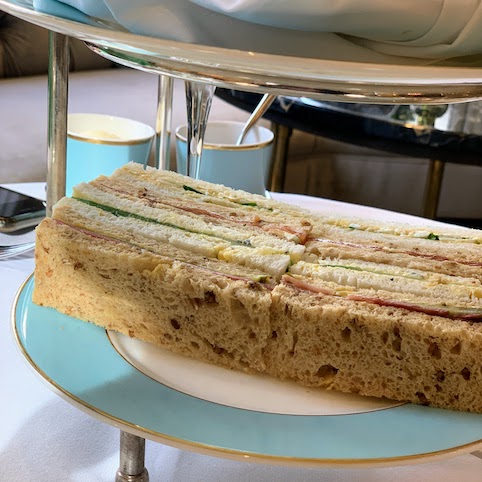
From the elegant tiered stand come sandwiches which are pukka and properly finger shaped  – there is St. Ewe Egg with watercress, Chapel & Swan smoked salmon with lemon cream cheese,  Cucumber with mint cream and Pastrami with gherkin and horseradish. All beautifully delicate and the teas make them taste even better.


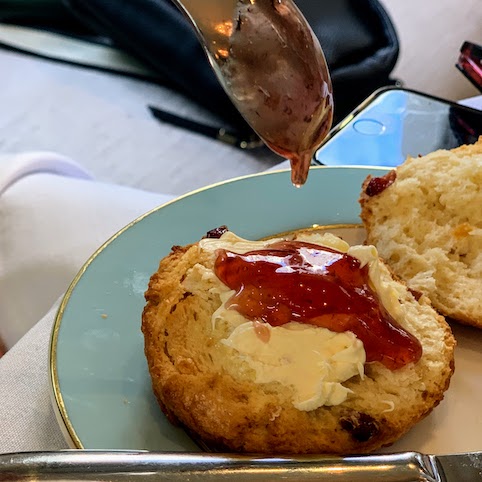
We have plain and fruit scones, cosily wrapped in a soft napkin. They are still warm. Thick clotted cream and homemade strawberry jam are slathered on.

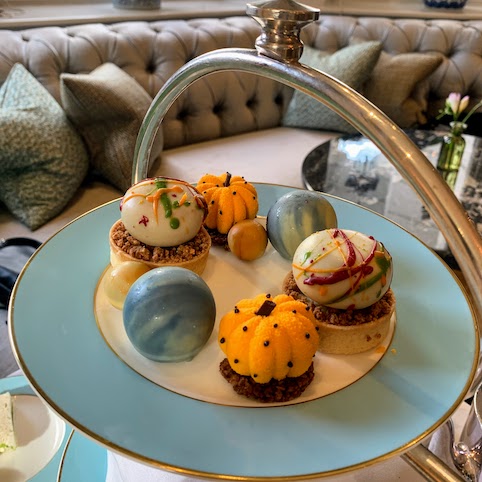
And now, as we wipe some off that jam off our shirts, we come to the art in the Art of Afternoon Tea.The sweet cakes have been inspired by artists and are quite incredible, so much detailed work has gone into them that it seems a shame to eat them so we look for a while instead.


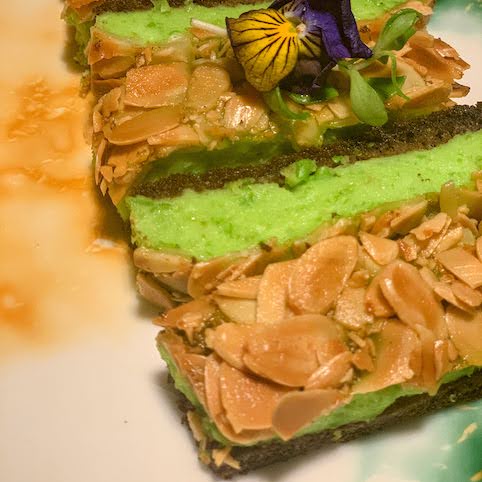
These are inspired by Jackson Pollock, Yayoi Kusama and Alicja Kwade. The Pollock  uses his ‘drip technique’ for a dark chocolate mousse tart with passion fruit parfait, Japanese artist Kusama’s cake is  polka-dot pumpkin of mango mousse shrouding  coconut yoghurt cream, and visual artist Kwade’s spheres are made from white chocolate vanilla mousse with pineapple compote centre.

Our photos do them some justice, but they are even more remarkable in the sweet, sugary flesh. A bit messy to eat, but I think that’s allowable.

We have our teapots refreshed and sink back into the deep cushions. The ceremony has done its job, we are no longer hungry but also feel that by dinner time we will be ready for more.

Everything done right traditionally and with a modern ‘arty’ twist. This Afternoon Tea is one you will savour.

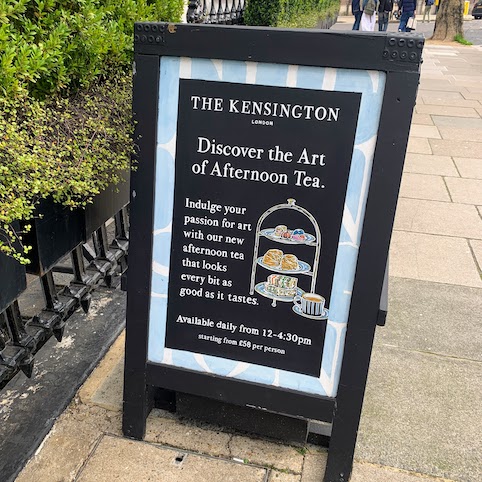
Prepared and served fresh daily, The Art of Afternoon Tea is available everyday from 12pm-4.30pm for £58 per person or £70 per person including a glass of champagne. 

The Kensington 

109-113 Queen’s Gate

South Kensington, London, SW7 5LP

El Norte Restaurant Review

If you’re looking for a grand night out amongst the moneyed and influential, along with finely cooked and presented food that has a price tag that keeps out the riffraff, then El Norte will make your year complete.

The passionate sound of Flamenco can be heard as you pass into the warmly low lit space that is El Norte, (you won’t take any bright shiny ‘Grams here). This could be a warning klaxon though, is someone going to start singing Y Viva Espana any moment? My dad used to do that at the drop of a castanet, I still blame Freddy Laker.

Well no, as is this not cheesy muzak Flamenco but the live sound of Monica Guech, a Spanish vocalist and composer who creates a fusion of Pop Soul, Jazz and Spanish Flamenco, and she’s here every Tuesday evening. 

It’s done very tastefully, non-intrusively, and at just the right volume so that you can still talk to others at your table. Doing things tastefully and, it has to be said, somewhat expensively, is what Arian and Alberto Zandi, co-founders of the Emerald Hospitality Group and creators of El Norte do very well.

It’s lush inside, as you’d expect in affluent Mayfair, and is said to be taking its inspiration from the great villas of Northern Spain with its vintage upholstery mixed with low slung lighting which, as I say, may be bad for Instagrammers but is very nice for couples. Too many restaurants today are lighting for mobile phones, not atmosphere. Photos here are therefore provided by the restaurant.

Service is also as slick as would be expected; impeccable staff formally dressed and gliding around on invisible wheels, delivering properly weighty fabric bound menus for cocktails, wine, and of course food, and then melting away with a smile. 

The cocktails are certainly creative, even if not always exactly Spanish, P’s Passion Foam Mule – Vodka , Ginger Syrup , Lime juice, Foam, looked like a pint of real ale in pewter mug and she loved the sharp astringency. I had Smocked (sic)  Bacon Old Fashion – Rye Whiskey , Choc Bitter’s (sic) , Bacon, Wood Smoke which was uncapped at the table to allow the aroma of camp fire to drift across our table, and to slightly alarm the folks next door until they realised it wasn’t actually a kitchen fire. There is by the way a bar attached to the restaurant where you can sample their cocktail creations until 1:30 a.m.

The menu at El Norte is pleasingly compact but even so has enough interesting dishes to keep you happily undecided. Many take their cue from traditional Spanish plates, but inject some striking modern touches. Broken into sections  para picar (nibbles), ensaladas y crudos (salads and raw dishes), vegetales de temporada (seasonal vegetables), carnes (meat and poultry), pescados y mariscos (fish and seafood), and para acompañar (sides) it has something, as they say, for everyone. 

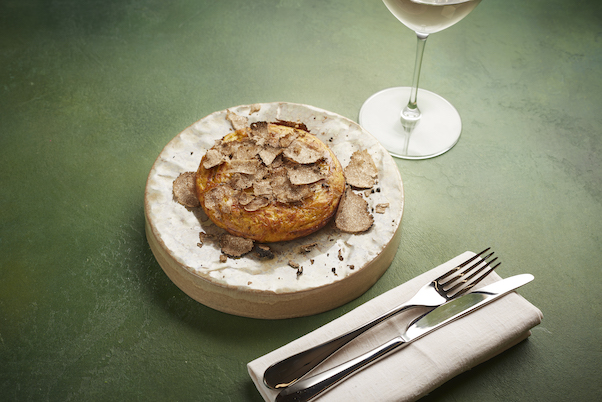
After a stylishly simple amuse of almond and garlic soup, and a few moments being tempted by Calamares Fritos Con Ali Oli – Fried calamari rings with lime mayo, which we know will be light years ahead of standard squid rings, we go for the tortilla de trufa to share because I love the honesty of tortillas.

These are so hard to get right at home, often being too oily, but no such problem here, the plump tortilla is packed with mushrooms, onion and, of course, potato, with generous slices of truffle on top and, masterstroke alert, lots of Manchego cheese on the side.

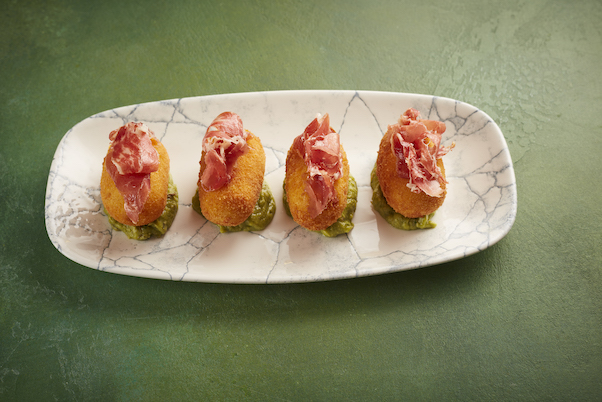
It’s a bit more decadent than your usual tortilla, but what a great dish it is, we busily clash forks for the last bits. After that, we probably don’t need the two croquettes we ordered, and to be fair the waiter did warn us we might be overdoing it, but they are worth it. Large, crispy coated, beautifully creamy inside flecked through with jamon, with extra jamon on top, because you can’t have too much Jamon, plus a lubricating blob of guacamole.

Much as I like the croquetas I felt that I could have pushed out the boat and gone for Tartar De Gamba Roja Y Lima – Red prawn tartare with lime olive oil, Red prawns are a bit of a gourmet rarity, but El Norte gets much of its food direct from Spain, so they would have been good to try. 

Once upon a time for my main I’d have been on the Galician grilled octopus like a starving shark. Everything from Galicia is gorgeous, but their seafood is especially sought after.  Spanish people go there just for their foodie holidays, as the weather, being on the Atlantic coast, is not a big draw.

I’ve seen too many nature documentaries now though, and I find octopuses both mysterious and fascinating.  Quite possibly they are emissaries from a higher alien civilisation, whose bosses won’t be too pleased when they find out we’ve been grilling their ambassador.

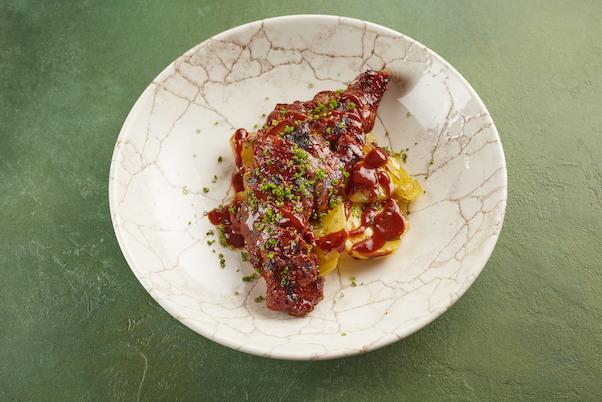
So its Pluma De Cerdo Iberico Glaseada,  Glazed Iberian pork with potatoes for me, a cut of  pork that is the Holy Grail of pork in Spain. Pluma, or Pen, is a triangular shaped cut with only one available from each pig and often weighing no more than 100g. It comes from the acorn-fed black pigs that give us Iberian Jamon and so, when you add all this up, it’s no wonder it’s a lot more expensive than fillet steak as well as a lot more tasty.

Here they’ve marinaded it overnight, before roasting it and glazing it for extra flavour and sweetness. It is delicious, and the potatoes, sliced and fried are all it needs. That said I also have some asparagus with almonds coated in Romesco sauce ( a classic sauce of tomato, almonds and paprika) which adds another level of taste and texture.

If steak is more your thing however, then Chuletón De Vasco Buey serves up a kilo of premium basque rib eye, and you can’t get much better than that. I see one go past and am a bit envious.

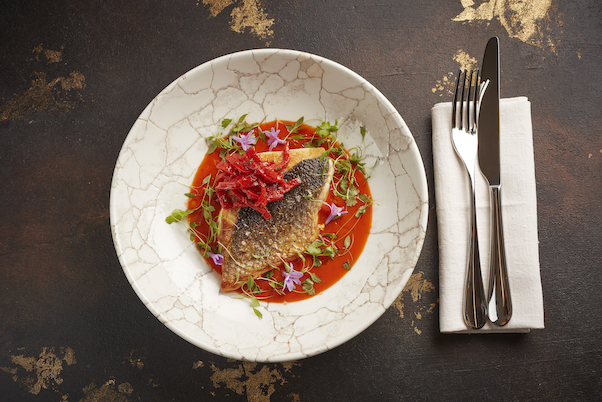
P is more delicate in her choices, having Lubina Salvaje A La Riojana – Wild seabass with sweet tomato and red pepper sauce rather than meat. Again this is first class sourcing, the large seabass fillet full of its own flavour and well able to balance with the sauce with tightrope walking accuracy. P shares the asparagus and some of my potatoes, even though I try and stop her.

So having eaten many of my potatoes, P is unable to do dessert so I order chestnut mousse and toffee, a seriously sweet dish with that unique chestnut taste I recall from my days at Scout camp, something I now try to repress. It’s gorgeous.

And so is El Norte. Spanish food has many guises, from the small and dusty tapas bar in  remote villages and the now Disney-fied food of San Sebastián, to the luxury take of El Norte and it’s all good (except for some of those San Sebastián places).

If you’re looking for a grand night out amongst the moneyed and influential, along with finely cooked and presented food that has a price tag that keeps out the riffraff, then El Norte will make your year complete.

Live music is every Tuesday and at weekends a new resident DJ, Santiago Perez is there every Friday and Saturday for a mix of Latin influenced house music.

19-20 Dover St, London, W1S 4LU

Website

When the boat comes in. A Taste Of The New(lyn) Cornish Food Scene.

In and around Newlyn, restaurants are cool, creative and it’s now a food destination that has to be tasted to be believed. I take a trip to taste for myself.

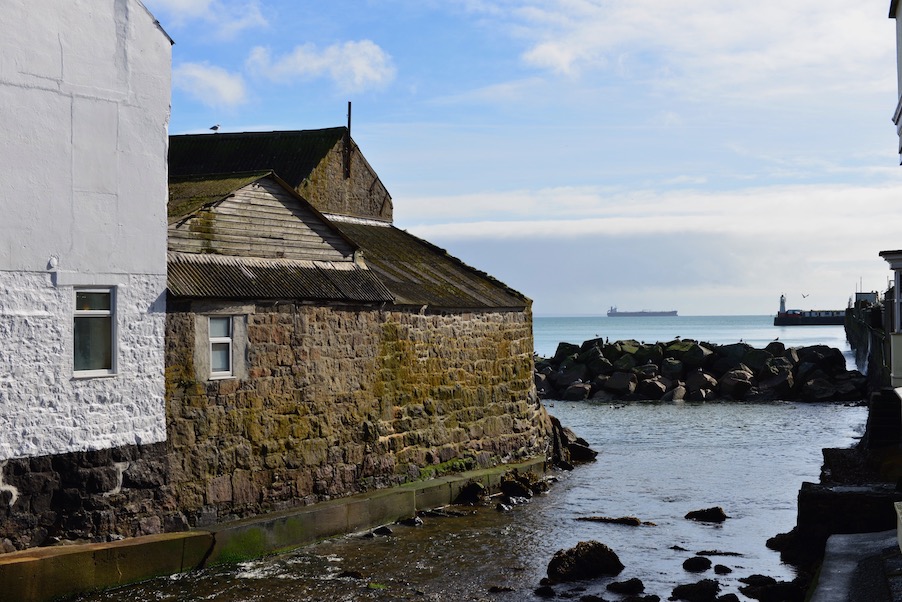
Just past Penzance on the south coast of Cornwall, and about as far west as you can get before falling into the sea, sits pocket-sized Newlyn  home to one of the largest fishing fleets in the UK.

Small winding lanes, many impassable for cars, conceal the cutest cottages often still lived in by the fishermen and their families. Up the hill, larger houses enjoy panoramic views of the ever changing coastal comings and goings.


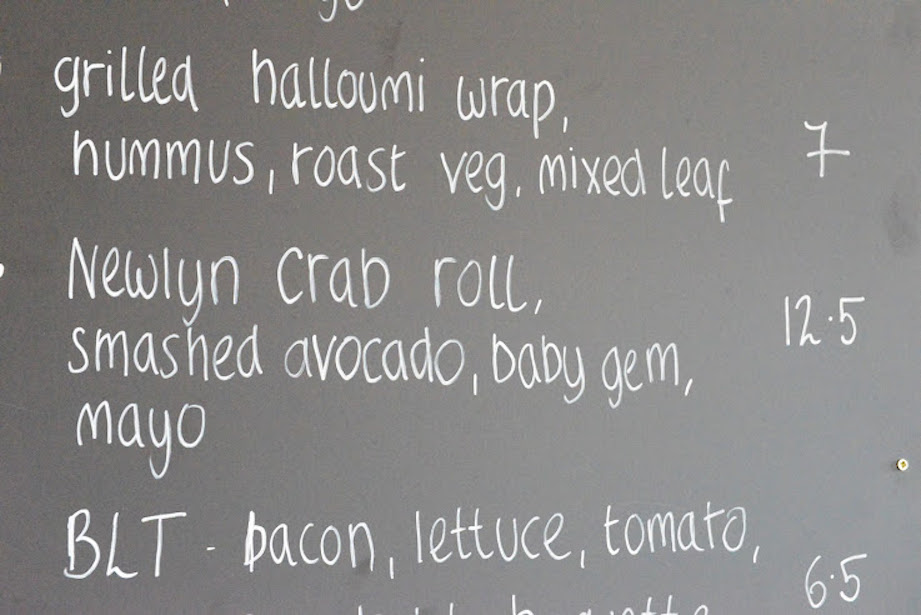
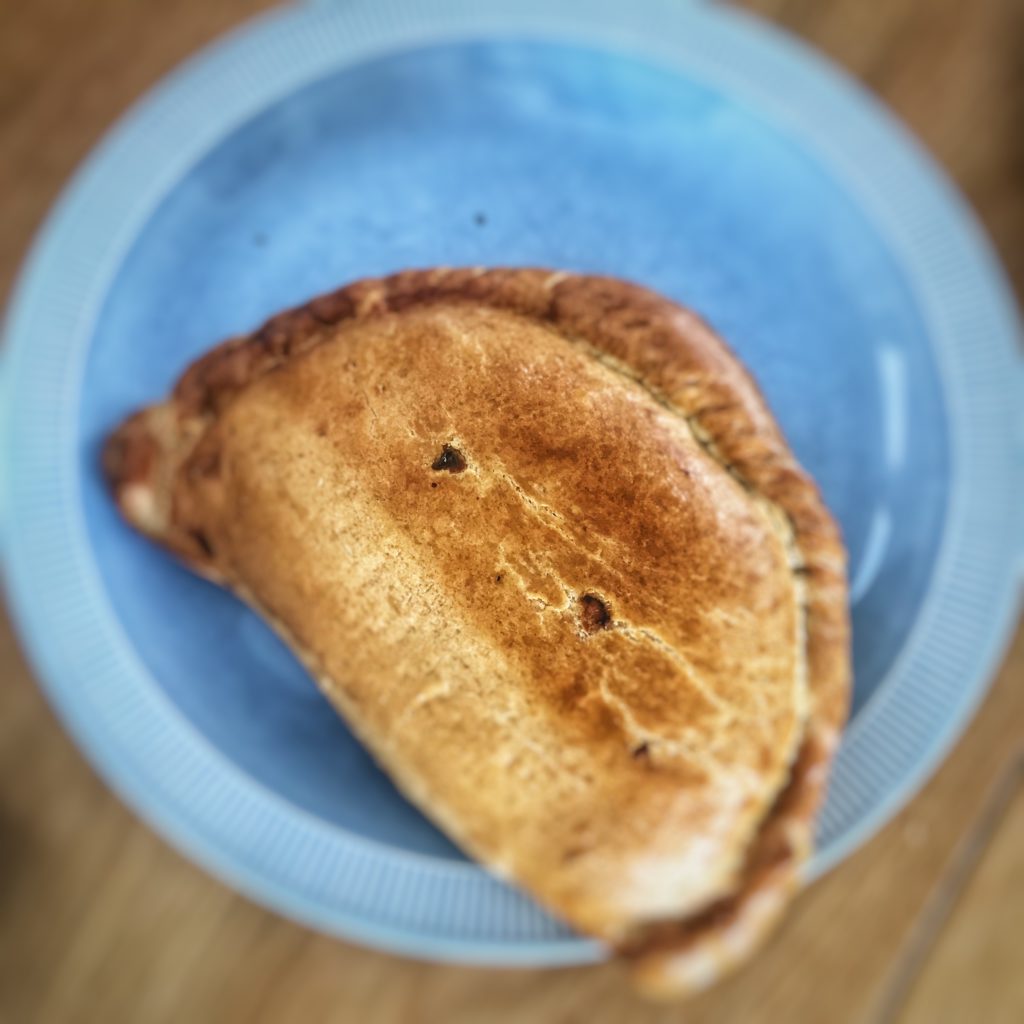
Once Newlyn was only food- famous for its Cornish Pasties, which are still delicious and home made at Aunty May’s, the place to score a proper steak pasty.

These are best eaten straight out of the bag, while sitting on the harbour wall swinging your legs, but the food scene has all changed recently with new and exciting restaurants popping up all the time.


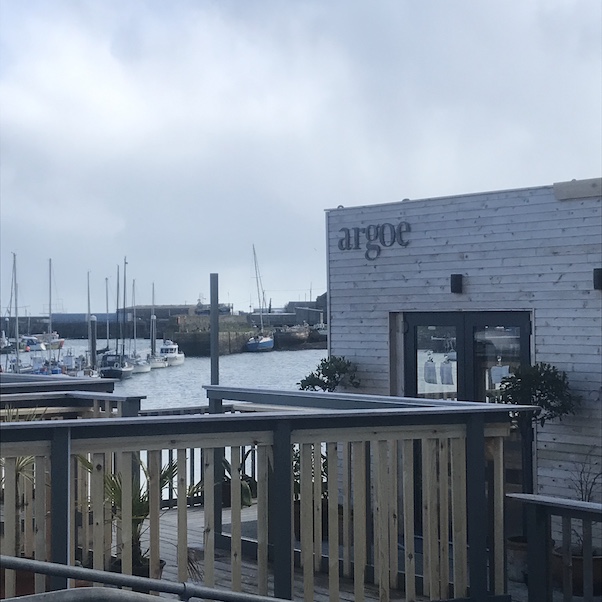
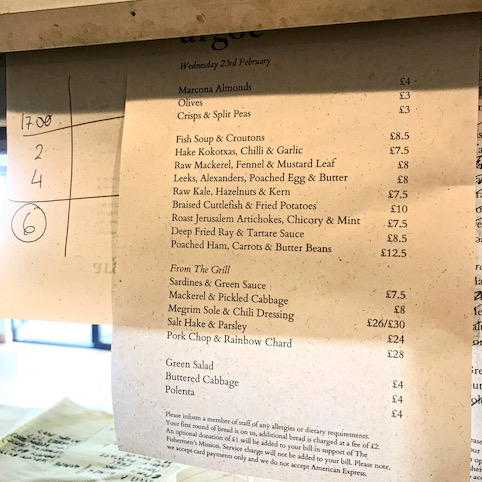
‘It’s different down here,’ says Rich Adams who styles himself owner/sous chef, ‘but these days mostly fish sourcer!’ of Argoe, a restaurant that’s a stylish hut located on the harbourside, cosily nestled among the fishing boats.

‘Not so long ago all the amazing fish and seafood caught here went straight out in lorries to London and beyond, which was such a shame.’ Rich points out. ‘Now there are new restaurants here in the port and all around all doing great things with our local produce. After all, the best place to eat fish is always by the sea!’

Argoe is definitely one of those places. As the afternoon February sun beams down on Rich and his team as they make more simple restaurant tables and chairs (he once trained to be a cabinet maker), go behind the pass to see the most important part of this kitchen, the charcoal grill.

Here they cook very simply, ‘fish, salt, olive oil, top quality charcoal,’ says Rich. It’s cooking in the style of the Basque country, such as you’ll find at places like Elkano near San Sebastian whose grilled turbot ‘rodaballo’  is legendary. At Argoe they use instead Megrim Sole, an ugly local fish underappreciated by most as it’s so cheap. It is, however, very tasty.

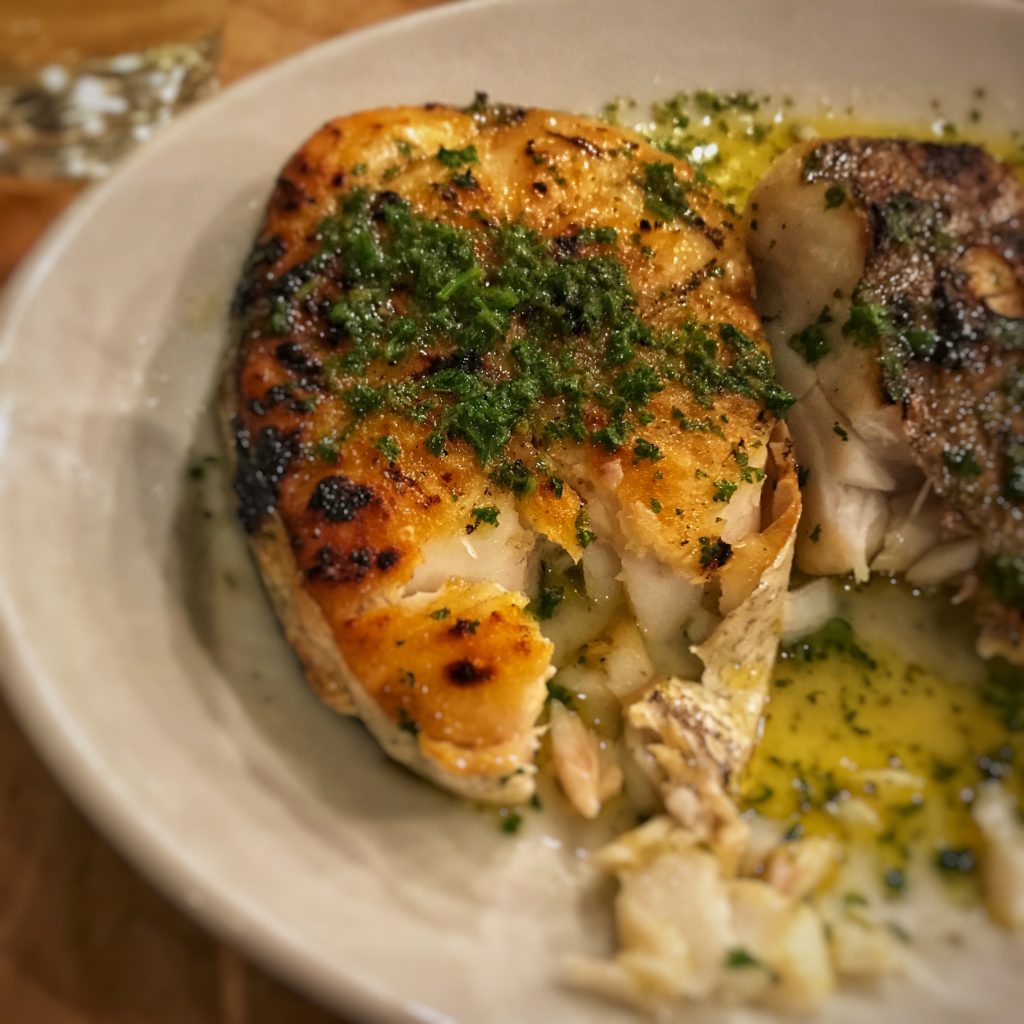
That night in Argoe I find the sole is soled out, so instead I have superb locally caught hake three ways, griddled on the coals and served with Kokotxas, the hake’s throat, a gelatinous delicacy in Spain that’s often discarded here. 

Rich’s father runs a big fish wholesaler over the road from Argoe, and Rich tells me he goes over to his father’s place to take the unwanted Kokotxas for the restaurant, often trimming them out himself.

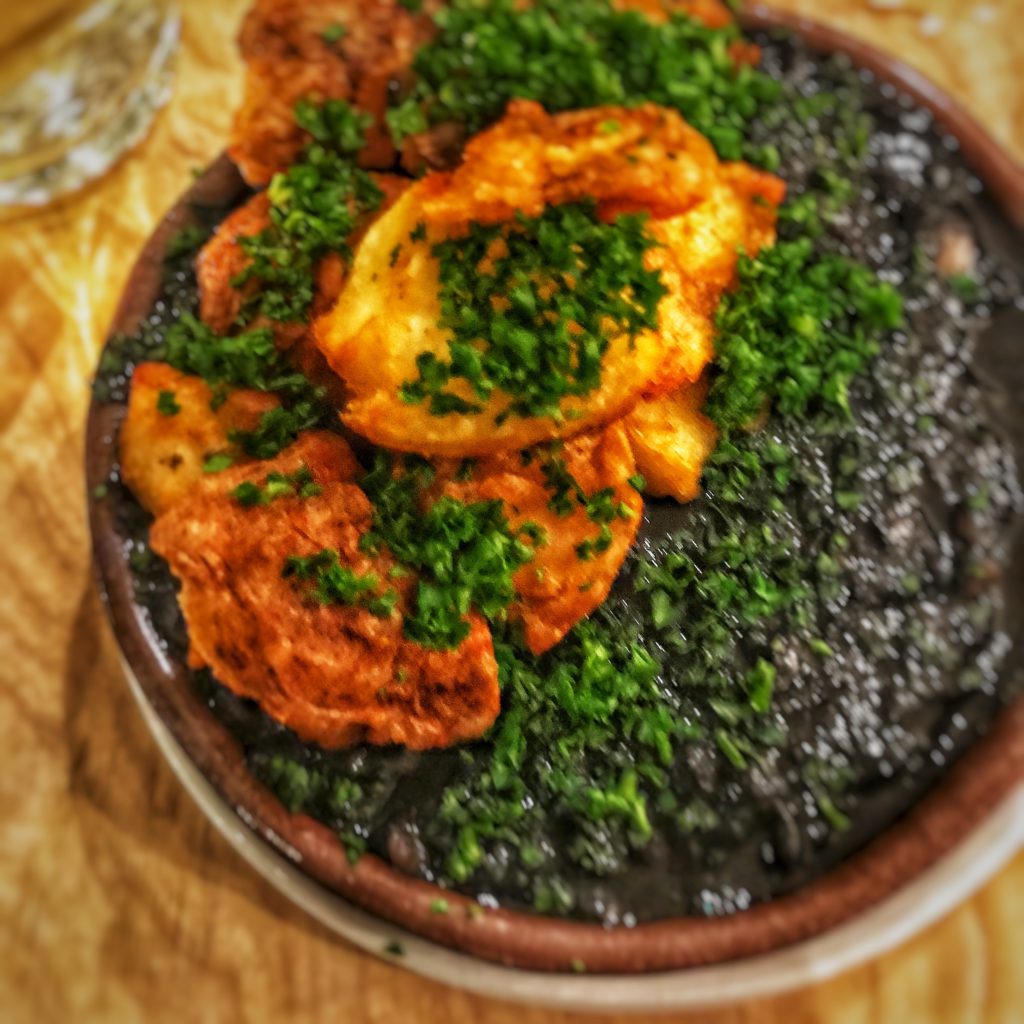
Kokotxas also feature as starters at Argoe, served with chilli and garlic, but we had Braised Cuttlefish and Fried Potatoes, the cuttlefish sweet and meltingly tender in a rich inky sauce.

Wines are natural, chosen by another new Newlyn place, Lovetts,  a tiny wine and coffee bar on Newlyn front ‘The Coombe’, serving a range of superb wines, and, as we found out, some rather good charcuterie as well. It’s a great place to make friends, as you’re so close together it’s impossible not to fall into conversation with other couples.

On ‘The Boat’

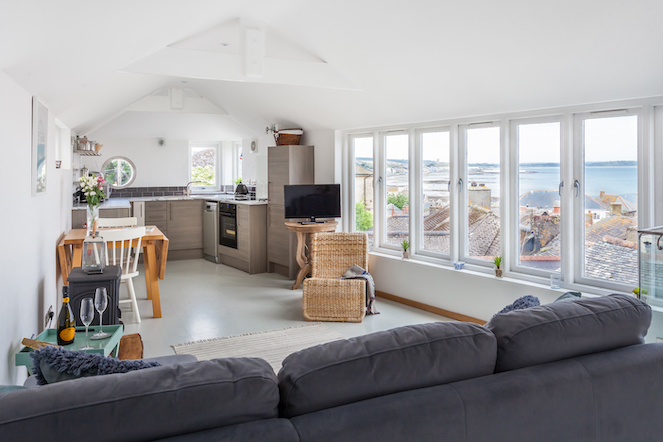
We had a couple’s retreat par excellence in Newlyn, The Blue Place, rented via Aspects Holidays, a marvellous converted old workshop a little way up the hill and a few minutes walk from the harbour.


Wooden, and so blue on the outside we could see it from the harbour, this quirky cosy place is cleverly ‘upside down’ so that the lounge and kitchen get the great views, as does the outside deck.

We took to calling it our ‘little boat’, as it felt so much like one, a cosy place to end the day’s exploring with snug underfloor heating and tight insulation. Fast wi-fi, and a TV that was internet enabled, took care of entertainment but really watching the harbour comings and goings was entertainment enough.

Downstairs was a comfortable bedroom with high quality linens, as well as a very smart bathroom with large walk in shower and lots of fluffy towels. Outside a pretty courtyard was just big enough to accomodate an average sized car, a very useful thing as parking in Newlyn is scarce. All in all, it was perfect.

The Blue Place also came with a wonderful welcome hamper of remarkable Cornish produce, including sea salt that we put to good use one night on brilliant takeaway haddock and chips bought from the legendary Lewis’s on the Coombe.

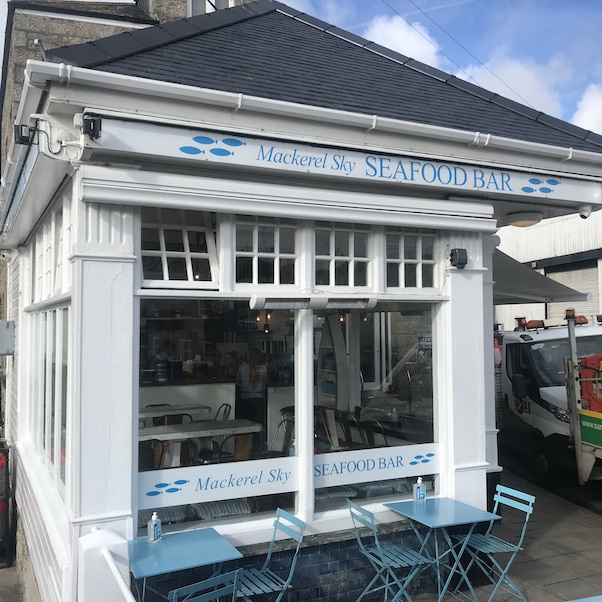
We’d heard from friends in Cornwall of another special place in Newlyn, the Mackerel Sky Cafe. “The queues are enormous, whenever we drive past’ said our friends.’ We don’t know what they’re selling, crack cocaine perhaps?, they joked.

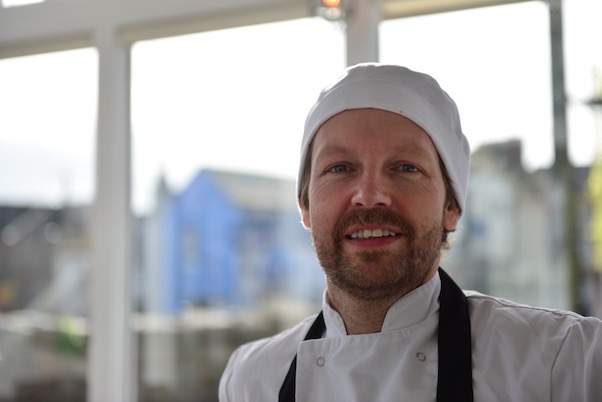
‘The queues do get a  bit long,’ laughs chef Paul when I mention it to him when we meet before the day’s opening,’ we don’t do reservations and, as you can see, it’s a small place’.

It certainly is, although there are outside seats which, as I’d seen the night before, people seem happy to use even on a chilly February evening, the food is that good.

Mackerel Sky was opened in May 2015 by Nina and Jamie MacLean who’d previously wowed locals and tourists alike in Penzance. Like Argoe it keeps it simple, letting the fish do the talking.

‘We don’t have any freezers, only fridges,’ says Paul ‘the boats text us with what they’re coming in with and every day we prep fresh fish for our service 12 am until 9pm. We can also call up fresh fish anytime of day if we’re running low, after all the sheds are just across the road.’

‘If people are waiting too long,  and the queue is down the road, we send them to Lovetts to have a drink or recommend other restaurants in Newlyn, we all help each other out, we’re not rivals.’


‘Our dishes are small plates and the whole experience is not geared to lingering; get in and order a load of dishes, enjoy and move on. We also do takeaway, if you’re staying in Newlyn.’

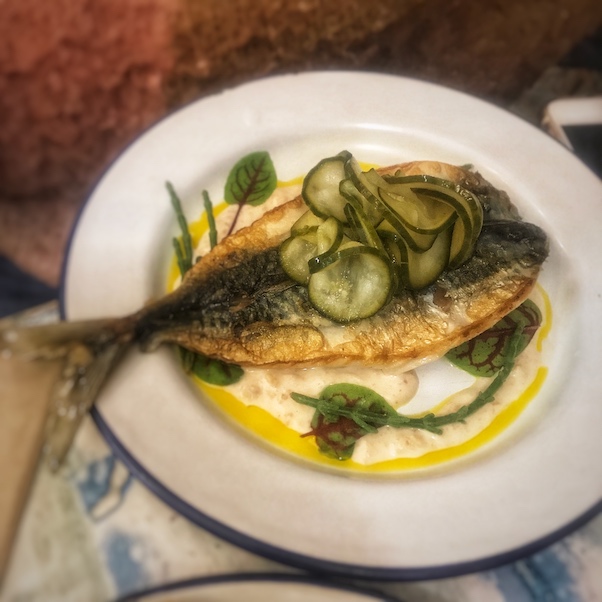
That night we timed it right to get a seat and soon found ourselves oohing and aahing over plates  of Salt & pepper squid with aioli; tender perfectly fried squid seasoned just right, then some Grilled mackerel, pickled cucumber, horseradish – something of a signature dish – was redolent of the sea.

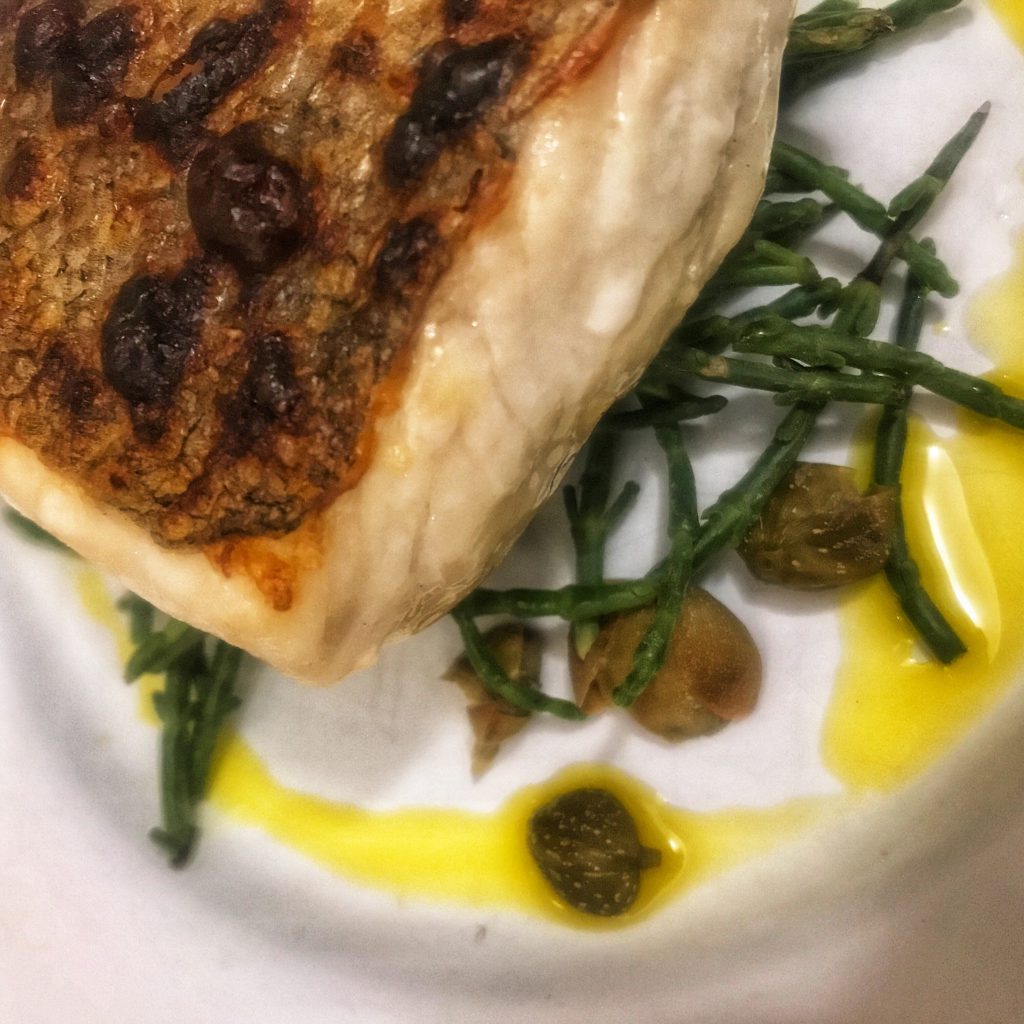
Finally grilled local white fish, samphire and capers. The fish also turned out to be hake that night, but we weren’t complaining. Hake is such a great fish that for some reason the British fail to appreciate fully. We washed it all down with St Ives Meor, a crisp IPA perfect for fish.

Good news is that Mackerel Sky will be expanding in time for the summer, taking over a small space next to Newlyn Cheese and Charcuterie, a wonderfully compact and aromatic artisan cheese shop with cheeses from all over the west county and France.

We ran out of time and couldn’t eat at The Tolcarne, which at ten years old is one of the more venerable ‘new’ restaurants in Newlyn, and one the most-respected, but I did get to speak to co-chef and owner Ben.

“We had been looking for a pub for some time,” he tells me. “It was a bit of a gamble at the time as Newlyn wasn’t on a ‘food map’ so to speak, but it had this raw appeal and I just thought – that’s where I want to be, I can make it work.”

“Simple dishes, which highlight excellent ingredients – that’s how Matt and I both like to cook. We spend more time removing components from dishes than adding them!”

At The Tolcarne you might find Spiced monkfish, hummus, fine beans, pomegranate molasses, dukkha on the lunch menu, and Hake, pancetta and fagioli bean stew, broad beans, salsa verde, pangrattato on at evening time. Hearty food that flits across borders, but is solidly built on Newlyn produce.

The boats keep coming in. The fish gets served. Newlyn is a food paradise, at the Land’s End.

Of course Newlyn is just the start, check out its antiques scene, the prestigious Newlyn Art Gallery, the remarkable fresh fish and shellfish at Trelawney Fish and Stevensons Fish, and  try the baked potato and crab at the timeless Ship Inn in beautiful, bijou, Mousehole just ten minutes away.

Top tip, take the bus because Mousehole has limited parking and is unsuitable for larger cars. You will lose at least one door mirror. Ask me how I know.

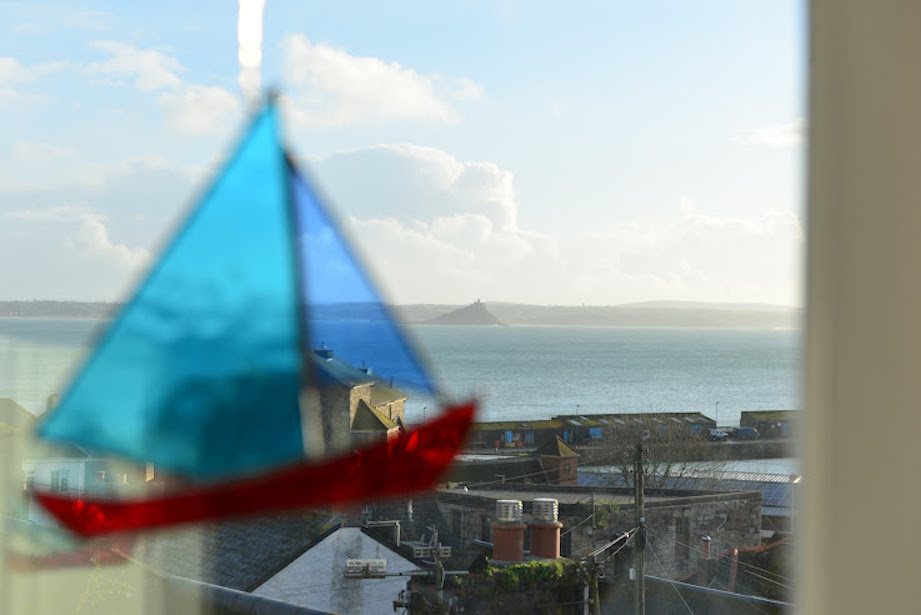
And further afield, and nothing is very far in this part of Cornwall, is Lands End itself, the rugged beauty of Zennor, the sands of Sennen and the remarkable grandeur of St Michael’s Mount clearly visible from Newlyn.


Oh and we have to mention the cafe at The Lizard, the southernmost point of the UK – lovely home made fruit cake, a dollop of clotted cream and a view of the rocks and waves to die for, if you don’t watch your step.

We stayed in one of Aspects Holidays Cottages, a Cornish company which began as a family business in 1989 and still feels like one. Their selection of quirky yet luxurious cottages is one of the best in Cornwall.

The Dark Secret Of Great Bread. Grano Arso

Not perhaps the best product name, for English speakers at least, Grano Arso is a magical baking ingredient.

Myth has it that back in 18th Century Italy, poor villagers would scrabble to gather the scorched grains left after farmers burned their harvested wheat fields to make way for new crops.

They’d use this free flour to make bread and pastas with a distinct flavour.


Well, as is often the way with food, what was once only for peasants has become sought after by the well-heeled.

Knowing that I am a keen bread baker, online Italian foods specialist shop Gourmica sent me a bag of Grano Arso(400g, £5.15) to try out. They make it by toasting 100% Durum wheat flour.

Opening the bag you get an immediate hit of the aroma of ash, almost sepulchral, and the colour is a darkish grey. It’s not as attractive as ordinary flour. This is probably what Nosferatu bakes with.

Usually I’d have made a sourdough loaf, but my ‘mother’ (who is now six years old) was having a bit of a sulk in the cold weather and not responding well to feeding, so I reluctantly fell back on Instant Yeast


I normally use 500g of strong white bread flour, so I decided to make this mix 400g white and 100g Grano Arso. Nothing added but fast action yeast, water, salt and a smidge of sugar.

The KitchenAid made easy work of the kneading (I don’t need to knead sourdoughs) and I soon had a dark ball of smooth dough which after two rises went into the oven for 35 minutes.

The resulting Humbrol Battleship Grey loaf was a bit flat, I’d used a bit too much water, but still good to go. I had to then impatiently wait for it to cool properly. If you cut into a loaf that’s still hot, you release steam and spoil it.

Finally slicing it a few hours later revealed a typical fast yeast close crumb, but grey. The aroma was of fresh bread in a dusty room. Not unpleasant.

The taste was at first a bit of a shock, a definite hint of ash, intriguing and moreish. Adding butter made it totally magical.

After a few slices I was hooked, it responds particularly well to toasting and is marvellous made into toast soldiers to dip into boiled egg.

I’ll be making sourdough next time for sure, and I am really looking forward to adding it 00 flour to make fresh pasta. Pasta always looks so bland. The pack also has a recipe for a kind of ciabatta, which looks interesting

You can also of course vary the flour ratio. I wouldn’t use any more than 1:4 myself but I might try a little bit less Grano Arso to see what happens. A pack won’t last long otherwise


It’s just one of the many products from Gourmica a new online destination for gourmet Italian food which focuses on extraordinary Mediterranean foods.

There are tomatoes (including the champagne of tomatoes, San Marzano); pasta, rice & grains; oils & vinegars; beans & pulses; soups & sauces; antipasti and even plant-based choc-hazelnut spreads. 

Gourmica is curated by Londoners Ernesto Coppola and Maria Suleymanova, of Coppola Foods , a fourth-generation family food business.

The team at Gourmica actively seek out family businesses whose specialist expertise has been passed down through the generations, just like the Coppola family.

Check out the whole range at www.gourmica.co.uk

And definitely try the Gran Arso, it’s not much of a name for sure, but it’s certainly something special to add to your food armoury.


When is a cow not a cow? When it’s a Txuleton

Before I begin, I assume none of you lovely readers are vegans or vegetarians? If so, you might want to stop reading now.

I myself eat meat, but not a lot. So, when I do eat it, I want something special.

Txuleton is that something special.Txuleton, or rib, steak usually comes from the Rubia Gallega cow.

It’s a cow from North West Spain that can be as old as 18 years before being turned into steaks.In the Basque country old dairy cows are used.

That is pretty old. I mean in the UK beef is usually slaughtered before the cow gets to three years.

Normally dairy cows past their milking prime are disposed of, but in the Basque country they are fattened up for eating.

So why are old cows so good?‘

Well’, says Sagardi Shoreditch’s meat selector Imanol Jaca, ‘it’s because mature muscle and fat tastes better and myoglobin in the muscles means a redder meat’.

Continue reading