Greek Pig Panigyri Feast: A Unique Dining Experience

Just because it’s winter, doesn’t mean you can’t enjoy the summery warmth of a Greek Pig Panigyri Feast

They’ve got the electric heaters going full blast at Pyro tonight, Mad Ed Milliband would be livid if he knew about it in his luxury hotel in Brazil.

They do need them though, because even on this unseasonably warm November evening, I blame Climate Change of course, there’s a bit of a chill breeze blowing around our legs.

Pyro’s veranda is not a bricks and mortar structure, but a kind of large ‘beach hut’ with walls made of clear plastic that roll down for the winter. This would be effective, were it not for the fact that the one next to our table stops a good thirty cm short of the ground and the breeze is making my trouser legs flap like sails.


I don’t care, we’ve soon got cosy rugs wrapped around our legs and we’re enjoying ourselves too much to be put off by a draft. The whole place is welcoming, warmly lit, charmingly decorated and with a great Greek feel to it. If the sun was shining you really could be in an island taverna, and not simply south of London Bridge.,

Chef Yiannis Mexis is the man behind Pyro, and he cooks on live fire, which is always a good way to cook. I can see the practical benefits of induction hobs in modern kitchens, but they add nothing to the flavour.
At Pyro every Wednesday from now and going forward, it’s the Pig Panigyri Feast, a Greek village festival. Inspired by Gournopoula, the Messinian tradition of roasting suckling pig over an open fire.It’’s a set menu designed to be shared with friends, although couples can also enjoy it just as much. We actually sat with two strangers and it couldn’t have been nicer, as we bonded over crackling, pork fat and Greek wine and the terrace filled up with other pork afficianados.


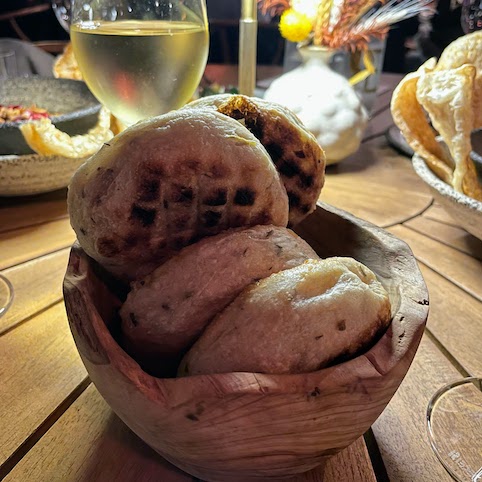
There are two cocktails for the set price. Pre feast was a Midas, a great combo of cinnamon infused tequila and aperol which set us up nicely for the arrival of sourdough potato pittas cooked on the griddle and with a good helping of syglino, a smoked pork fat.

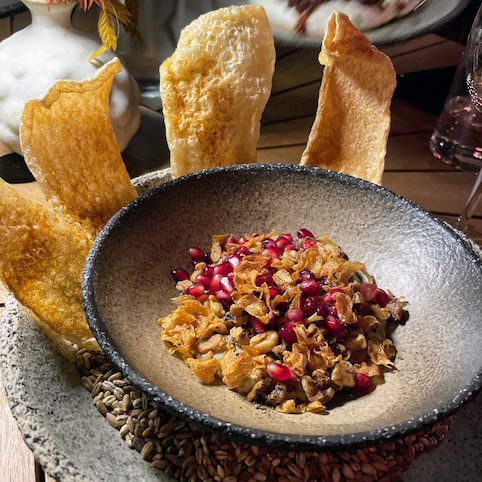
These pittas are fat and round and delicious and prove perfect for loading up with the creamy sheep’s milk labneh with pork and a smattering of chick peas. Superb, as is the smoked aubergine puree with roasted garlic, this time scooped up with perfect crispy tranches of crackling. A dusting of pomegranate seeds add colour, but do get caught in my teeth.

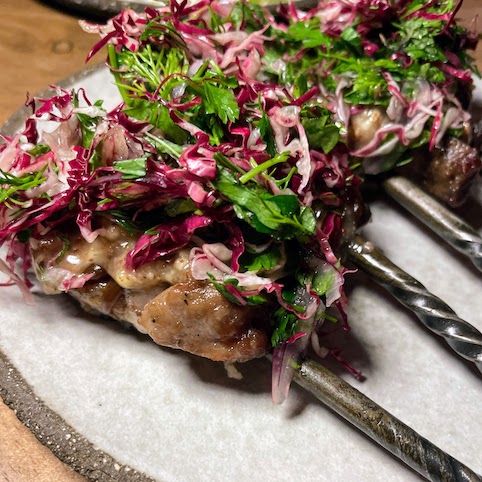
If you only know souvlaki from the excellent album by Slowdive, you can’t have been to Greece where you find it all over the place. Meat grilled on a skewer over charcoal, it’s often served in a pitta with toppings. Here some Iberico pork’s goodness is further enhanced by sweet smoked prunes, almonds and an inspired topping of sour apple and radicchio. Another winner dish.


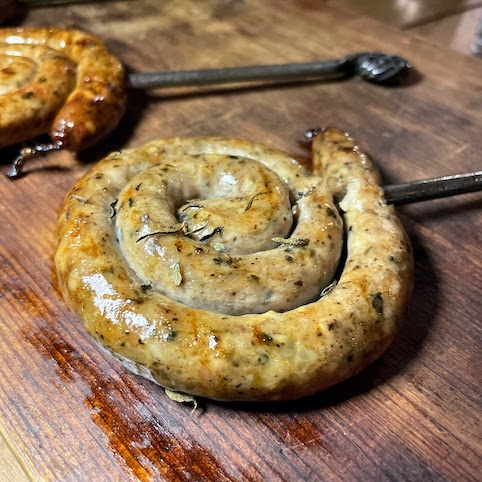
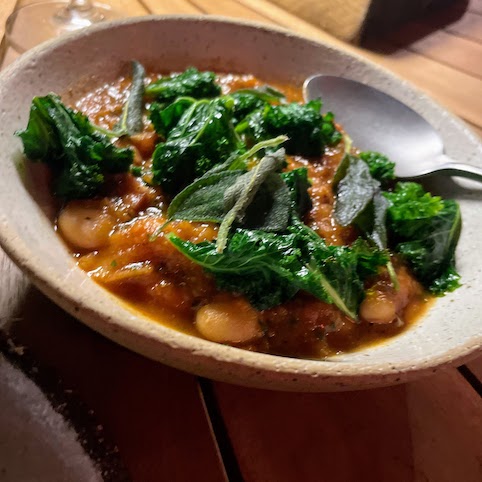
And from out of the fire comes more, this time a ‘Mykonian’ style sausage, curled like a Cumberland, it’s porky perfect and you can taste the fresh herbs embedded inside. An accompanying stew of butter beans, or ‘gigantes’ offers up super soft beans infused with flavour and cheerfully doing the backstroke in a rich tomato sauce topped with barely cooked kale and lots of lovely sage.

And the main event arrives, suckling pig (s) have been spit roasted over myrtle, an evergreen shrub found all over Greece. Suckling pig is not something for anyone who’s in denial about where meat comes from, I find it a bit hard to look at myself so I didn’t watch for long and waited for it to arrive portioned at our table.


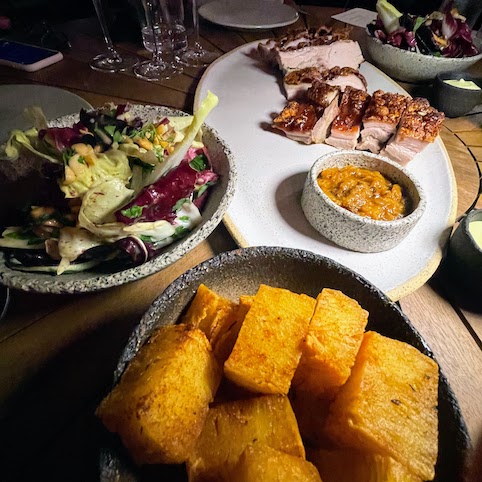
Succulent, quite fatty, very tasty and set off by burnt clementine chutney and partnered with potato cooked in pork fat served with skordalia, which is a garlicky puree with potatoes and nuts, plus a fat-cutting salad of bitter leaves it did a great job of leaving us sated.

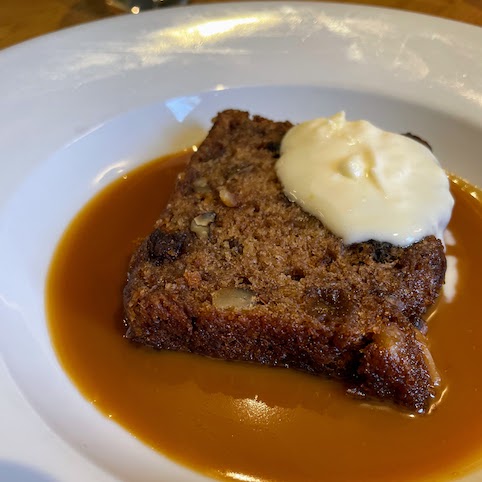
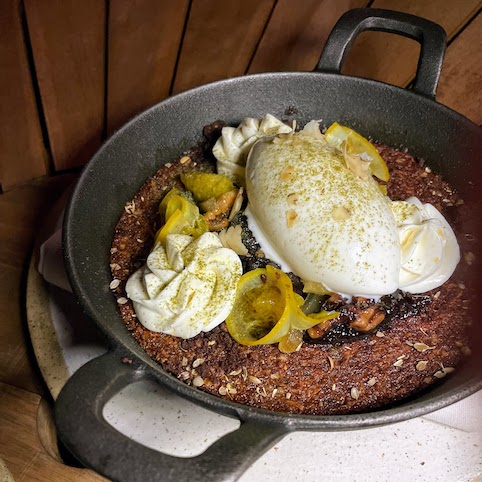
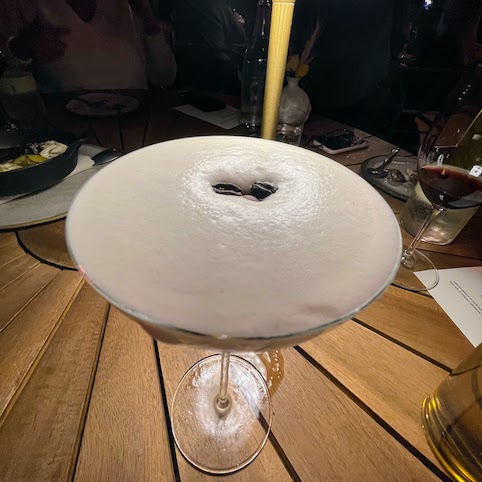
We managed to still eat Greek walnut cake, or karydopita, with creme fraiche before washing it down with Aegina, a crazily creamy vodka cocktail bursting with Greek yoghurt foam.


It really was a proper  feast and a celebration of pig,  and I really recommend you get your trotters in the trough asap.

53b Southwark St, London SE1 1RU

pyrorestaurant.co.uk/

Lilibet’s Restaurant Review

Opulent and impressive, with a side order of slightly camp, this restaurant celebrates the past and feels guaranteed to have a glorious future

An IKEA TV campaign, not so long ago, urged everyone to ‘chuck out their chintz’. It seems that much of it ended up in Lilibet’s. I’ve not seen so much of the stuff since my maiden aunt died at 97, the same day as Elizabeth II, and her house hadn’t changed since the 1940s.

This new restaurant is on the site of the building where Elizabeth (Lillibet) II began her life, although the actual house was demolished years ago.


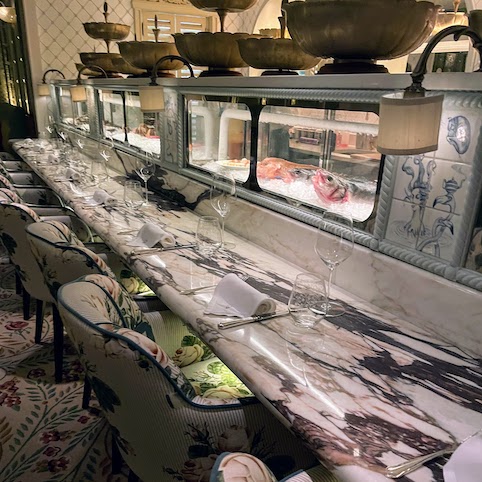
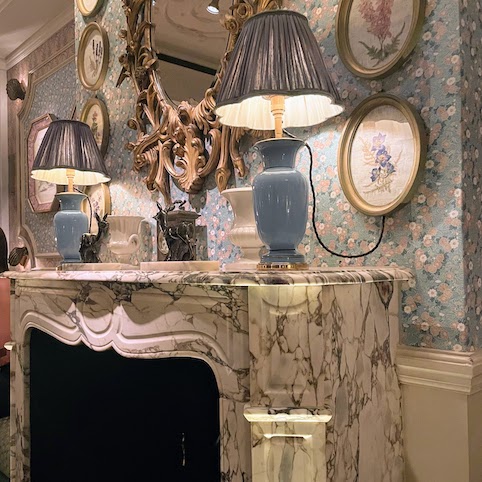
Internally Russell Sage Studios have created what can be either called a loving homage of interior design trends back then, or an affectionate parody of the same. There are handwoven Gainsborough silks on the walls, and even the sort of fake fireplace once found in stately council homes. Usually accompanied by a car up on bricks outside.

I like it, everything about the place has a wry smile on its face and it’s extremely welcoming, comfortable and, yes, it is actually elegant. There’s nothing else like it in an area that has become very blingy, majorly catering to Russian and Middle Eastern tastes.

It’s not perhaps what you’d expect from Ross Shonhan, once Executive chef at Zuma London, and who created the iconic Bone Daddies ramen bars that for years were the talk of blogland, with people scrambling to get as much oily broth inside themselves as possible..

Here it’s fish, fish  and more fish across a very large space divided into zones. A bar, a marble topped seafood bar, (oysters and caviar feature, of course) a fish grill, and traditional seating to eat whatever you want. These seats are extra plush, and whilst the tables have no tablecloths, they are dark wood and so still feel upper class.

It’s a menu that could have you indecisively flicking back and forth for a month, but we know what we want.


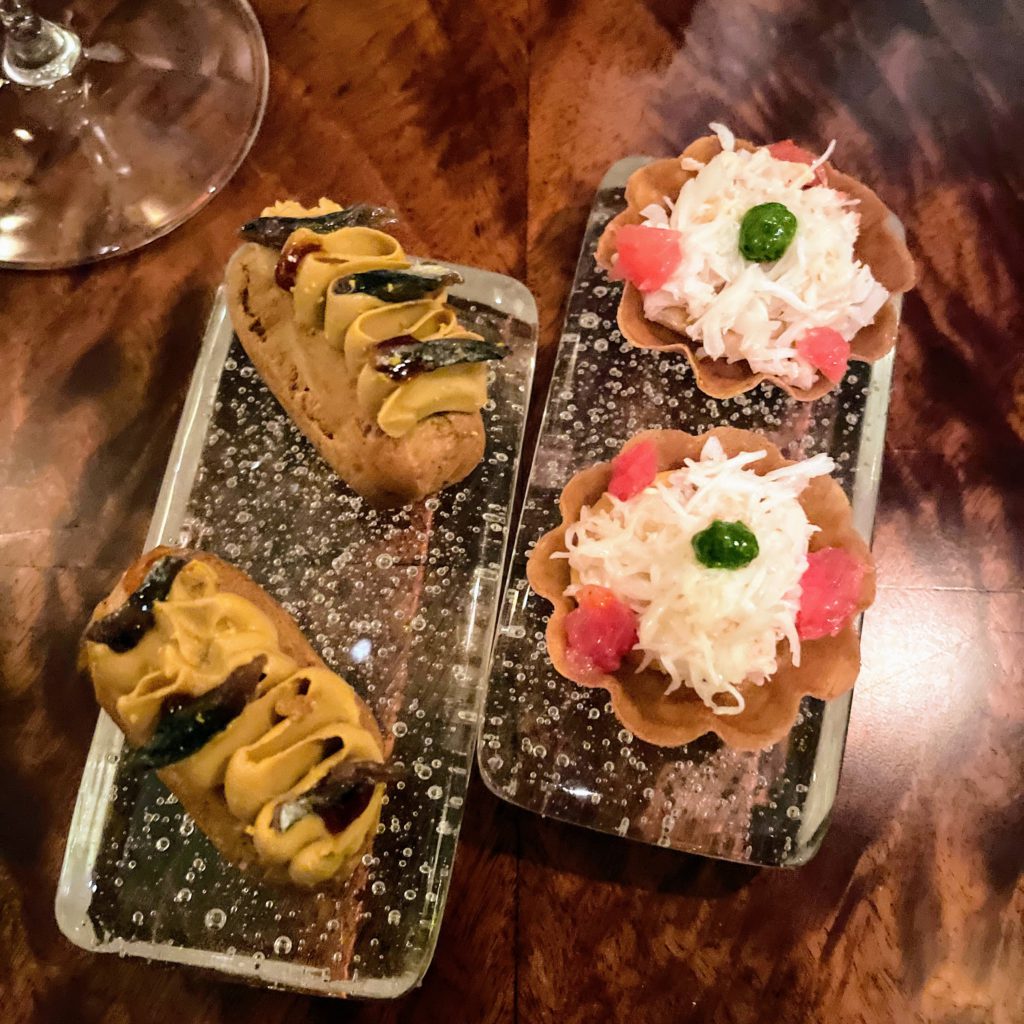
Anchovy éclairs and crab tarts are more nibbles than full on starters, but they are both rather wonderful. I love anchovies, particularly the tinned brown fillets, but they do repel some people. The important thing is to get the best you can find – cheap anchovies don’t have the rich texture and deep umami that’s so present here.

I saw a recipe for these in the The Official Downton Abbey Christmas Cookbook (don’t judge me). So as a savoury they have been around a long time in posh circles. They’re usually made with puff pastry, here though it’s proper choux with the hollow space inside piped with anchovy parfait and on top sharp/sweet sauce. Gone all too quickly, but the memory lingers.

The crab tarts are equally impressive, small works of culinary art, super-fresh sweet crab enlivened by citrus and cosseted in pastry shells that are as delicate as the porcelain  Liz 2 probably had her afternoon tea served in.

Did I mention it’s a big menu? Well we dither over the Ricotta agnolotti,  lobster spaghetti, whole turbot pil pil as choices, but the “fish triptych,” fish served in three different ways – a crudo, a grilled main and a soup  – sounds too unique not to try.


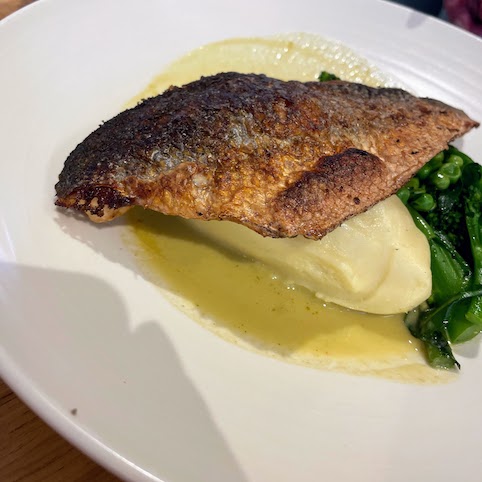
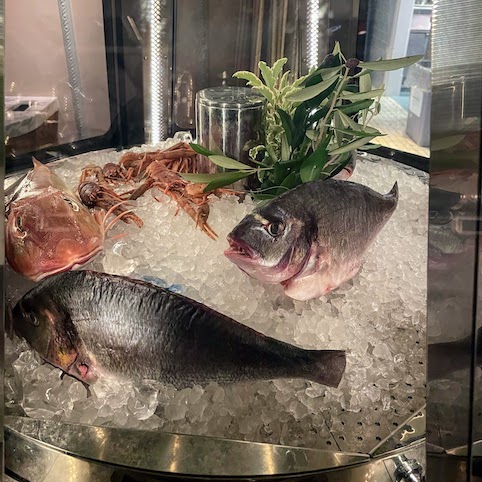
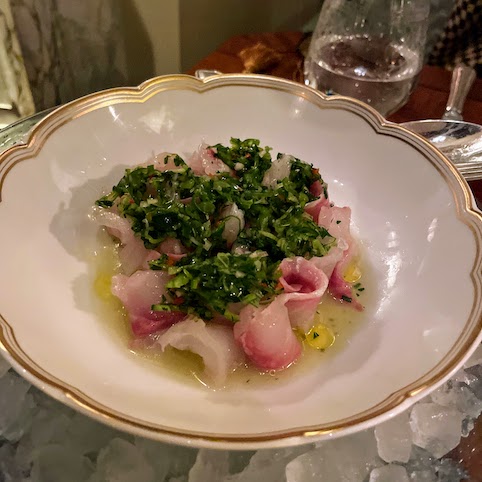
From the fish of the day we have the Sea Bream. This arrives first as crudo – raw – dressed with olive oil, salt, lemon and perhaps vinegar, and liberally scattered with herbs. This really showcases the fish which is firmly ‘cooked’ by the acids to a divine buttery texture. My only caveat being that the fresh chili was rather too fierce at times.

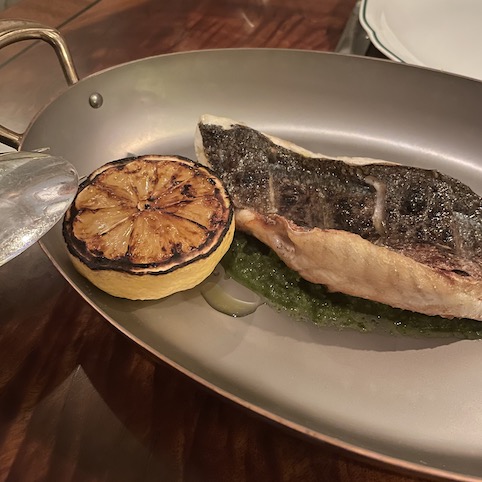
Next from the same fish comes its fillets, cooked in the searing heat of the bespoke wood oven. A perfect piece of fish, the skin crispy and golden, the flesh gorgeously creamy. It is so naturally excellent that the mojo verde sauce is in some ways not needed,  but in other ways I need lots more. And a spoon, too. I could also do with some chips, but then I am common.

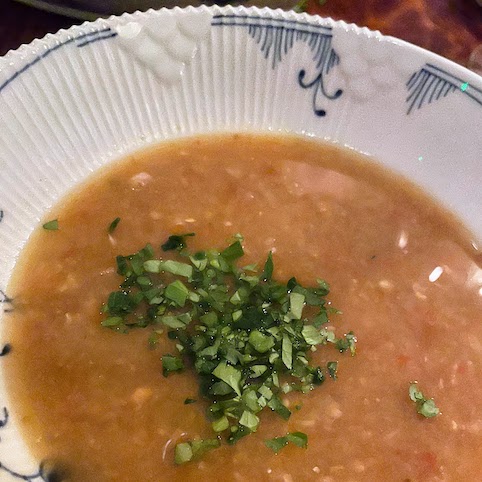
Lastly, the remains of the fish are cooked fast in a pressure cooker to create one of the best fish soups either of us have ever tasted, and yes we have been to the South of France.

It’s ladled out tableside, which is posh, and we boat it back with little oohs and aahs. There is some left in the tureen, so rather than summon a footman I top up our bowls myself. Sometimes one simply cannot wait to be served.


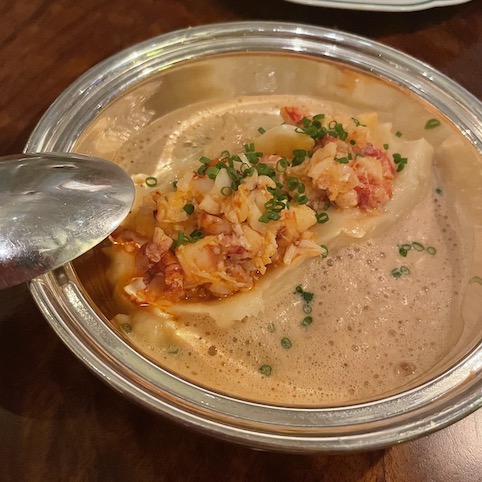
I now have to mention the Lobster Mash, after all everybody else has. Firstly it gave me an annoying earworm; I can’t stop hearing ‘Monster Mash’ in my head, and secondly it really is very good. Buttery, creamy, mash anointed with a lobster bisque? How can it fail?

It’s served after the soup, I’d have liked it served with the #2 fish, although that may not have been the best way to showcase either dish. Anyway, it is decadent, depraved and delicious. It’s a must have, a right royal treat.

They do a rather odd dessert here, a Prego sandwich. It’s a garlic steak sandwich, the word ‘prego’ in Portuguese means ‘nail,’ perhaps the nail in your coffin? It is actually a well-loved Portuguese snack that is often eaten after a seafood meal. I don’t really fancy it, but a twist on crepes suzette does sound good.

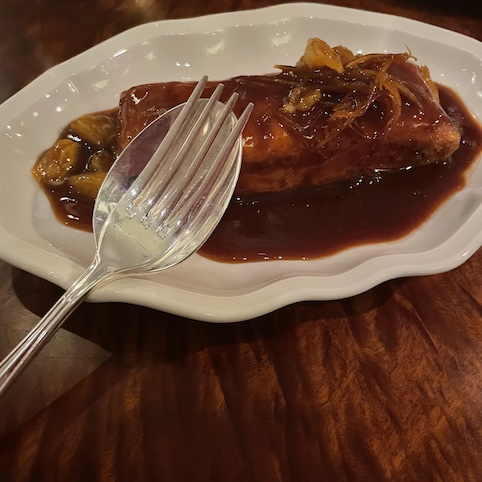
It arrives rolled up, topped with a sauce of caramelised sugar, orange juice and butter, plus thin candied orange peels, and yes, it is torched (or flambeed as they say in more refined circles) at the table. It’s a blast from the past and a very welcome one.

Lillibet’s really is something special in London; its interiors, its staff, its food all remind me of why I go out to eat in the first place, not to greedily catch a trend but to relax and enjoy time with friends and family in a place that believes in the basics. 

Lillibet’s I am sure will become as much a part of London’s history as Liz 2 was, and hopefully live just as long.

17 Bruton St, London W1J 6QB
lilibetsrestaurant.com

You Be Chef. Light Up Your BBQ Game

These boxes of deliciousness from the Isle of Wight  are just the thing to make your barbecue sing

Okay yes I know, the weather has been a bit awful. Not that it ever stops me BBQ’ing though because I have the best BBQ in the world, the Weber Kettle, and it has a lid.

In the UK we tend to refer to anything cooked over charcoal as BBQ but, to be more accurate, what we Brits tend to do is grill.


BBQ means the food is not cooking directly over the charcoal, but instead is ‘oven cooking’ with the BBQ lid on, This is what traps the delicious smoky aromas and is perfect for large pieces of meat. That lid also means you can cook in the rain. I also have a remote thermometer so I can monitor the temperature inside the meat without leaving the house. Cunning, eh?

So we got ready to cook with one eye on the sky and the lid at the ready.

You Be Chef comes from the Isle of Wight, via chef Robert Thompson. Not only does he have an MBE, but he also won a Michelin star in 2007.

Robert is a champion of Isle of Wight produce, and is a big part of the Island’s food scene. His idea was to take the island’s produce, write recipes around it, and send the food and instructions all over the UK.

Our trial chilled box arrived on the hottest day of the year (so far) and was thoughtfully left on the front doorstep, in the blazing sun, by a delivery driver who obviously didn’t think it was worth ringing our bell.

Luckily he did at least send me a text and so I was able to call my wife to rescue the parcel before it melted away, or became victim to our local ‘porch pirates’. They will pinch anything round here, even though they have no idea what it is they’re nicking.

Unboxing was fun, each panel revealing a message, and it was good to see most of the items were in recyclable packs, some sort of cardboard material. 

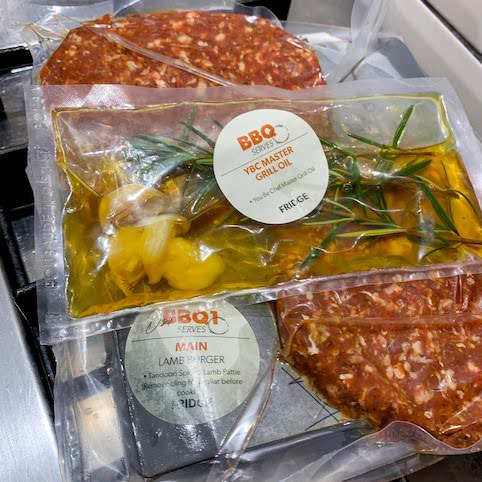
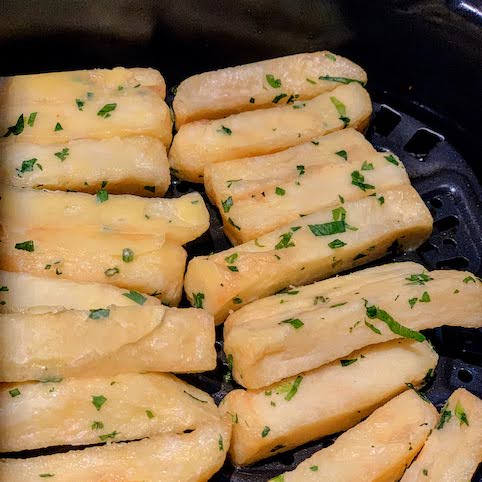
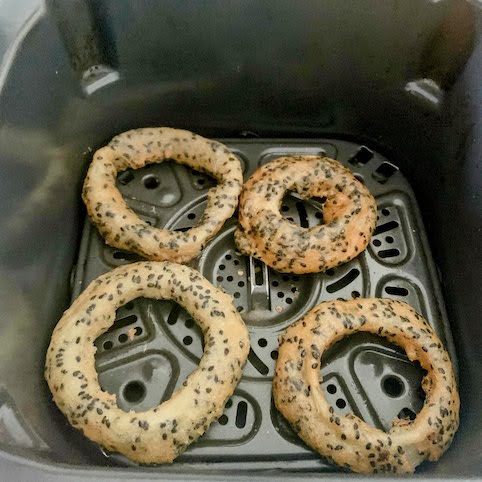
We had the Tandoori Lamb Burger for two. So we had the burgers (natch), and then in various packs – Sesame Challah Buns,  Pont Neuf Potatoes with Garlic and Flat Parsley Butter; Onion Rings – Fried in Curious IPA Beer Batter with Black Onion Seeds; Rose Harissa Hummus; and Crushed Avocado with Lime, Beef Tomato slices, Feta, and Baby Gem Lettuce. Oh and there was Red Onion, Mint and Lime Salad and flavoured grilling oil.

It all appeared good, but for the lettuce leaves, which clearly had not enjoyed their journey and were rather limp and tired looking.

Juggling the oven times for the chips and the onion rings was a bit tricky. After some thought we cooked the rings first in our brilliant Ninja Foodie,  then took them out and kept them warm while we cooked the chips, then we put the rings back on top for the final minutes to get them hot again.

The burgers were a large diameter, I had my doubts they would fit in the buns, but once cooked they became the right size.

Now I am no chef, but I was surprised when the instructions said to give the burgers six minutes a side. I was so doubtful, that after rubbing them with the supplied grill oil,  I only gave them three minutes a side, after which time my trusty Thermapen read 62C in the centre, which is just right. I suspect there may be a typo in the instructions and it really means six minutes in total.

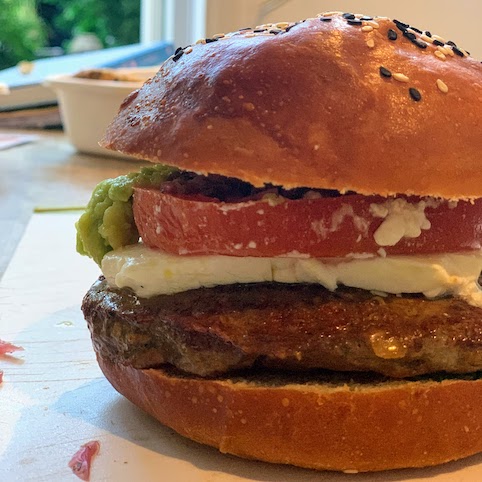
We added, as per instructions, the feta to the top of the meat for the last minute to warm it up, then split our buns (ooo err madam) toasted them lightly, and put the lettuce on the bottom (it’s important to ‘waterproof’ the bun from the juices), then added all the other ingredients to create an impressively stacked burger.


I’m a survivor of the burger craze which swept social media a few years back, ending only when the biggest influencers realised they were killing themselves eating so many monster burgers a week and gave up, so I know what to look for and this burger was perfect.

It had size, but with heavy pressure it was compressed to be eatable. And very good it was too, with the lamb superbly juicy and spicy. The other ingredients all added to the pleasure, particularly the salty feta and the limey avocado. The buns were a bit sweet for me, but fine.

The Red Onion, Mint and Lime Salad was rather like shredded pickled onion, no bad thing and mint is always an ideal partner for lamb.

The onion rings were crunchy and also sweet. We liked them a lot, but couldn’t eat all eight, and the chips were excellent, although dangerously hot inside so we had to leave them to cool for a bit. They were great dipped into the hummus, which was not as spicy as feared.

It really was a great BBQ blow out. Having everything ready made was a game changer and made it all so easy. And it didn’t rain.

Order your boxes at www.youbechef.com

Tacos and Steaks At Number 8

This special deal is a cracker, but, like the government,  you have to go to the country

On one of the hottest days so far, we get in the car and head out from South London to Sevenoaks. We can’t stand another sticky evening, or standing over a hot stove, so the lure of the country is strong.

It’s an area I know quite well, all my school friends lived out that way, while I lived a bit further in. Driving out this evening  I drove my wife mad as memories came flooding back of sixth form trips to pubs, to teenage parties and the time we rolled an overloaded Bond Bug down a local steep hill and it broke in half lengthways, leaving us all lying in a field wondering what had just happened.

Sevenoaks is a lovely old market town, the buildings well-preserved above the shop plimsoll line. Why do people ruin perfectly good old shops with plate glass? What do they have inside that’s so wonderful that it requires a clear view? I am talking about you, Nationwide.

In the centre, Number 8 is a venerable building from the outside with a charming open space in front. Once perhaps a rich merchant’s house, or a local dignitary’s

Inside it’s modern and chic, it reminds me of a boutique hotel. Everything is sparkling clean, it’s clearly a tightly-run ship with active staff and a warm welcome.

No surprise perhaps as Stuart Gillies who runs this, as well as the excellent Bank House, was CEO of The Gordon Ramsay Group for seven years and before that was chef at Michelin-starred restaurants including Daniel in New York, Hotel Lord Byron in Rome and The Connaught alongside Angela Hartnett.

The menu here looks very interesting, but we’ve come for Taco and Steak night, Two courses £25 per person, every Wednesday.

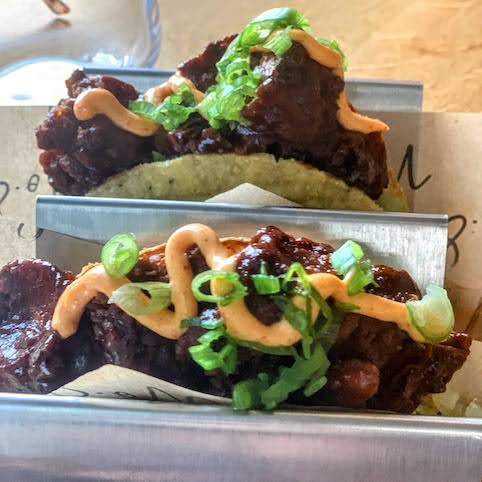
I like a simple choice and this couldn’t be simpler. Korean BBQ Buttermilk Fried Chicken, Cos Lettuce, Red Chilli Mayo tacos, or Crispy Beef Rib, Cos Lettuce, Grated Cheddar, Pineapple Salsa tacos. We order each.

Very delicious both, the chilli on the chicken is perfectly judged and all the taco shells are good and crunchy, but the crispy beef wins our hearts. It really is excellent and the pineapple salsa inspired.


Now the steak. Opinions vary on best cuts. Fillet I find boring, it’s okay en croute, indeed it’s the only viable option, but it lacks flavour. Rump, sirloin and all the other midfield players are fine, but if I want the back of the net I want onglet.

Or as I am delighted to see here, Picanha. This is a cut from the rump area, in the UK it can be often called Rump Cap. It’s very popular in Brazil and, let’s face it,  the boys from Brazil know their meat.

Also available are Chart Farm 28 Day Matured Rump Steak (£2 Supplement),  6oz Chart Farm 28 Day Matured Sirloin Steak (£3.5 Supplement), and for the veggies, Black Tiger Prawn, Coconut & Potato Curry with Grilled Flatbread. Sauces are supplemental, but why drown your steak?

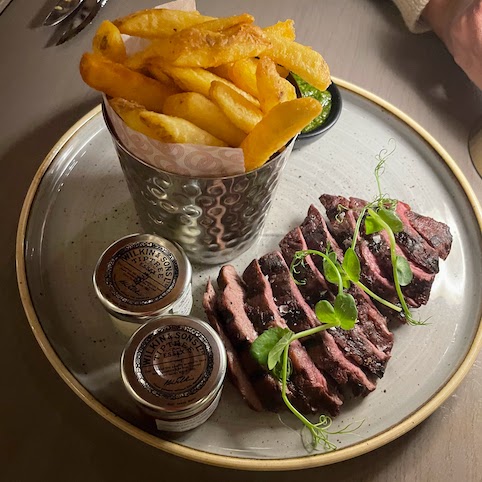
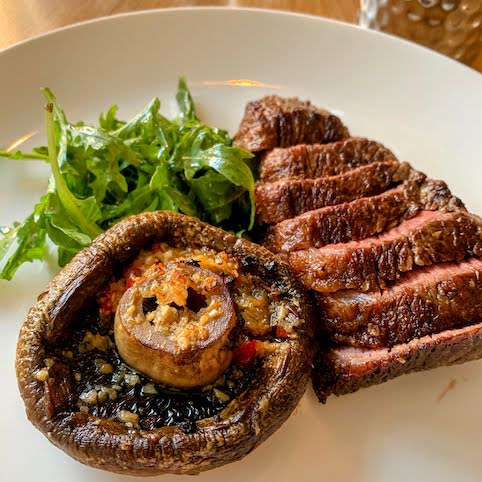
We both choose Picanha,  and what a great steak it is. It needs only careful cooking to medium rare, and, if the chef is good, it will have been cooked with its fat cap on which will be removed before serving, and it will have had a sprinkle of rock salt. This is all done right, it’s delicious.

Full marks for the chips too, which have bits of potato skin on them so, unless it’s a very determined piece of forgery,  I’d say they`re home made. A mushroom loaded with garlic is enjoyable.

Number 8 has a really excellent wine list by the way. Nothing too expensive but everything’s a bit unusual. They even have some Orange Wines, but I think that particular trend ship sailed some years ago. We had a Crianza, an up-from-basic Rioja, which was perfect,

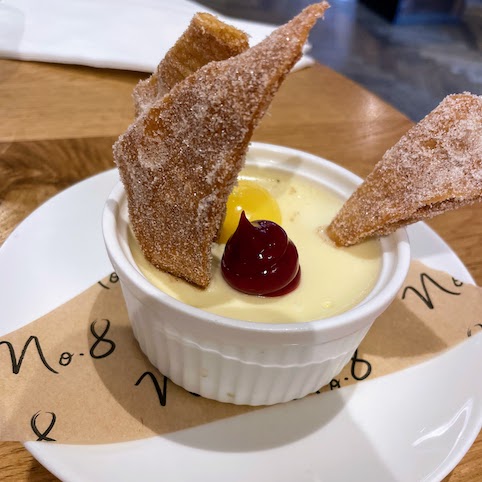
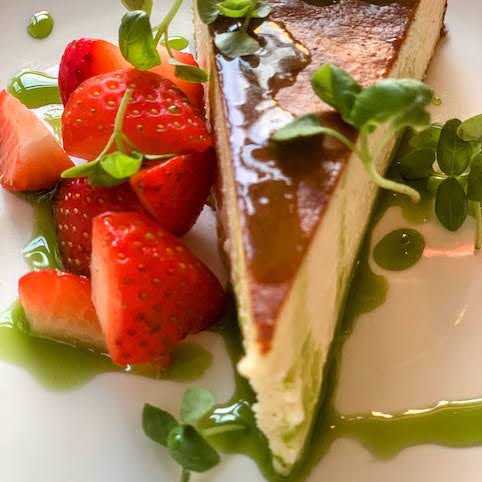
Dessert is not included in the set price, but we share a Basque cheesecake with Kentish Strawberries and a basil syrup. Again, really good. We loved that basil syrup against the strawberries.

Number 8 has all kinds of meal deals running all week, so it’s well worth keeping an eye on their website. This steak and tacos deal is a very good one.

If you’re local you probably know Number 8. If you’re not, then get in the car. Just be careful not to roll it down the hill.

8 London Rd, Sevenoaks TN13 1AJ

01732 448088

info@no8sevenoaks.com

Beef Brisket Mondays at Smith’s Bar and Grill Review

Low and slow is the recipe for success with this cut of meat. Smith’s Bar and Grill have pretty much nailed it

BBQ-ing brisket is a kind of religion in the US of A, especially in Texas. It’s a slow process, ten to twelve hours in a hot smoker, if it weighs around five kilos. Anything smaller will dry out.

It’s a labour of love and skill. I tried it once in my Weber Smokey Mountain and well after darkness had fallen the meat still wasn’t cooked and a small rebellion was going in our garden with guests demanding I go out and buy sausages as they were so hungry.

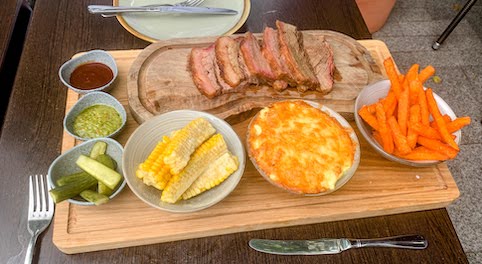
Available only on Mondays at Smith’s Bar and Grill restaurant in Paddington, this Beef Brisket Platter is slow-cooked for 13 hours and served with mac-n-cheese, pickles, corn and sweet potato fries.


I had to try it, to learn something about its cooking if nothing else, and on a hot day sitting by the Grand Union Canal seemed like a very good idea.

An idea that appeared to have occurred to a lot of people, as the terrace was full and the platters were flying out from Head Chef David Reyes’ kitchen at lunchtime.

It’s not terribly easy to find the canal when you leave Paddington Statio  if you’ve not done so before, or it’s been a while. So much has changed in a relatively short time. I went in a large frustrating circuit of the station and found myself pretty much back where I started, before a kind local put me straight.

It’s a lovely location with some houseboats bobbing on the water, some other boats converted into bars and restaurants, and well-heeled locals languorously drifting along what was once the towpath.

So the platter. £40 to share, which isn’t bad at all, and served on a wooden board as these things so often are

The corn has been sliced into quarters lengthwise, which is not a bad idea. It’s a lot easier to eat this way, less butter down the shirt. The mac n cheese is gooey in a good way, and who can resist a pickled gherkin? Not me.

The sweet potato fries I am not sure about, I like the taste, but they’re as limp as a politician’s handshake. I’d have preferred standard fries, but I know that Americsns do like sweet things with their meat.

Well what about that meat? I’m coming to that. I like to see a good ‘burned’ coat on slow cooked ribs and brisket but this didn’t have it. It’s called ‘bark’ and it comes from chemical reactions, as well the Maillard reaction and polymerization with the rub ingredients.

However there was ‘pinkness’ in the outer edges, clear evidence of smoke getting in, and it did taste very good. The meat was ‘cut with a spoon’ tender and with enough fat remaining to keep it all moist. We were actually rather impressed and tussled over the last slices, although there were plenty for two.

At £40 for two it’s a bit of a bargain and you can get a bottle of red or a white wine selected by Head Sommelier, Maurizio Titone, at 50% off every Monday. An opportunity to discover new fine wines at a fraction of the price.

Proper Parmesan Takes Its Time

If your cheap parmesan tastes terrible it’s because it’s not the real thing. I went to Parma to see how genuine, PDO protected, proper Parmigiano Reggiano is made and why it has a premium price tag.

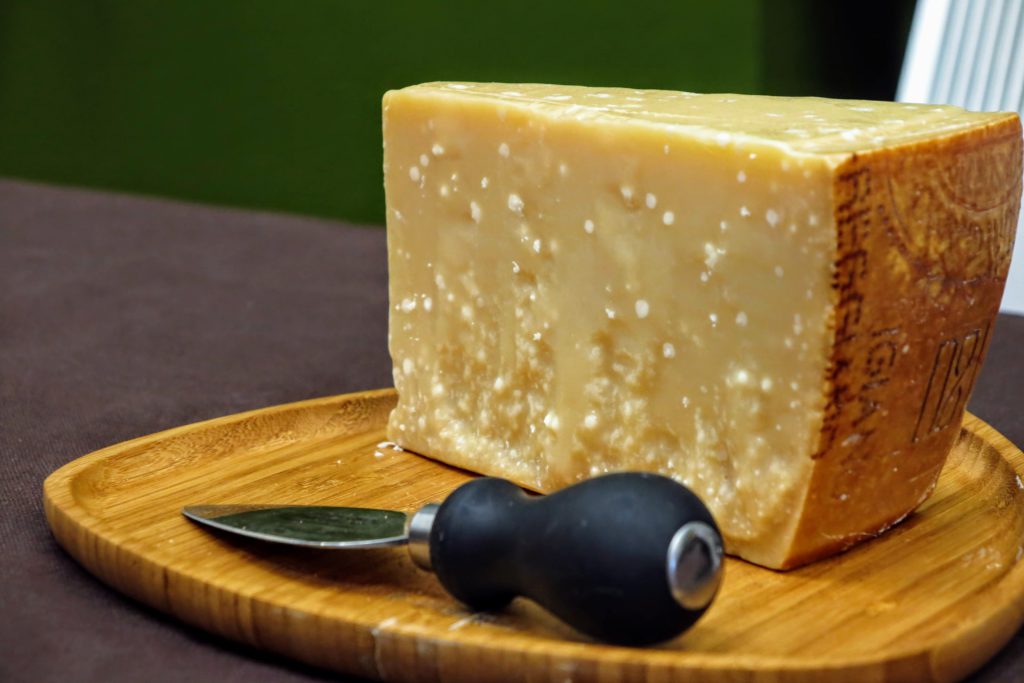
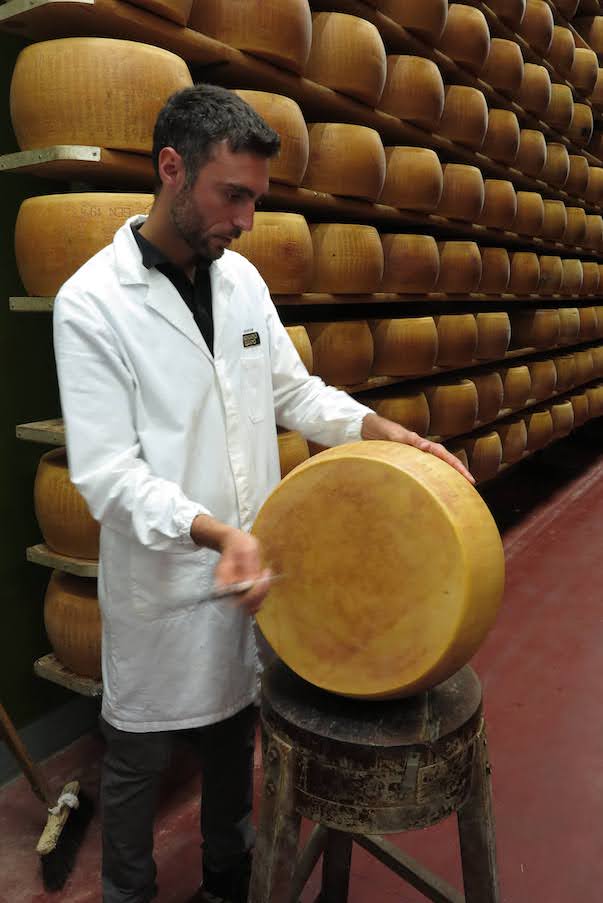
‘So this cheese is twelve years old,’ says Simone Ficarelli, the international marketing officer of Parmigiano Reggiano, expertly wielding the short, stubby, knife that’s the traditional tool used to break off chunks from the giant wedges.

There are white lumps in it, a distinct mark of a mature cheese. These are calcium lactate crystals, and are perfectly safe to eat. In fact the crystals in Parmigiano Reggiano cheese are a sign that the cheese has been properly aged. When you eat the cheese the crystals spark out a nutty flavour that complements the saltiness.

DOP Parmigiano Reggiano has been made for over 900 years and is only produced in the provinces of Parma, Reggio Emilia, Modena, Bologna to the left of the Reno river, and Mantua to the right of the Po river. This is the area of the farms where the cattle for the milk are fed on locally grown forage. It can only be made with this skimmed cow’s milk, salt, and rennet for curdling.

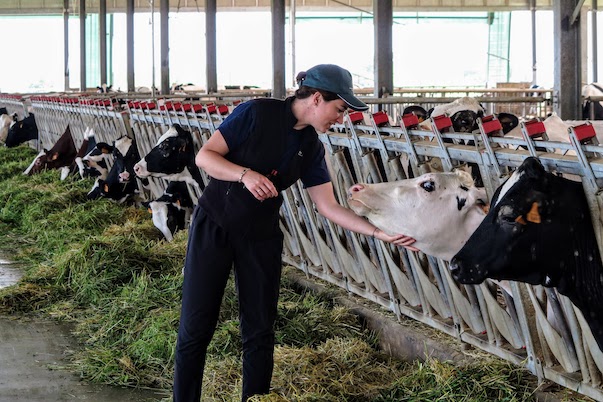
The cows live in airy open-sided barns, with extra fan cooling in summer, and they eat bundles of the lush grass that surrounds them. Strict rules ban the use of silage, fermented feeds and animal flour. They seem very happy, with plenty of room to move, and their waste is regularly pushed out and used for the farmlands. Water is carefully rationed for cleaning, no more than is necessary. This is an eco conscious process with rainwater collected from the giant roofs

Making milk into magic

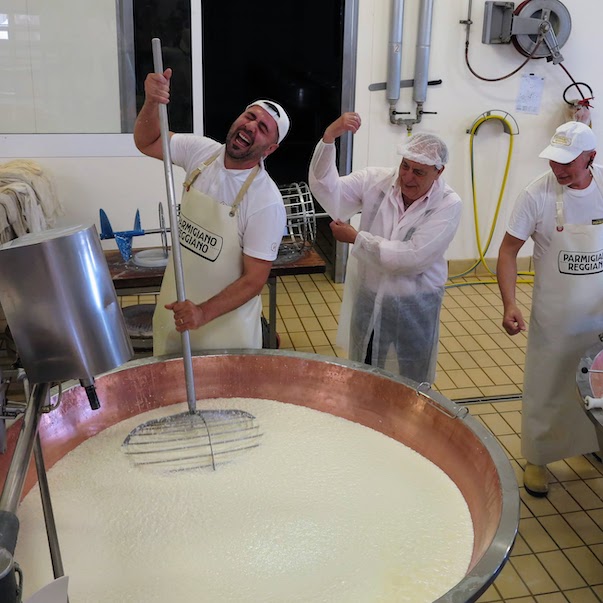
TIn the dairy later, suitably attired in hair net and white coat, I learn more. Their milk then travels just a hundred metres to the next door dairy where, after being left long enough for the cream to rise and be skimmed off, it’s poured into traditional copper vats to be heated. It takes about 550 litres of milk to produce one wheel of Parmigiano Reggiano.

Rennet is added to curdle the milk and I watch the expert cheese makers sift the milk through their fingers to check the process. It’s a skill that a machine cannot emulate, only experience can work the magic.

When the expert decides the time is right, a large ‘whisk’, a  traditional tool called a “spino”, is used to break up the curd into smaller pieces. It’s hard work but the men cheerfully put their backs into it. This isn’t just a job, this is a labour of love.

The cauldron is heated to 55 centigrade, and the granules slowly sink to the bottom forming a single mass. After about fifty minutes the large lump that’s formed is divided into two with a  large wooden paddle and these are lifted out in muslin bags. The remaining liquid, the aromatic whey, will be sent off to feed local pigs and give us delicious Parma ham.

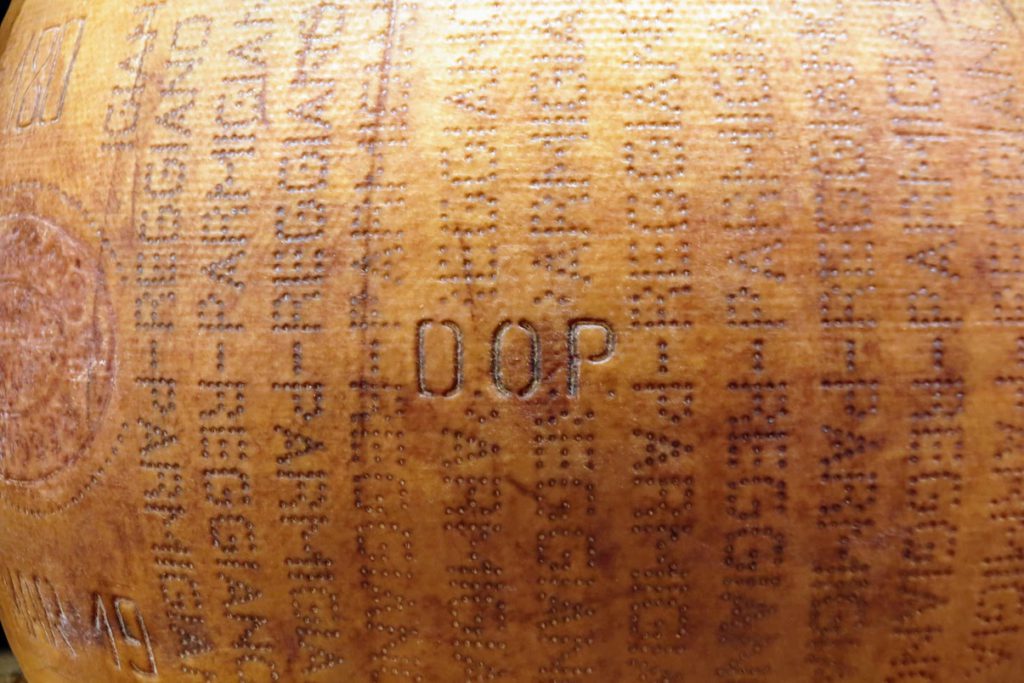
The next stage is to put each lump into the cheese moulds. These have a plastic lining embossed with all kinds of details of date, time and place, as well as a number that tells if the cheese was made in Reggio Emilia, Parma, Modena or Mantua 

This information embeds itself permanently into the rind as it forms, meaning the cheese has a ‘signature’ that’s impossible to fake or remove. Apparently though they are also experimenting with putting a microchip in the cheese to make it even easier to check provenance. As I say, there is big money in forgery and this product is so fine that the consumer has to be protected. 


The cheeses then head off for a relaxing salt bath for about three weeks. Here modern machinery is used to do the regular lifting and turning. These cheeses are very heavy at this point, being still full of moisture. In the old days it must have been very tough work.

Age is key

The cheeses once out of their briny bath are never aged for less than 12 months. At this stage the aroma is of fresh fruit, grass and flowers and the cheese is almost sliceable. After 24 months the crumbliness develops, while at 36 months spicier notes arrive. 36 months is usually the cut off point for general consumption, but some cheeses are pushed on to 48 which is a bit of a connoisseur’s cheese.

The cheeses are stored for all this time in vertiginous racks in massive temperature controlled rooms, and regularly tested by tapping them with a special hammer, as has been done down the ages.

The sound it makes is just a dull thud to my ears, but it tells the experts how well  the cheeses are maturing and any subtle tone variation will also reveal any fissures hidden inside the cheese. A fissure means the cheese, while perfectly good in every other way, must be rejected for sale as a whole cheese, the identifying rind will be removed and it will be broken up and used to make high quality ground Parmigiano Reggiano instead.

Cheese to please

The different ages result in cheeses for all occasions. The more mature being ideal for eating on their own as an aperitif, the irregular lumps really spreading the flavours onto the palate. Try some with a dab of honey and perhaps some walnuts.

Of course they are all delicious grated or shaved fresh onto salad or over pasta, but never please over seafood. Pasta with lots of butter, black pepper and grated Parmigiano Reggiano is a simple and delicious dish when made with such a quality ingredient.

It is of course delicious in a risotto, that final addition lifting all the flavours up

To keep a large block, which is a great investment, ideally wrap it in greaseproof paper, vac pack it, and put it in the fridge (never the freezer). It should be brought out to room temperature at least an hour before eating so the aromas and flavours reawaken.

If you have a large pestle and mortar then grate  Parmigiano Reggiano in, then add the best basil you can find, pine nuts, garlic and olive oil to make the very besto pesto.

So don’t just use Parmiggiano Reggiano for your spag bog! This versatile cheese has taken a long time to get to your kitchen, so take the time to make the very best of it.

#tasteofeurope #enjoyitsfromeurope #parmigianoreggiano #parmesan #euquality @parmigianoreggianouk

Swaledale Lamb. From The Dales to your door

If you don’t have a decent butcher on your doorstep don’t worry, you can still get the finest meat delivered

I don’t live in a ‘nice’ London postcode. Waitrose won’t set up shop anywhere near us and Ocado has an armed escort and throws the shopping at our door rather than risk stopping.

Well not really, but we do lack posh shops and the nearest proper butcher is many miles away. So we are at the mercy of the big supermarkets, and much as I like lamb, particularly at Easter, I have had too many expensive disappointments from supermarkets to ever buy it there again.

So Swaledale had me in interested with their talk of being an award-winning Yorkshire-based online butcher that works in partnership with small-scale, sustainable farms on The Dales. They specialise in heritage breeds of cattle, sheep and pigs, wild venison, and native game birds, supplying many a top restaurant.

The Dales are particularly noted for sheep farming, with hardy breeds such as Swaledale, Lonk, Dalesbred and Herdwick all foraging freely on the lush grass, herbs and flowers. The result is smaller, darker-fleshed lamb that tastes of the ‘terroir’, although I suspect many down to earth Yorkshire people would gag at such fancy French talk.

So we tried out some of their lamb by post. Lamb chops, because a perfectly cooked lamb chop chewed off the bone is one of life’s’ great pleasures. We also chose some Merguez sausages because we were intrigued to taste a Yorkshire merguez. Another great pleasure is eating merguez slapped into a buttery baguette, a staple snack at every French bric a brac market and always served with a barquette of freshly cooked from frozen frites and glass of raw vin rouge.

And just for ‘fun’ we also had some mutton chops. A lot of people give mutton a miss, it’s regarded as a bit old fashioned and can also be a bit too ‘gamey’ for modern tastes, but good mutton is well worth seeking out.

The lamb chops were excellent. The plan was to grill them on our new Weber, but while I factored in the weather I forgot it gets dark at 6pm, so we cooked them on a cast iron grill on the kitchen gas rings. Three to four minutes a side with the grill hot as Hades, the internal temp checked with the trusty Thermapen – overcooking lamb is a criminal offence, or should be.

The Merguez were the best I’ve tasted outside North Africa, quickly frying to an attractive gold colour and with a firm snap to the skins. We ate some cooked with red peppers dobbed with a poached egg, and the next day sliced into pieces in a couscous. My suggestion that we should also have them for breakfast was vetoed.

Finally the mutton chops. For these we thought we’d be a little adventurous and used the recipe from the take it easy chef for mutton chops karnatkas style. This involved pressure cooking the chops in some water and spices before adding a masala mix and simmering for twenty or so minutes.

Indian cooks use pressure cookers a lot, they’re fast and energy efficient. Here the cooker turned the meat very tender without taking hours of slow cooking. Lots of flavour and an authentic taste.

So we were impressed with Swaledale’s lamb. As traditional quality butchers become harder to find, and hard to afford, mail order meat is certainly a great way to go.

swaledale.co.uk


Yee-Hah! I sample SOUND London’s brand-new Americana menu
I’m not normally a fan of stereotypical American food, but I get kinda converted at a lavish preview

American food is often defined solely by the UK’s rather twisted lens. Watching TV we tend to think that all Americans ever eat is steaks bigger than plates and burgers so enormous you need to dislocate your jaw like an anaconda to fit them in.

Of course that’s not entirely unfair. Americans do things big and that includes food.

SOUND London is a very big space inside the Cumberland Hotel, so large it’s even got a London taxi in reception.

Walking in is like entering a classic bar in Florida, it’s all very colourful and bright and packed with people, and on the stage is a band. This is the kind of place usually called a Sports Bar where giant TV screens beam the big games with state of the art sound sound systems, and have live music at other times. The food is equallyloud and proudly Comfort American,

SOUND London at The Cumberland Hotel in Marble Arch now has a brand new Americana menu with lots of small plates, burgers, BBQ meat platters with sharing sides and gravy, and the mighty 20oz Tomahawk steak for sharing served with mash, chilli greens, baked tomato topped with a garlic and herb crumble, as well as salsa verde and red wine gravy.

So I starved myself all day in anticipation.

We skirted around the sweet little robot server trundling cheerfully up and down, and nabbed a table in front of the stage where an acoustic trio were competently playing all the hits and more. Rather oddly the two seat tables are arranged so one of you has his or her back to the stage, it would be better surely to have seats side-on so you both can see?

The menu is not massive ,but it certainly inspires big hunger. We had a cocktail each and were undecided for starters between Stuffed jalapeño poppers, Jumbo prawns with spicy mango salsa, Grilled corn ribs, Buttermilk Chicken Tenders and the ‘Ultimate Onion Ring Tower’.

We had the peppers and the prawns and also succumbed to our server’s insistence to try the onion tower – well, when in the U.SA etc.

The peppers were great, ideal for accompanying drinks, ideally ice cold beers. The prawns fat and juicy, the batter crisp and fresh. And the onion rings? Well these were impressive and certainly towering.

They were also extremely, deadly, hot. We both had serious problems through taking too big a bite, the batter burning us and the onion inside annoyingly reluctant to be bitten through. We decided to let them cool down and concentrated on our other dishes. If your kids order the tower, and this is a kid friendly place, be careful.

We wanted the Tomahawk steak to share, who wouldn’t, but apparently it’s marinaded in red wine and J is allergic to tanins. We agree to share the The Smokehouse Platter instead – BBQ-glazed smoked beef feather blade, pulled pork shoulder, glazed pork ribs, Texas hot link sausage, grilled corn ribs, BBQ ranch beans, red cabbage slaw, pickles and tear ‘n’ share mezzaluna bread.

It’s brilliant, a real feast of America. The ribs fall apart perfectly, the shoulder easily falls to the fork and we devour it all hungrily as the band lurches into an acoustic version of Oasis’ Stand By Me.

Anyone not on the red meat train could go for the Big Bird Platter -BBQ-glazed skin-on chicken breast, slow-roasted chicken wings in a choice of BBQ or Buffalo Hot Sauce, buttermilk chicken tenders, grilled corn ribs, BBQ ranch beans, red cabbage slaw, pickles and tear ‘n’ share mezzaluna bread and it looks good,.

Sounds Big Burger

And if you want a burger well fear not because the Burger Studio has The London Double Decker, crispy buttermilk chicken Clucky and smokey BBQ Pulled Pork. And they are biggggggg!

We watch them go past rather wistfully, as we are now sated, and just about manage a House Apple Cobbler, and a thick Millionaires Brownie. We are stuffed and then some.

Take me home, country roads. Or rather, take me home Northern Line. I did enjoy our visit to America.

 https://sound.london/

@sound.london 

Great Cumberland Place, Marble Arch, London, W1H 7DL 

For more information please visit: https://www.guoman.com/the-cumberland  

#HITPLAY 

Seaweed – A Collection Of Simple And Delicious Recipes by Claudia Seifert, Zoe Christiansen, Lisa Westgaard & Hanne Martinsen

Take off your socks, roll up your trouser legs and wade happily into the world of edible seaweed.

Bladderwrack, Oarweed, Thongweed, Dulse, Laver and Winged Kelp. No, not the names of a new bunch of Marvel superheroes (and haven’t we had more than enough of them by now?) but the names of just some of the seaweeds we should be chowing down on.

Because they are super in themselves – rich in nutrients, sustainable and environmentally friendly. And tasty, let’s not forget tasty.

This immaculately produced book, translated from Norwegian, is not only beautiful to look at, but packed sardine-like with great and frequently beautiful recipes, simple to prepare for single meals or family feasts.

Main courses, snacks, soups, salads and desserts. Vegetarian and with seafood. Plus, some experimental type dishes of tapas, too.

Getting hold of seaweed doesn’t mean having to actually head down to the seashore, although the authors do have guidance for doing so safely and respecting the seaweeds’ sustainability (taking a large pair of scissors is a must). And they do encourage you to do so.

In fact, most seaweed is sold dried, either in specialist shops or online, and has to be soaked at home where it almost miraculously unfurls into large and juicy green leaves and tendrils. The book has a list of useful seaweed stockists at the back.

Seaweed delivers umami, which is why it’s such a favourite ingredient in Japanese cooking and it is also a source of salt. It has few calories or carbohydrates, is low-fat but rich in protein often with minerals such as calcium, magnesium and potassium, as well as amino acids and trace elements.

So, what can you make? Well for a start and for starters there’s classic miso soup of course. Or how about an omelette with peas, feta cheese and sea lettuce? Salmon with coffee, chili and winged kelp sounds delicious too.

It adds flavour to a vegetable stock and will raise up your bowl of ramen. Add it to a quiche along with spinach, wrap it around cod and slow cook for a fish that truly tastes of the sea.

You might also want to browse this delightful book with a Gin seaweed tonic, seabelt Martini in your hand, the recipe is here too.

Each photo is a work of art, none of your tedious top down stuff so beloved by Instagrammers, these are proper professional images that would look perfect framed on the wall.

The whole book is an eye-opener and more than enough incentive to head for the beach

ISBN: 9781910690512. Published by Grub Street

£20.00